orgo lab exam 1
 Call Kai
 Learn
Learn Practice Test
 Spaced Repetition
 Match
Match Flashcards
 Knowt Play
1/187

There's no tags or description
Looks like no tags are added yet.
Name | Mastery | Learn | Test | Matching | Spaced | Call with Kai | Chat |
|---|
No analytics yet
Send a link to your students to track their progress
188 Terms
salicylic acid structure

carboxylic acid and alcohol substituents
salicyclic acid properties
keratolytic agent: common ingredient in acne creams, antidandruff sahmpoo, antibacterial properties: toothpaste, mouthwash, precursor to aspirin
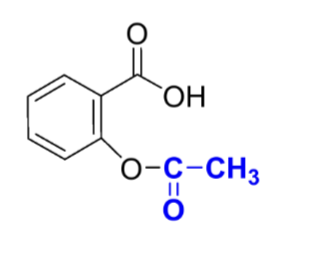
aspirin structure
synthesis of salicyclic acid (equation)
methyl salicylate + 2 naoh > salt + meoh + h2o
salt + 2hcl > salicyclic acid + 2nacl

what transformation of fxnal group to form salicylic acid
from methyl salicylate, phenol functional group remains, but ester (R-O-OCH3) is transformed to carboxylic acid (R-O-OH)
what transformation of fxnal group to form aspirin from salicylic acid
phenol functional group goes to ester functional group (R-OH > R-(C=O)-OH)
general hydrolysis of esters? R-(C=O)-OR’
acidic condition: form carboxylic acid, but basic condition: carboxylate anion (R-(C=O)-O-)
base-promoted hydrolysis of methyl salicylate to salicylic acid
Hydrolysis is base promoted, not base catalyzed -- because the base (OH–)
is the nucleophile that adds to the ester. It participates in the reaction and is
not regenerated later.
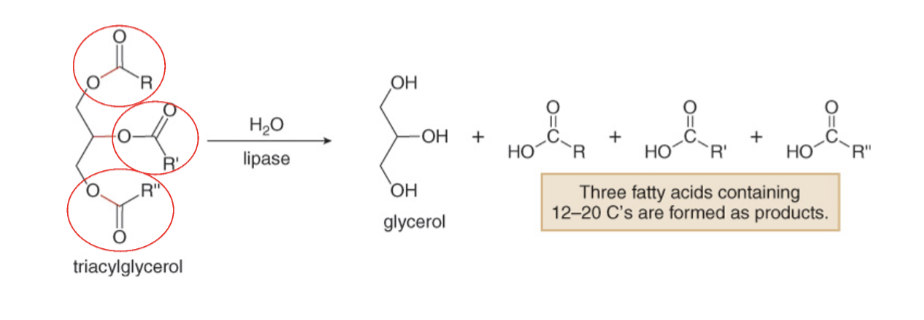
hydrolysis of triacylglycerols
A triacylglycerol is a triester containing three long hydrocarbon side chains
(Typically, the R groups have 12-20 C’s) .
Metabolism of a triacylglycerol: Hydrolysis of three ester linkages forms Glycerol and
three long-chain fatty acids.
Hydrolysis of a Lipid is the same as the Hydrolysis of an Ester Hydrolysis.
This lipid hydrolysis is catalyzed by the enzyme lipases
BASE-promoted hydrolysis of triacylglycerols
saponification

experimental details of lab A
reaction flask: clamped erlenmeyer
stir bar
grad cylinder
pasteur pipette
hot plate/stirrer
limiting reactant
The reactant that is present in the smallest
amount and would limit the amount of product possible. The
moles of product (i.e. theoretical yield) is determined by the
moles of “limiting reactant” on a molar equivalent basis.
theoretical yield
The yield of a reaction assuming 100%
conversion of the limiting reactant to the product
percent yield
is calculated based on the amount of product
actually obtained in the experiment and the Theoretical Yield.
% Yield = Actual Yield / Theoretical Yield x 100
multistep synthesis percent yield
the overall percent yield is determined by multiplying the yield of
each step expressed as a decimal.
- multiply the answer by 100 to convert final value back to
% yield
recrystallization
Convenient way to purify a solid organic compound by using a suitable
solvent.
steps of recrystallization
Step 1. Impure solid is dissolved in an appropriate hot solvent – the
impure crystal lattice breaks down
Step 2. Slow cooling of the solution - (first on bench top, undisturbed, and
later, later cool in an ice-water bath)– allows for the formation of purer,
larger crystals. This is because impurity molecules have sufficient time to
return to the solution
why no rapid cooling for recrystallization
results in precipitation – impurities are trapped due
to rapid formation of the lattice
choose good solvent for recrystallziation
The solid you are trying to purify should be soluble in
the hot solvent and insoluble in a cold or room
temperature solvent
vacuum filt
that is used
to quickly & completely
separate a solid from the
liquid with which it is mixed; buchner, adapter for right seal, clamp, vacuum filt, ring stand
vacuum filt tubing
Employs Heavy-walled rubber tubing – to prevent the tubing from collapsing from atmospheric pressure on the
outside when the vacuum is applied.
when washing filtered crystals with solvent
Always use small portions of solvent – to avoid washing away small amounts of your product
ensure efficient drying of product
after first round of filt, Empty the mother liquor from the vacuum filter flask; Connect the filter flask back to
vacuum line. Pull air only over the crystals inside the filter funnel
sources of vacuum
1. Water Aspirator or
2. Compressor-driven
Vacuum System (we are using)
Drying product for lab a
our Product is wet! - even after Vacuum filtration.
• Weigh an empty watch glass.
• Transfer the product to the watch glass.
• Weigh the product – record this weight as wet mass
in your lab notebook.
• Break down big clumps of the product, and leave it to
air dry in your drawer until the next lab period.
• Following week - weigh the dry product – Compare
the wet mass and dry mass of the product.
how to characterize sample
Melting Point Range/ Boiling Point Range
• Thin Layer Chromatography (TLC)
• Column Chromatography
• Nuclear Magnetic Resonance (NMR)
Spectroscopy
• Infra-Red (IR) Spectroscopy
determine MP range
Always record the OBSERVED Melting Point as a Range
- First reading of the range – temperature at which the
solid block first begins to liquefy.
- Second reading of the range – temperature at which
the solid is completely melted.
impurities will ___ observed mp range
lower
melting
Solid Phase changes to Liquid Phase
• Loss of order in crystalline lattice
digi melt
Rate at which the temperature of
the heating block increases can be programmed.
You can input the Start temp., End Temp.,
and Ramp Rate.
heating rate digimelt
to be maintained at 2 oC per minute – Sample has to be melted
SLOWLY > A. Thermometer Lag – occurs when the sample melts before the thermometer
has a chance to reach that temperature.
B. Broad range – is observed when melting too quickly.
digimelt melting range considerations
Samples should never be re-melted.
• Used Melting point (MP) capillary tubes should be disposed off into the Red
Sharps container
prep sample digimelt
Melting point capillary tubes (labeled MP) – should be closed on
one end
Efficient packing of sample in capillary tube - Tap the capillary tube
on the bench inside the hood or let it fall through a long glass tube.
Digi-melt also has a “tube tapper” option to pack the MP capillary
tubes more uniformly.
Sample height in capillary tube – approx. 2-3 mm
safety precuations
Dress appropriately for lab (per Lab Safety Guidelines handout).
• Wear your apron, safety goggles and gloves at all times inside the lab.
• Keep all chemicals covered and INSIDE your chemical fume hood. There should
be no chemicals or glassware on your writing tables. Those are only meant for
your lab notebooks.
• Do not stick your head inside the chemical fume hood.
• Do not kneel, when doing experiments in the lab.
• Keep the fume hood window shut when not in use.
• Do not handle the door knobs with your gloves on.
• Keep your cell phones INSIDE your backpacks and leave your backpacks by
the wall.
• NO FOOD OR DRINKS, and no chewing gum are allowed inside the lab.
• Listen to your TAs.
• At the end of lab, take care of waste disposal first, followed by glassware
rinsing (prep, per instructions provided), and finish writing lab notebook
waste acidic filtrates
label, ph paper, bicarb, ph , dump in sink, rinse beaker with water

claisen adapter, vacuum adapter

3 way distillation, thermometer

vigreux column
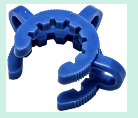
keck clip
procedure for salicylic acid (formation)
formation of salicylic acid:
Dispensing pipette: 10mL methyl salicylate in grad cyl, transfer to 50mL Erlenmeyer flask
Add 30mL 4M NaOH > formation of heavy white precipitate (disodium salt of salicylic acid)
Clamp Erlenmeyer (avoid spilling), place magnetic stir bar and put on hot plate
Bring solution to boil (half stir, full heat) > solution goes completely clear/homogenous because salt has dissolved. only then will solution boil at 100C > go for 15 minutes
considerations are if solid gets stuck on wall, floating, stir bar stuck to bottom > use glass rod to unstick
after 15 min, move flask into ice water bath for 5 min. insert thermometer inside flask until 16C, then take off.
Obtain 6M HCl to acidify solution. Stir and add HCl in 10mL increments (2x). White precipitate formed > SALICYLIC ACID crashing out only when enough HCl added. Add add’l mL of HCL to ensure solution is acidic. If adding HCl when flask is still on hot plate, acidic content will spill over + burn me.
vacuum filtration (round 1 lab A)
250mL filter flask connected to vacuum + clamp; buchner funnel w filter paper
Pour Erlenmeyer flask into buchner, along with stir bar > impure salicylic looks powdery; rinse rxn flask with a bit of water (avoid losing product, which has some solubility in water)
Let SA sit under vacuum. Pour out contents of filtrate flask in waste acidic filtrate beaker (neutralize later!).
recrystallization of salicylic acid
transfer impure solid to 125mL erlenmeyer flask. add 60mL water. place flask flush to hotplate stirrer (full heat, mid stir). remember, solution must be homogenous before boil.
Observe rolling boil > move clamped erlenmeyer to ring stand and leave undisturbed until u see crystals forming. Put in 400mL ice water bath.
Filter with buchner, empty flask, filter. Preweigh watchglass and transfer! Break down big clumps to help dry faster.
hazards for lab a
methyl salicylate (harmful if swallowed), naoh + hcl (corrosive)
if you wash crystals with too much water
dissolve and enter the filter flask decreasing the percent yield
why to empty the filtrate from the vacuum filter flask
to create a tighter seal so that the bulk of the vacuum pressure is on the solid crystals
large crystals are more likely to be formed…
when the solution is cooled slowly to allow the crystal lattice time to develop and for impure molecules to return to solution
limiting reagent for lab a
methyl salicylate
general overview of lab a
base-promoted ester hydrolysis (methyl salicylate + xs naoh > disodium salt of salicylic acid + meoh + h2o)
acidification (disodium salt + xs hcl > salicylic acid + nacl)
aspirin
develop by bayer in 1897, marketed as aspirin in 1899; oldest and most widely used drug worldwide; analgesis, antipyretic, anti-inflammatory
reaction scheme for aspirin
salicylic acid + acetic anhydride (h3po4 catalyst) > aspirin (acetylsalicylic acid) and acetic acid
equilibrium reaction; use 3x of acetic anhydride (to push reaction towards formation of aspirin) and an acid catalyst
fxnal group transformation for synthesis of aspirin
acetylation of phenol -OH fxnal group in salicylic acid to form an ester in aspirin
equivalent
experimental ratio in which reactants are added to the reaction; in aspirin rxn, 3:1 acetic anhydride to salicylic acid
calculations done for labs a+b
theoretical and actual yield; use 90% SA for aspirin synthesis, keeping 10% for MP
aspirin recystallization
small scale solvent test: sample of impure aspirin (transfer a small amount using a spatula) to two test tubes + 1/3 of the test tubes with solvent (h2o or ethanol) respectively
purity check of aspirin with aq fecl3 solution
test salicylic acid (containing phenol group) to react w fecl3 aq; to produce a deep purple solution
set up two test tubes: 1ml ethanol + 3 drops 0.02M aq FeCl3
tube 1: salicylic acid (control)
tube 2: aspirin
KEY: identify phenolic -OH groups, which react w aq. fecl3 to form a deep purple complex; SA has phenolic OH group
purple=colored solution indicates
presence of a phenolic OH group > residual salicylic acid is present in aspirin product
acetic anhydride
corrosive; irritating to nose
h3po4
corrosive if concentrated; avoid contact with skin + clothing and flush contaminated area with copious amount of water ; catalyst for aspirin formation
waste disposal for aspirin
non-halogenated (CHO, ethanol), halogenated (CHOX, not used); waste acid filtrate from buchner neut w nahco3, then poured down sink; aq fecl3 waste special container
classification based on chemical hazards
flammable, corrosives, lachrymator, carcinogen, teratogen, reactive
flammable
(Low flash point)
Flash point is the lowest temperature at which a liquid can form an ignitable mixture in air near the surface of the
liquid.
• The lower the flash point, the easier it is to ignite the material
flammable

corrosives
are materials that can attack and chemically destroy
exposed body tissues, causing severe chemical burns.
Some examples of ____: H2SO4, NaOH, HNO3, Ca(OH)2, Br2
corrosives

lachrymator
A lachrymator is an irritant that causes tearing (watering of the
eyes).
(Some examples of lachrymators: Thionyl chloride, Acrolein,
Methacryloyl chloride)
carcinogen
A carcinogen is a substance that is capable of causing cancer.
(example: Benzene, Arsenic, Methylene chloride
(or Dichloromethane))
teratogen
A teratogen is a drug or other substance capable of interfering with
the development of an embryo fetus that may lead to birth defects
or developmental malformations.
(Some examples: Phenol, Benzene, Dinitrotoluene, Dioxane)
reactive
Things that go BOOM
(Some examples: Na metal, sodium hydride, calcium carbide)
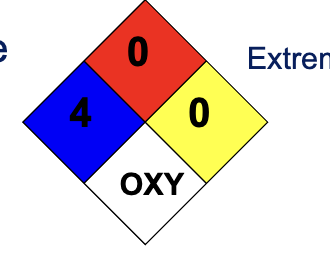
national fire protection association (nfpa) ratings

blue nfpa
4 Deadly
3 Extreme Danger
2 Hazardous
1 Slightly Hazardous
0 No Health Threat
HEALTH HAZARD
red
FIRE HAZARD
Flashpoints
4 Below 73 F
3 Below 100F
2 Below 200F
1 Above 200F
0 Will not burn
White
Specific hazard
W Water reactive
OX Oxidizing agent
ACID Acid
CORR Corrosive
Yellow
Reactivity Hazard
4 May detonate
3 Shock or Heat may detonate
2 Violent chemical reaction; water reactive
1 Unstable if heated
0 Stable
Extreme health danger
phosphoric acid

flammable
acetone

extremely corrosive
bromine
sources of chemical info
MSDS Sheets – Good resource for chemical information
How to look up the following chemical information:
A) Physical Properties (MP, Density)
B) Chemical Properties (Solubility, etc.)
C) Toxicity
Use the Merck Index link on Canvas
Sigma-Aldrich Catalog
merck index phosphoric acid
Molecular Formula: H3O4P
• Molecular Weight: 98.00
Properties: orrosive.
Misc with water, alc; sol in 8 vols of a 3:1 ether: alc mixture. Properties of phosphoric
acid solns. d25 1.8741 (100% soln); 1.6850 (85% soln); 1.3334 (50% soln); 1.0523 (10%
soln). d= density, nD = refractive index
acetic anhydride boiling point range
138-140 C
thermometer lag result
sample melts before thermometer can reach that temp; affect melting point range through causing a higher, broader recorded range compared to the actual range
why do synthesis of aspirin in erlenmeyer
carrying out this synthesis in an erlenmeyer flask allows for more efficient mixing, and its sloped sides decrease the risk of solvent evap or products spill
procedure for synthesis of aspirin
heat up beaker for warm water bath
clamped 50mL erlenmeyer flask and put 90% shiny white salicylic acid in w powder funnel
3eq acetic anhydride (liq) added to reaction flask w 1 eq SA; add 5 drops of phosphoric acid using pipette bulb (TA)
cover flask and let sit for 10 min
clamp flask and put in warm water bath uncovered for 10 min > solution CLEAR!
clamp flask and put in ice water bath uncovered for 10 min; scratch sides with glass rod to induce WHITE SOLID PASTE formation
add 10mL of ice and 10mL water to rxn flask. stir w glass rod
vacuum filt; rinse w 2mL ice cold water x2 (rxn flask), 2 min vacuum then empty filtrate and vacuum 2min more > SOFT WHITE POWDER
vacuum filt
quickly and complete separate a solid from the liquid with which it is mixed. make sure ring stand FACING you. filter flask clamped. rubber adapter used to ensure tight seal. use heavy walled tubing to prevent tube from collapsing when high pressure applied. sidearm on flask connects to source of vacuum. wet paper with solvent that rxn corresponds w (otherwise product seeps thru and under filter paper)
Solvent test for recrystallization of aspirin
2 test tubes: asp + h2o, asp+ etoh
polarity of solvent used for recrys and cpd being recrys should be similar (like dissolve like)
if dissolved at rt > etoh bad for recrys!
Recrystallization of aspirin
transfer crude aspirin from buchner to new 50ml erlenmeyer flask
clamp flask and add 10ml solvent (water)
crank hot plate to hottest setting, flush rxn flask to bring to a boil > CLEAR HOMOGENOUS SOLUTION, then rolling boil
move clamped flask away to cool at RT until crystals form > CLOUDY FIRST, then crystals
Cool in ice water bath for 2 min, then vacuum filt
lab b overview
Aspirin synthesis from salicylic acid
Recrystallization (solvent test)
Purity test FeCl3
lab c 3 solids
benzoic acid, 2-naphthol, 1,4-dimethoxybenzene
separation of ternary mixture procedure
tertiary butyl methyl ether 25ml; clearless organic solvent covered by inverted beaker; transfer with pyrex funnel (long stem) with the stopcock in horizontal position.
switch to powder funnel (short stem) and transfer 1g in each of benzoic acid (strong acid), 2-naphthol (weak acid), 1,4-dimethoxybenzene (neutral) twisted weighboats
shake sep funnel until homogenous solution > complete dissolution in tBME
place sep funnel back on ring clamp; tBME was colorless, solids were white except for 2-naphthol > now, homogenous solution is light brown
pyrex funnel > add aq 10% sodium bicarbonate in 2 increments (15mL x2, 30mL total). flask underneath is BICARBONATE EXTRACT.
immediate phase separation inside sep funnel between aqueous and organic (based on densities of solvent; aq is 1g/mL, but organic is 0.74g/mL)
stopper and shake with finger on top of stopper. this time, VENT funnel frequently (burp)
back in clamp; remove glass stopper and wait until fizzing stops. drain bottom aqueous layer into BICARB EXTRACT thru moving stopcock to vertical position. x2. after this, only organic solvent in sep funnel w 2-naphthol and 1,4-dmb
NaOH extract flask put underneath stem of sep funnel; obtain 15mL 10% naoh. immediately see formation of 2 separate phases. shake, no need to vent. give layers a chance to separate > switch between color of layers: bottom aq is colored, organic is not bc of shift of 2-naphthoxide to aq layer.
treat extracts with conc. HCl using pasteur pipette (4). after precipitates form, stir w separate glass rods and check pH < 4.
cool each extract in ice-water bath (set aside)
label 3rd erlenmeyer flask and drain remaining liquid (yellowish).
vacuum filt extracts w buchner funnel. use EXTRACTS to wet the filter paper. liquid that enters filter flask is water. rinse erlenmeyer flask w water to recover solids coating sides of flask. RECOVER BENZOIC ACID + 2-NAPHTHOL
3rd ernlenmeyer flask; add anhydrous calcium chloride as drying agent, then swirl flask. gravity filtration w 100mL RBF + shaping GF paper into a cone in powder funnel. can use spatula to remove stuff in erlenmeyer.
use spatula to transfer wet solids onto watchglasses, weighing empty before.
place RBF with tBME and 1,4dmb in rotary evaporator
sep funnel setup
125mL sep funnel with horizontal stopcock (closed), ring clamp for support, 125mL erlenmeyer flask positioned by stem of sep funnel, glass stopper on top of funnel
why erlenmeyer flask under sep funnel good practice?
catch any leaks
organic solvent lab c
tertiary butyl methyl ether 25ml organic solvent
1,4 dmb lab c
big chunky solid; may need to be crushed before added and then pushed down w glass rod. a neutral compound

2-naphthol lab c
pinkish brown solid; -OH fxnal group (phenol); weakly acidic relative to benzoic acid. pka = 9.5

right sized glass stopper lab c
19/22 standard taper joint (19mm width, 22mm length) to match sep funnel dimensions
when to vent sep funnel while shaking lab c
after adding 15mL sodium bicarb to homogenous mixture of 3 solids + dmb > phase separation prior to shaking. lots of fizzing due to generation of co2
purpose of adding sodium bicarb in lab c
by adding a weak base, we have deprotonated benzoic acid into its sodium salt (sodium benzoate + co2); sodium benzoate is ionic and can be extracted into aqueous layer. we do it twice in order to ensure we have extracted ALL of benzioc acid from organic layer to aqueous layer.
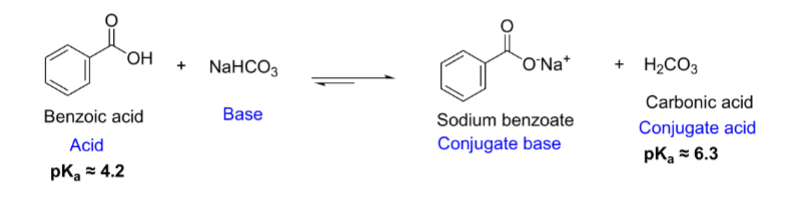
color shift in lab c
originally, color in organic layer. after addition of naoh, color in aqueous layer. this is caused by the addition of naoh to 2-naphthol; strong base addition causes it to form its sodium salt, 2-naphthoxide. 2-naphthoxide is an ionic species that will enter the aqueous layer, which can then be drained
inside bicarb extract
sodium benzoate (benzoic acid + sodium bicarb); clear. when conc hcl added, thick, fluffy precipitate formed
inside hydroxide extract
2-naphthoxide and naoh; yellowish brown; when conc hcl added, brownish pink solid precipitates at
if u drain organic along w aqueous lab c
organic layer will form film over aqueous layer, making it very difficult for product to crash out of solution when treated w concentrated acid later