Art History Exam 4
 Call Kai
 Learn
 Practice Test
 Spaced Repetition
 Match
 Flashcards
 Knowt Play
1/16

There's no tags or description
Looks like no tags are added yet.
17 Terms

Church of Saint Cyriakus—Ottonian Period, Germany
~961
One of the few surviving Ottonian Churches that was not burned or refurbished.
Basilica: large rectangular building (similar to Old St. Peter’s Basilica)
Used as a convent; made for his widowed daughter-in-law
It has a three story elevation, clerestory (3 is representative of the holy number)

Narrative Column of Bishop Bernward—Ottonian Period, Germany
1020
From the Church of Saint Michaels of Hildesheim
Narrative (tells a story)
Made of bronze but was not melted down because the figure represented was Jesus.
~12.5 feet tall
Bernward is most likely the guy who designed this (he was also the tutor of Otto II)
Compare to the column of Trajan (they are both tall narrative columns that show a story of victory)
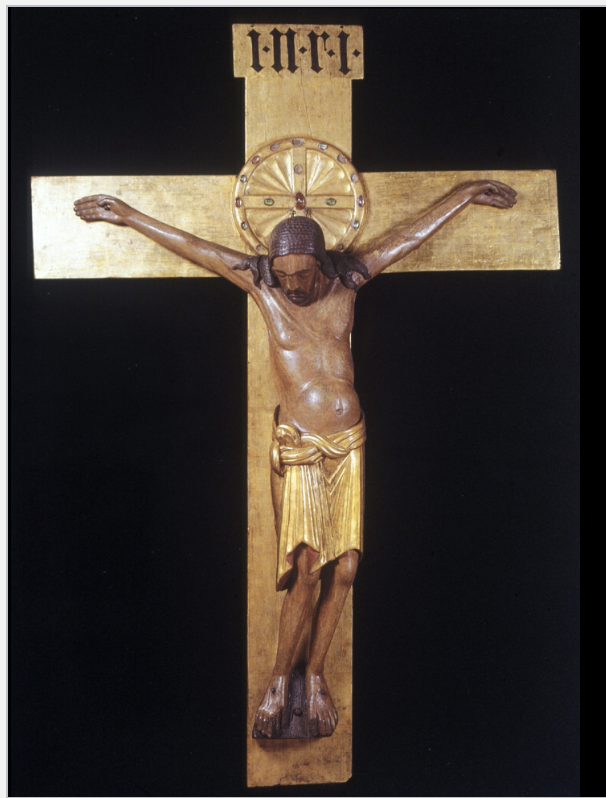
Gero Crucifix—Ottonian Period, Germany
970
Shows a change in the depiction of Christ and Religion
Compare to the Lindau Gospel: Front Cover
they both have halos covered with gemstones (and gemstones have importance because people believed they flowed down from the rivers of heaven)
The Lindau Cover shows him looking triumphant, but the Gero Crucifix shows him defeated in a moment of weakness.

Aachen Gospels “Otto III Enthroned”—Ottonian Period, Germany
996
Sometimes referred to as the Luther Gospels
Imperial Propaganda piece
Shows him ruling above the Earth (the lady below him with a rock-like appearance) and is being crowned by God himself.
He holds the orb of power with a crucifix above, and surrounds himself with the four evangelists.
Has 2 registers of organization: the bottom shows more religious figures

Great Mosque—Early Islam Period, Cordoba
They were renting out this church structure
Symbolic: taking a christian foundation and making it Islamic
Expanded to be much bigger

Prayer Hall, Great Mosque—Cordoba, Early Islamic Period
785
Spoilia: columns taken from other christian churches and reused here.
There are two tiers of arches to make them appear taller.
Alternating red and white megalithic stones used for both visual appeal and to help from Earthquakes (because they are made from two different materials)

Pyxis of al-Mughira—Early Islam Period, Spain
986
Able to depict figures as long as it does not represent God himself
Made of Ivory (imported from Africa/India, expensive)
Relief Sculpture
6in tall, 3in diameter (art mobilier: portable art)
Made as a gift for the Caleb’s youngest son
Would have held perfume scents

Santa Maria de Naranco—Early Islam Period, Spain
Mozarabic Art (christian and islamic religions combined)
Reconquista: taking Spain back from Islamic Rulers
First half of 8th Century
Was once a Roman audience hall, transformed into a Church
Divided into three sections (3 is the holy number)
Basilica: rectangle shaped building

“Islamic Rider,” Gerona Beatus—Early Islam Period, Spain
970
Named after an 8th Century Monk
Based on the Book of Revelation
Adoptionism: the belief that Jesus was born human and then adopted by God into holiness.
Written by Beatus to criticize adoptionism and call it heretical.

“Tower and Scriptorium,” Gerona Beatus—Early Islam Period, Spain
970
People working on a manuscript
Shows the monastery where this book was produced
The scribe was called Numeritus and he was a master painter

Standing Buddha—Silk Road Period, Afghanistan
1 of 2 gigantic Buddhas built here
One is 115ft tall, and the other is 180ft tall
They are carved out of the stone face, and plaster was used to mold parts.
Were brilliantly painted at some point
You could circumambulate the head (the ability to circle around a structure and pray simultaneously)
Bombed by the Taliban in 2001 and no longer exists
They now use projections to show what the Buddha would have looked like.

Seated Buddha from Yungang—Silk Road Period, China
This was polychrome (which means painted in many colors)
Religious structures but also represents political power
Emperors paid to have these created
Relief Sculpture: a carving that projects from the surface
In the 5th Century, Buddhism was declared the state religion
He has the characteristics of Buddha such as the elongated ears, hair fastened in a bun, and the halo behind his hand.
Connect to the Standing Buddha

Great Wild Goose Pagoda—Silk Road Period, China
Was rebuilt in the 8th century
Was build for a famous monk who journeyed on a 16 year pilgrimage to India
He returned with a scripture translated from Sanskrit
The pagoda is based on the Great Stupa
Is a mixture of a stupa and the Han Dynasty watchtowers

Camel Carrying a Group of Musicians—Silk Road Period, China
Ceramic: made of dried clay
26in tall
Made with different colors of glaze
The musicians are Turkish
The camel was the primary beast of burden on the Silk Road
It is partially molded
Representative of different cultures that met and mixed on the Silk Road

Santiago de Compostela—Romanesque Period, Spain
Became an important pilgrimage site
It was built to hold the body of St. John
It has one apse instead of two
Basilica: large rectangular building
It has a transept: the crossbar in a cruciform-shaped building
Compare to Old St. Peter’s Basilica

The Rule of Saint Benedict—Romanesque Period
Delivery of the Book
Saint Benedict is known as the father of wester monasticism
He wrote the rules for how monks should live
Benedict emphasized work as an aspect
The rule of Saint Benedict became the most popular kind starting in the Carolingian Period

Abbey Church of Fontenay (Notre Dame)—Romanesque Period, France
12 monks lived here
lacks a lot of art and is not very welcoming.