BCH4024 Douma Exam 4 - Lecture 8
 Call Kai
 Learn
Learn Practice Test
 Spaced Repetition
 Match
Match Flashcards
 Knowt Play
1/44

There's no tags or description
Looks like no tags are added yet.
Name | Mastery | Learn | Test | Matching | Spaced | Call with Kai | Chat |
|---|
No analytics yet
Send a link to your students to track their progress
45 Terms
What is a key difference between prokaryotic and eukaryotic gene structure?
Prokaryotes have operons with multiple open reading frames; eukaryotic genes are standalone transcriptional units without operons.
What do parentheses next to 'promoter' and 'terminator' in eukaryotic genes indicate?
Eukaryotic genes can have multiple promoters and terminators, leading to different proteins depending on which are used.
What is an exon?
A protein-coding sequence in a eukaryotic gene.
What is an intron?
A non-coding sequence that interrupts the coding sequence within a eukaryotic gene.
Does RNA polymerase distinguish between exons and introns during transcription?
No, RNA polymerase transcribes both exons and introns continuously.
What is the primary transcript in eukaryotic transcription?
The initial RNA transcript that contains both exons and introns.
What must happen to the primary transcript in eukaryotes?
It must be processed to remove introns before becoming the final mRNA used for translation.
Can transcription and translation occur simultaneously in eukaryotes?
No, transcription occurs in the nucleus and translation occurs in the cytoplasm.
What is epigenetic regulation?
Regulation of gene expression through chromatin structure changes without altering the DNA sequence.
How do prokaryotic and eukaryotic cells differ in response to the environment?
Prokaryotic cells adjust gene expression directly in response to environmental changes; eukaryotic cells regulate gene expression for specialized cell functions.
What contributes most to differences in protein expression across eukaryotic cells?
Regulation of transcription initiation.
What is chromatin?
The complex of DNA, proteins, and RNA that makes up chromosomes.
What is chromatin remodeling?
Structural changes in chromatin that regulate DNA accessibility and transcription.
When is the genome highly condensed into X-shaped chromosomes?
During mitosis (cell division).
What does chromatin look like during interphase?
It is diffuse, allowing easier access to DNA for transcription and replication.
What is heterochromatin?
Densely packed chromatin that is transcriptionally silent.
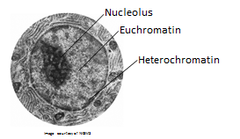
What is euchromatin?
Less condensed chromatin where active transcription occurs.
Give an example of a region always found in heterochromatin.
Centromeres and telomeres.
What is the basic unit of chromatin?
The nucleosome.
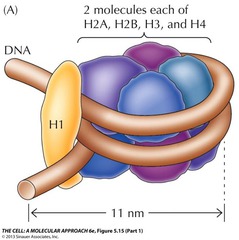
What makes up a nucleosome?
A histone core of 8 histone proteins and about 200 base pairs of DNA.
What is linker DNA?
The DNA between nucleosomes that links them together.
What is the 'beads on a string' structure?
Nucleosomes spaced out with visible linker DNA, necessary for active transcription.
What are nucleosomes also called?
10 nm fibers (diameter of a nucleosome).
What are histone proteins?
Positively charged proteins that are tightly associated with chromatin and function to package and order the DNA.
What do histones interact with?
They interact with the negatively charged sugar-phosphate backbone through electrostatic interactions and hydrogen bonds.
What proteins form the histone core?
Two copies each of H2A, H2B, H3, and H4.
What is the role of histone H1?
It binds linker DNA and clamps DNA onto the histone core, stabilizing nucleosome structure.
What parts of histones interact with neighboring nucleosomes?
Their N- (H3 and H4) and C-terminal (H2A and H2B) tails.
How do cells regulate nucleosome interactions?
By modifying histone tails to either strengthen or weaken interactions between nucleosomes.
What are epigenetic markers?
Covalent modifications to histone proteins or DNA that regulate chromatin structure and gene expression without changing the DNA sequence.
What enzyme adds acetyl groups to histone tails?
Histone acetyltransferase (HAT).
What effect does histone acetylation have on chromatin?
It opens chromatin structure, promoting active transcription.
What enzyme removes acetyl groups from histones?
Histone deacetylase (HDAC).
What donor molecule provides acetyl groups for histone acetylation?
Acetyl-CoA.
What is histone methylation?
The addition of one, two, or three methyl groups to lysines or arginines on histone tails.
What enzyme catalyzes histone methylation?
Histone methyltransferase (HMT).
What donor molecule provides methyl groups for histone methylation?
S-Adenosyl methionine (SAM)
What is the general effect of hypermethylation of histones?
It is associated with transcriptional silencing and heterochromatin formation.
Does histone methylation always repress transcription?
No, some methylation marks are associated with active transcription depending on the site and degree of methylation.
Why does acetylation promote transcription?
It neutralizes the positive charge of lysines, reducing electrostatic interactions between nucleosomes and spreading individual nucleosomes apart.
What are trimethylated histone marks generally associated with?
Transcriptional silencing and heterochromatin.
Is there more diversity in histone modifications in euchromatin or heterochromatin?
Euchromatin. There is more diversity in histone modifications in actively transcribed genes than transcriptionally silent ones.
What does the histone code represent?
A systematic way of describing specific histone modifications, indicating which histone, amino acid, position, and type of modification.
How is acetylated lysine 5 on H2B written in histone code?
H2BK5ac.
How is trimethylated lysine 27 on H3 written in histone code?
H3K27me3.