Chloe CHEUNG - Year 9 Physics Assessment
 Call Kai
 Learn
 Practice Test
 Spaced Repetition
 Match
 Flashcards
 Knowt Play
1/59

There's no tags or description
Looks like no tags are added yet.
60 Terms
Transverse Waves
Waves in which the medium moves perpendicular to the direction of wave. (radio waves, microwaves, infared waves, Ultraviolet light, water ripples)
Longitudinal Waves
Waves in which the medium moves parallel to the direction of wave. (sound, spring vibration, earthquake)
Law of reflection
The law of reflection states that when light bounces off a smooth surface, the angle of the incoming light equals the angle of the outgoing light
Elements of Transverse
peak/crest, trough, amplitude, equilibrium position (zero displacement), wavelength
Elements of Longitudinal
wavelength, compression, rarefraction
Low amplitude
Low/High frequency
High amplitude
Low/High frequency
Waves are vibration through…
Oscillation
Amplitude
big or small
Frequency
high or low
Wavelength
long or short

small amplitude
small amplitude, low frequency, long wavelength

small amplitude, high frequency, short wavelength

big amplitude, low frequency, long wavelength

big amplitude, high frequency, short wavelength
wavelength measures (y)
space (metres)
period (T)
time (seconds)
Frequency (f) is
the number of waves per second (Hz).
Period (T) is
the time (sec) it takes for one wave.

higher frequency
(shorter period)
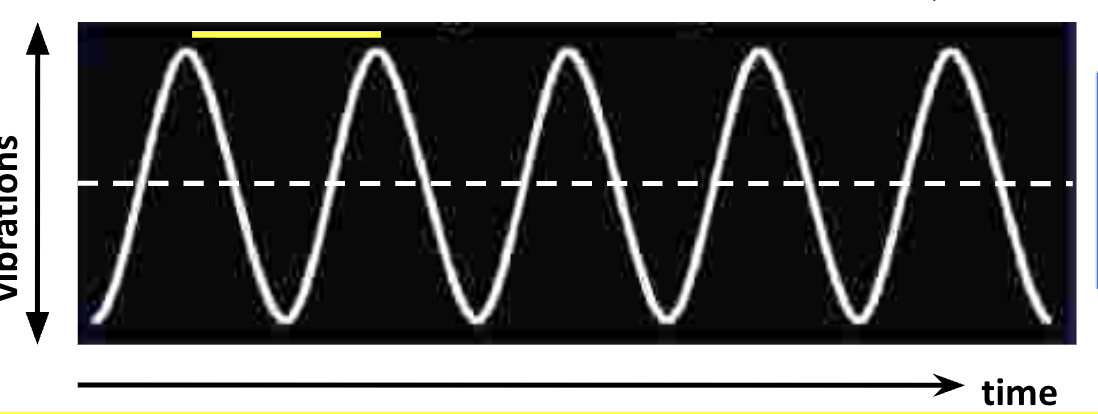
lower frequency
(longer period)
f=
1/T
T=
1/F or time taken/number of waves
mm>/<sec
/1000 ×1000
mHz>/<Hz>/<kHz
/1000 ×1000
Identify the highest frequency you can hear
20,000 Hz (20 kHz)
Electromagnetic spectrum
radio waves
microwaves
infared waves
ultraviolet light
visible light
x rays
gamma rays

CONVEX (diverging)

CONCAVE (converging)
converging and diverging irl
spoon, magnifying glass, glasses (near/farsighted), microscopes
WAVE EQUATION wavespeed (v) =
frequency x wavelength
frequency =
speed/wavelength
wavelength =
speed/frequency
highest frequency humans can hear
20,000 Hz (20 kHz)
high frequency
high pitch
low frequency
low pitch
how to describe how waveform sounds
frequency and pitch/amplitude and loudness
how are secondary colours made
by mixing equal amounts of 2 primary colours
EM waves all travel at the same speed through a vacuum, but have different wavelengths, frequencies, energies.
radio waves
bluetooth/wifi
Extremely powerful equipment can heat body tissue too fast and cause deep burns.
microwaves
heat up food
Handling hot dishes or boiling liquids from containers causes a lot injuries.
infared waves
thermal imaging used in strict searches
Excessive heat can lead to heat exhaustion, heat stroke, dizziness and headaches.
visible light
sunlight provide light for human and animal vision
if looked at for too long, the human eye can be blinded
ultraviolet light
uv sterilisation disinfection
if you stay in the sun too much (overexposure), the human body can burn
x ray
internal imaging
small chance of causing cancer due to cell damage
gamma rays
gamma knife, cancer treatement destroys tumors and cancer cells
can destroy dna
why we see different colours
White light contains all colors of the visible spectrum (Red, Orange, Yellow, Green, Blue, Indigo, and Violet). How we see different colors depends entirely on how light waves interact with materials through being absorbed, reflected, or transmitted.
how does sound travel from objects to ear
object makes sound by vibrating > vibrations pass through air by making air molecules vibrate back and forth > vibrations are picked up by ear drums
components of ear
nearsighted
myopia
farsighted
hyperopia
refraction
the bending or redirection of a wave (such as light, sound, or water) as it passes from one medium to another, caused by a change in the wave's speed
refraction rl examples
glasses, camera, microscope, magnifying glass
move to more dense medium
bend towards normal
move to less denser
bends away normal
waves travel faster through
solids > liquids > gases
what happens when you shine light through prism
as white light moves from the air to the denser glass of the prism, it slows down and bends (refract) toward the normal line. White light is made of combining different colours with different wavelengths, meaning each colour travels in a slightly different speed inside the glass. the colours that make up the white light sepereate and disperse into..