Alkene Reactions
 Call Kai
 Learn
 Practice Test
 Spaced Repetition
 Match
 Flashcards
 Knowt Play
1/17

There's no tags or description
Looks like no tags are added yet.
18 Terms
H2, Pt
Halogenation: Syn addition of two H

HX
(X = Cl, Br)
Hydrohalogenation (Markovnikov)
Halide added markovnikov (most substituted)
Halide and H are added syn

HBr, ROOR
Hydrohalogenation (anti-markovnikov)
Halide added anti-markovnikov (least substituted)
Halide and H are added anti

X2, CCl4
(X = Halides = Cl, Br)
Halogenation
Addition of two halides across a double bond, anti

X2, H2O
(X = Cl, Br)
Halohydrin Formation
Addition of OH and halide across double bond, anti
OH added markovnikov, halide is anti

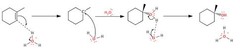
H2SO4, H2O
Acid Catalyzed Hydration
Addition of water, OH and H, across alkene, syn
OH is markovnikov, H is anti-markov
1. Hg(OAc)2, H2O
2. NaBH4
Oxymercuration-Demercuration
Addition of H and OH across alkene, anti
OH is markovnikov, H is anti

1. Hg(OAc)2, ROH
2. NaBH4
Alkoxymercuration-Demercuration
Addition of ester and H, anti
Ester is markovnikov, H is anti-markov

1. BH3,THF
2. H2O2, NaOH, H2O
Hydroboration-Oxidation
Addition of water, OH and H, across alkene, anti
OH is added anti-markov, H is markov

MCPBA
Epoxidation
Formation of an epoxide

OsO4 OR KMnO4, cold
Dihydroxylation (syn)
Addition of two OH across alkene, syn

MCPBA, H3O+
Dihydroxylation (anti)
Addition of two OH across double bond, anti

KMnO4, H3O+
Oxidative Cleavage
Formation of a ketone and carboxylic acid by breaking DB

O3, (CH3)2S
Ozonolysis (aldehyde)
Break DB forming aldehyde

O3, H2O2
Ozonolysis (carboxylic acid)
Break DB forming two COOH

CH3CH2O- , CH3CH2OH
Forms an alkene that is stable
Stable = more substituted
Sodium Ethoxide is a small base and can take a H from a tertiary C

T-butox, CH3CH2OH
Forms an alkene that is unstable
Unstable = least substituted
Tert butoxide is a bulky base so it pulls a H from the ends

H2SO4
Using sulfuric acid can turn any alcohol (1º,2º3º) into an alkene
