DP1 Unit 3 Part 1 - A3.1 Material Properties
 Call Kai
 Learn
Learn Practice Test
 Spaced Repetition
 Match
Match Flashcards
1/66

There's no tags or description
Looks like no tags are added yet.
Name | Mastery | Learn | Test | Matching | Spaced | Call with Kai | Chat |
|---|
No analytics yet
Send a link to your students to track their progress
67 Terms
synthetic
not naturally produced; made by artificial processes

polymer
A large molecule formed from many smaller molecules like building blocks
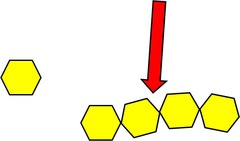
composite
made up of separate parts

plastic
a synthetic material made from polymers like PVC, nylon, etc.

alloy
A mixture of two or more metals

textile
A fabric made by weaving, used in making clothing

physical property
A characteristic that can be observed without changing the material

chemical property
A characteristic that describes its ability to change chemically

mechanical property
Any of the physical properties of a material that change when force is applied

Density
A physical property defined as the amount of mass per unit volume (Mass per unit volume of a material (e.g., kg/m³ or g/cm³). Important for product portability and weight.

Thermal expansion
A physical property defined as the tendency of a material to change its dimensions (length, area, or volume) in response to a change in temperature.

Thermal conductivity
A physical property defined as the ability of an object to transfer heat. This is a measure of how fast heat is conducted through a material. High = good conductor; low = good insulator.

Melting point
A physical property defined as the temperature at which the material changes from solid to liquid

Electrical resistance
A physical property that resists the flow of an electric current

Electrical conductivity
A physical property defined as the ability of an object to carry electric current

Corrosion Resistance
A chemical property defined as the ability to withstand deterioration from environmental factors.

Reactivity
A chemical property defined as how easily a substance combines chemically with other substances (such as baking soda and vinegar)

Hygroscopy
A chemical property defined as the ability to attract and hold water molecules from the surrounding environment

Flammability
A chemical property defined as the ability to burn in the presence of oxygen

Tensile strength
A mechanical property defined as being able to resist breaking under tension

Compressive strength
A mechanical property defined as the force at which a material breaks under pressure (compression)

Stiffness
A mechanical property defined as being able to resist bending

Hardness
A mechanical property defined as how easily the material can be scratched

Toughness
A mechanical property defined as the ability to handle overloading before it fractures.
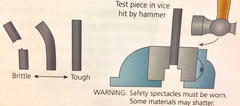
Malleability
A mechanical property defined as the ability to be hammered or beaten into thin sheets

Elasticity
A mechanical property defined as the ability to bounce back after being changed (bent, pulled, etc)

Plasticity
A mechanical property defined as the ability to be deformed permanently without breaking

Ductility
A mechanical property defined as the ability to be drawn, pulled, or extruded into a wire

Tensile Strength
The ability of a material to withstand pulling (tensile) forces without failure.

Compressive Strength
The ability of a material to withstand being pushed or squashed (axial loads) without failure.

Stiffness
A material's ability to resist bending or deflection and maintain its shape; the ratio of stress to strain.

Toughness
The ability of a material to absorb energy and resist the propagation of cracks without fracturing. The opposite of brittle.

Hardness
The resistance of a material to penetration, scratching, cutting, or indentation.

Malleability
The ability of a material to be plastically deformed under compressive force (e.g., hammered into thin sheets). Gold is the most malleable metal.

Elasticity
The ability of a material to return to its original shape after being deformed, once the applied force is removed.

Plasticity
The ability of a material to undergo permanent deformation without breaking.

Ductility
The ability of a material to be drawn or extruded into an extended shape such as a wire under tensile stress. Copper is a good example.

Corrosion Resistance
The ability of a material to withstand damage caused by oxidation or other chemical reactions with its environment.

Flammability
A measure of how quickly a material can be ignited and how rapidly it will burn.

Hygroscopy
A chemical property describing a material's ability to absorb moisture from the surrounding environment.

Reactivity (food safety)
The extent to which a material will react with another substance, including air, to become unsafe for food contact.

Melting Point
The temperature at which a material transforms from a solid to a liquid.

Electrical Resistivity
The measure of how strongly a material opposes the flow of electric current. High resistivity = insulator.

Electrical Conductivity
The measure of a material's ability to conduct electricity. High conductivity = good conductor.

Physical Properties
Characteristics of a material that can be observed or measured without changing the material in any way (non-destructive testing).

Mechanical Properties
Properties that describe the relationship between stress and strain, or a material's reaction to an applied force.

Composite Material
A material made from two or more constituent materials with different properties, combined to create a material with superior characteristics.

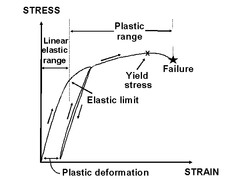
Stress
Force applied over an area (measured in Pascals).

Strain
The resulting deformation (a dimensionless ratio).

Young's Modulus
The ratio of stress to strain in the elastic region and indicates stiffness.
Tensile
Pulling/stretching a material apart.

Compressive
Pushing/squashing a material together.

Shear
Forces pushing sideways in opposite directions.

Torsion
Twisting forces applied to a material.

Bending
A combination of tensile and compressive forces causing deflection.

Mohs Scale
Ranks minerals 1-10 by scratch resistance. Diamond = 10.

Stainless steel
Metal alloy made from iron, chromium, carbon and other minerals. Valued for its corrosion resistance.

Rubber
A flexible, elastic material with high electrical resistivity (good insulator)

Density calculation
D = M / V --> Density = Mass / Volume

The material with the highest rating on the Mohs hardness scale
Diamond

Piezoelectric materials
The ability to convert pressure into electricity and electricity into pressure
Photochromic materials
Materials that change in response to light

Shape memory alloy
A smart material which can be moulded and return back to its original shape once heated e.g. glasses and springs

Material that is the best thermal conductor
Silver

Non-hygroscopic
Unable to absorb moisture from the environment easily, such as PVC and other polymers

A material that is hard and strong but not tough
Ceramics - they are hard (not easily scratched), strong (compressive & tensile strength), but brittle when hit by a blunt force

Brittle
Opposite of toughness
