AP Stats - Unit 1B
 Call Kai
 Learn
 Practice Test
 Spaced Repetition
 Match
 Flashcards
 Knowt Play
1/38

There's no tags or description
Looks like no tags are added yet.
39 Terms
Explanatory Variable
The variable that may explain or predict changes in the response variable.

Response Variable
The variable measured as the outcome of a study.
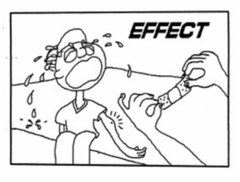
Three Components of a Good Investigative Question
Identify the population of interest, specify the variables, and ask about a relationship or comparison that can be answered with data and accounts for variability.
Confounding Variables
Variables whose effects on the response cannot be separated from each other, making it difficult to determine which variable caused an observed effect.

Observational Study
A study in which researchers observe or measure variables without assigning treatments. It can show association but generally cannot establish causation.

Prospective Observational Study
A study that follows individuals forward in time and records outcomes as they occur.

Retrospective Observational Study
A study that looks backward using existing records or recollections to examine past exposures and outcomes.

Survey
A method of collecting data by asking people questions.

Direct Observation Study
An observational study that collects data by watching or measuring behavior or events directly.

Experiment
A study in which researchers deliberately impose treatments on experimental units and measure the responses.

Experimental Units
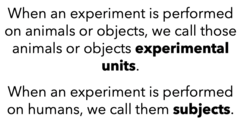
The individuals or objects to which treatments are assigned. Human experimental units are often called subjects or participants.
Treatments
The specific conditions imposed on experimental units. With multiple factors, a treatment is a particular combination of factor levels.
Random Assignment
Using chance to assign experimental units to treatment groups. It helps balance other variables across groups and supports cause-and-effect conclusions.

Census vs. Sample
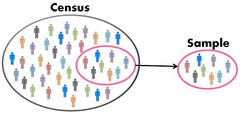
A census collects data from every member of a population. A sample collects data from only part of the population.
Simple Random Sample (SRS)
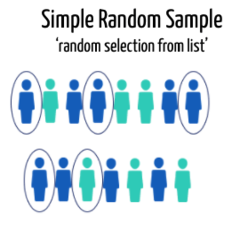
A sample of size n selected so that every possible group of n individuals has an equal chance of being chosen.
Cluster Random Sample
Divide the population into groups called clusters, randomly select some clusters, and include every individual in the selected clusters.

Stratified Random Sample
Divide the population into groups called strata based on a shared characteristic, then take a random sample from every stratum.

Judgment Sample
A nonrandom sample selected using the researcher's judgment about which individuals would be useful or representative.

Systematic Random Sample
Choose a random starting point, then select every kth individual from an ordered population list.

Generalizability
The extent to which findings from a sample can be applied to a larger population. Random sampling supports generalization to the population sampled.

Causal
A relationship in which changing one variable produces a change in another. A well-designed randomized experiment provides evidence of causation.

Bias
A systematic tendency in a study's methods to produce results that differ from the truth in a particular direction.

Sampling Bias
A sampling method that systematically favors certain members of the population, potentially producing an unrepresentative sample.

Undercoverage Bias
Bias that can occur when some groups in the population are left out or inadequately represented in the sampling process.

Nonresponse Bias
Bias that occurs when selected individuals do not respond and differ in relevant ways from those who do respond.

Voluntary Response Bias
Bias caused when people choose themselves to participate, often overrepresenting those with strong opinions.

Response Bias
A systematic pattern of inaccurate answers caused by factors such as wording, interviewer influence, faulty memory, or a desire to appear favorable.
Question Wording Bias
Response bias caused by leading, confusing, or emotionally loaded wording that influences answers.

Self-Reporting Bias
Response bias that occurs when people inaccurately report their own behavior, experiences, or characteristics.

Extraneous Variables
Variables other than the explanatory variable that may affect the response. They can become confounding variables if their effects cannot be separated from the treatment's effect.

Four Principles of Experimental Design
Comparison: compare two or more treatments. Randomization: randomly assign units to treatments. Control: keep other conditions as similar as possible. Replication: use enough experimental units in each treatment group.

Placebo
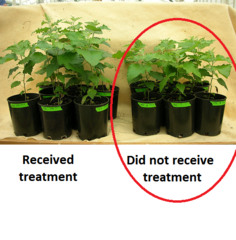
A treatment with no active ingredient that resembles the treatment being tested.

Control Group
A group that provides a baseline for comparison. It may receive a placebo, no treatment, or an existing standard treatment.
Placebo Effect
A change in a participant's response caused by the expectation of receiving treatment rather than by the treatment's active ingredient.

Single-Blind Study
A study in which either the participants or the people interacting with them or measuring responses do not know which treatment each participant receives.

Double-Blind Study
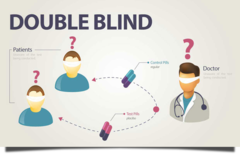
A study in which neither the participants nor the people interacting with them or measuring responses know which treatment each participant receives.
Completely Randomized Design
An experimental design in which all experimental units are assigned to treatments entirely by chance, without first forming blocks.

Randomized Block Design
Group experimental units into blocks of similar units based on a characteristic that may affect the response, then randomly assign treatments within each block.

Matched Pairs Design
A randomized block design comparing two treatments using pairs of similar units or the same unit twice. Randomly assign treatments within each pair or randomize treatment order when each unit receives both.
