8. Pharmacology of the autonomous nervous system
 Call Kai
 Learn
 Practice Test
 Spaced Repetition
 Match
 Flashcards
 Knowt Play
1/25

There's no tags or description
Looks like no tags are added yet.
26 Terms
The autonomous nervous system
Important physiological regulatory system
Target for many durgs and other bio-actives
Functionally and anatomically divided into:
Sympathetic nervous system
Parasympathetic nervous system
connected with many organs
Anatomy of a neuron
Neurons or nerve cells
Receive stimuli and transmit action potentials
Organization
Cell body or soma
Dendrites: input
Axons: output
Neuroglia or glial cells
Support and protect neurons
Types of neurons
Functional classification
Sensory or afferent: action potentials towards CNS
Motor or efferent: action potentials away from CNS
Interneurons or association neurons: within CNS from one neuron to another
Structural classification of neurons
Multipolar (a)
Bipolar (b)
Unipolar (c)

Action potentials
cells produce electrical signals called action potentials
‘Rapid’ transfer of ‘information’ from one part of the body to another
Electrical properties result from ionic concentration differences across the plasma membrane and ion permeability of the membrane.
How is resting potential maintained?
Na+/K+ ATPase pump → Na+ out, K+ in; resting potential -70 mV
Depolarization and repolarization
When threshold of -55 mv is reached, it will depolarize
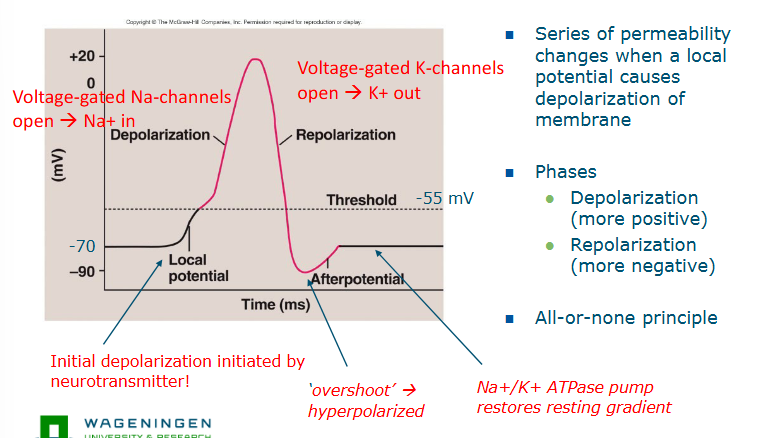
Refractory period
During this time the cell can not receive stimulus, absolutely not during absolute period and if strong enough during relative period.

Synaps
Junction between two cells
Site where action potentials in one cell cause action potential in another cell (via neurotransmitters)
The neurological synaps

Activation and inhibition of nervous systems
Sympathetic nervous system → ‘activation’
Parasympathetic nervous system → ‘inhibition’
What nervous system is responsible for fight or flight? What does it do?
The sympathetic nervous system
Produces tachycardia
Raises blood pressure
Dilates the pupils
Dilates the trachea and bronchi
Stimulates the conversion of liver glycogen into glucose.
What nervous system is responsible for calming the body down? What does it do?
Parasympathetic nervous system

How is our physiology regulated?
Antagonistic control with the two nervous systems working as gas and break: antagonistic control
Tonic control
Antagonistic control
Structures served by both sympathetic and parasympathetic nerves
The effects are usually opposite or antagonistic
Most structures that receive parasympathetic innervation also receive sympathetic innervation
Most internal organs, salivary glands, tear glands, and intrinsic eye muscles
Tonic control

Neurotransmitters
All preganglionic neurons, both sympathetic and parasympathetic
Release acetylcholine (ACh) onto nicotinic (ion channels) ACh receptors on all the postganglionic dendrties
Always excitatory

Beta-1 receptors (agonist)
Agonists
Limited use/applications
Dobutamide
Heart failure, shock
Epinepherine (Adrenaline)
Cardiac arrest
Shock
Allergic reactions (anaphylactic shock)
‘epi-pen’
Beta-1 receptors (antagonist)
Found in many drugs
‘beta-blockers’ - beta-1 selective or non-selective b1-b2 blockers
angina pectoris
hypertension
tremors
What they do:
Decrease of blood pressure
Decrease of cardiac output (and decreased AV-conduction)
Decreased peripheral circulation
Beta-2 receptors (agonists)
To improve airway function during e.g. asthma or COPD
e.g. salmeterol, salbutamol
Typically as inhalers but also other routes of administration
Side effect: increase of muscle formation and strengths + decrease of fat tissue
Beta-3 receptors
B3-agonists are very effective thermogenic anti-obesity and insuline sensitising agents in rodents
Lots of effort has been put in search for agonists active in humans since 1990
Problems with receptor selectivity and species differences in types of fat tissue prevented a break through
With discovery of brown fat in humans of adult age this may change…
Alfa-1 receptors (agonist)
Agonists → smooth muscle contraction, e.g. in skin vascular bed
Not frequently seen
Anti-congestive effects, local effects in nose
xylometazolin (otrivin), oxymetazolin (nasivin)
Alfa-1 receptors (antagonist)
To prevent urinary retention for example in benign prostate hypertrophy: tamsulosin, alfuzosin
To produce lowering of blood pressure via peripheral vasodilation: effective but not first choice (e.g prazosin)
For Raynaud’s syndrome (limited cases)
Alfa-2 receptors (agonists)
Limited in use…
Clonidine → acts via central alfa-receptors → blood pressure reduction
Indirectly actin sympathomimetics
Ephedrine: alkaloid from Ephedra, in ma huang. In many (illegal) food supplements (weight loss etc.)
Amphetamine: CNS stimulant. In the past its analogue fenfluramine (ponderIR) was used as appetite suppressant
Tyramine: in fermented food products (see food-drug interactions)
Methylphenidate: Ritalin (known ADHD drug); NE uptake inhibitor
Atropine
Increases heart rate
Decreases secretion
Relaxation of smooth muscle - bronchi, urinary bladder, GI tract
Dilation of pupil
Relaxes ciliary muscle - focus far vision
Adverse effects: dry mouth, constipation, urinary retention