Cultural Psychology (Heine) Module 1 - Chapter 1,2,3
 Call Kai
 Learn
 Practice Test
 Spaced Repetition
 Match
 Flashcards
 Knowt Play
1/32

There's no tags or description
Looks like no tags are added yet.
33 Terms
general psychology
Richard Shweder's term for the overarching perspective of the field of psychology of assuming that the mind operates under a set of natural and universal laws that exist independently of the context that the individual is in and of the content of what they are thinking about
nonuniversal
the fourth, and lowest, level of universality, which states that a give cognitive took does not exist in all cultures and can be considered a cultural invention
existential universal
the third level of universality, which states that a given cognitive tool exists across cultures, although the tool is not necessarily used to solve the same problems across cultures, nor is it equally accessible across cultures
functional universall
the second level of universality, which states that a given cognitive took exists across cultures and is used to solve the same problem across cultures, but is more accessible to people from some cultures than others
accessibility universal
the first and highest level of universality, which states that a given cognitive took exists across cultures, is used to solve the same problem across cultures, and is accessible to the same degree across cultures
WEIRD societies
western, educated, industrialized, rich and democratic societies - a shorthand for the kinds of societies that the psychological database is largely based on
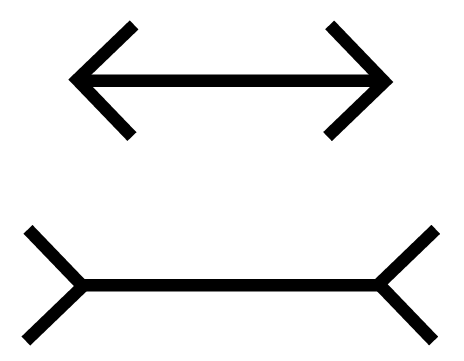
Muller-Lyer illusion
a visual illusion in which a line with ends that angle away from the line apprears longer than a line with ends that angle towards the line
color-blind apprach
looking beyond individuals' ethnicities or race in an effort to focus on their common human nature
multicultural approach
attending to and respecting the distinctive aspects of different cultural groups
ethnocentrism
the tendency to judge people from other culrures by comparing them to the standards of one's own culture
Russian cultural-historical school
a school of thought which argued that people interact with their environment through the tools or human-made ideas that have been passed down to them through history
prestige bias
a tendency to imitate prestigious others more than less-pretigious others- that is, those who have the respect and attention of others
theory of mind
a human ability to understand that others have minds that are different from one's own, and thus that other people have their own distinct perspectives and intentions
imitative learning
a type of social learning in which the learner internalizes aspects of the mode's goals and behavioral strategies
emulative learning
a type of social learning focused on the environmental events involved with a model's behavior, such as how the use of one object could potentially affect changes in the state of the environment
ratchet effect
the process by which cultural information becomes more complex and often more useful over time because an initial idea can be learned from others and then modified and improved by the learners
cultural worlds
worlds that contain cultural ideas that have accumulated over time
encephalization quotient
the ratio of an animal's brain weight to the brain weight predicted for a comparable animal of the same body size
social brain hypothesis
the theory that cognitive demands inherent in social living led to the evolution of large primate brains
neocortex ratio
the ratio of the volume of the neocortex to the volume of th rest of the brain, which is used as proxy measure of intelligence
proximal causes
causes that have direct and immediate relations with their effect
distal causes
initial differences that lead to effects over long periods of time and often through indirect relations
evoked culture
the notion that all people, regarless of where they are from, have certain biologically encoded behavioral repertoires that are potentially accessible to them, and that these repertoires are engages when the appropriate situational conditions arise
transmitted culture
the notion that people learn about particular cultural practices through social learning or by modeling the behavior of others who live near them
natural selection
the evolutionary process that occurs when three particular conditions are present
1. individual members of a species vary in certain traits
2. those varying traits are associated with different survival rates
3. those traits have a hereditary basis
dynamic social impact theory
a theory suggesting that individuals influence each other through their interactions, which gives rise to clusters of like-minded people separated by geography
contemporary legends
firctional stories told in modern societies as though they are true
minimal counterintuitive ideas
ideas that violate our expectations enough to be considered surprising and unusual but not too outlandish
individualistic culture
culture with many practices and customs encouraging individuals to prioritize their own personal goals ahead of collective goals and to emphasize the ways in which they are distinct from others
collectivistic culture
culture with many practices, institutions, and customs encouraging individuals to place relatively more emphasis on collective goals that individual ones
subjective well being
the feeling of how satisfied one is with one's life
autokinetic effect
an effect caused by the involuntary saccades of the eyes, which, in the dark, create the illusion of movement
pluralistic ignornance
the tendency for people to collectly misinterpret the thoughts that underlie other people's behaviors