Brain & Cognition sem 1 part 2
 Call Kai
 Learn
 Practice Test
 Spaced Repetition
 Match
 Flashcards
 Knowt Play
1/47

There's no tags or description
Looks like no tags are added yet.
48 Terms
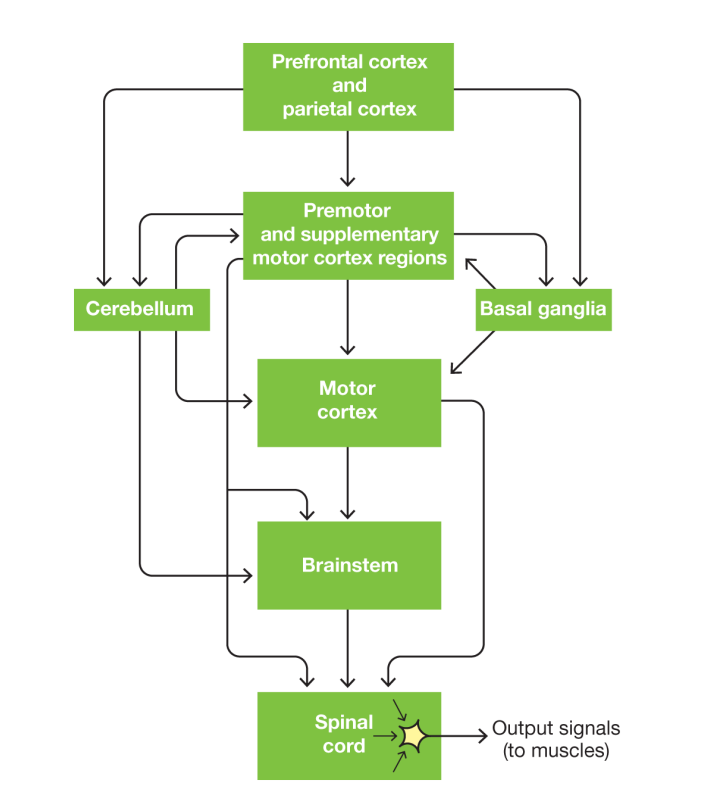
8.1
Motor pathways
frontal/parietal; translate goals into movement
association area’s
primary motor cortex; commands muscles (with cerebellum & basal ganglia)
brain stem
spinal cord; neurons activate muscles/ reflexive movements
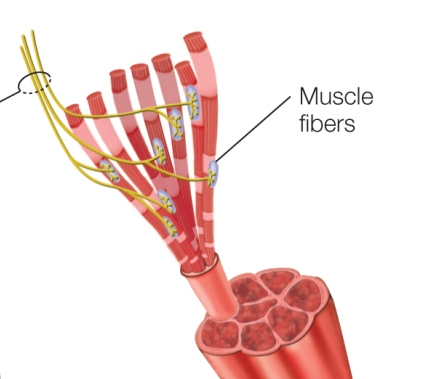
Anatomy of muscles
What type of neuron activates muscles and how?
Alpha motor neuron (ventral side of spinal cord);
releases neurotransmitter
muscle fiber contraction

Effector
A part of the body that can move; generates movement if it’s muscle fibers are stimulated
Stretch reflex
muscle spindles form an afferent nerve
interneurons in spinal cord
alpha motor neurons cause muscle to return to original length (if a stretch is unexpected)

Muscle spindles
Sensory receptors in the muscles that provide information about how much the muscle is stretched
Pyramidal vs extrapyramidal tracts
Pyramidal (voluntary); axons that originate in the cortex and terminate in the spinal cord (contralateral)
Extrapyramidal (automatic; posture/balance); axons that originate in subcortical nuclei and terminate in the spinal cord (contralateral/ipsilateral)

Ataxia
difficulty maintaining balance and producing well-coordinated movements (because of damage to the cerebellum)
5 nuclei of the basal ganglia
1) caudate nucleus
2) putamen
3) globus pallidus
4) subthalamic nucleus
5) substania nigra

Brainregions involved in motor control
1) Primary motor cortex (M1); output has biggest influence on pyramidal tracts (somatotopic representation of body)
2) Premotor cortex (PMC); planning and control of movement (external cues)
3) Supplementary motor area (SMA); strong connections with the medial frontal cortex (self-initiated actions)

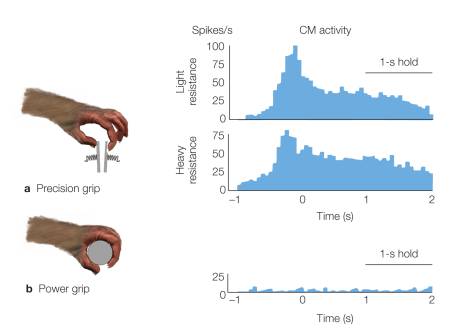
What are CM neurons and what do they do?
CM neurons; corticomotorneurons (originate from M1)
Control upper limb muscles and fingers/hands (voluntary; without interneurons in spinal cord)
What are CM neurons specialized in and which experiment proved this?
CM neurons specialize in fine motor control
Experient; CM neuron fired more strongly for the precision grip task than power grip task
Hemiplegia
loss of voluntary movements on the contralateral side of the body (because of damage to pyramidal tract/M1)
Integrate-isolate model of M1
Revised model of homunculus; effector-specific regions (=precise control of particular body part) are surrounded by effector-independent regions (= coordinate actions with multiple body parts).

Dorso-dorsal vs ventro-dorsal stream
dorso-dorsal; reaching for an object (damage leads to optic ataxia)
ventro-dorsal; planning learned, skilled actions (damage leads to apraxia)

8.2
What are central pattern generators and which experiment proved them?
central pattern generators; neurons in spinal cord that produce motor commands
Brown severed spinal cord in cats; they could still walk (= central pattern generators produced actions without descending commands/external feedback)

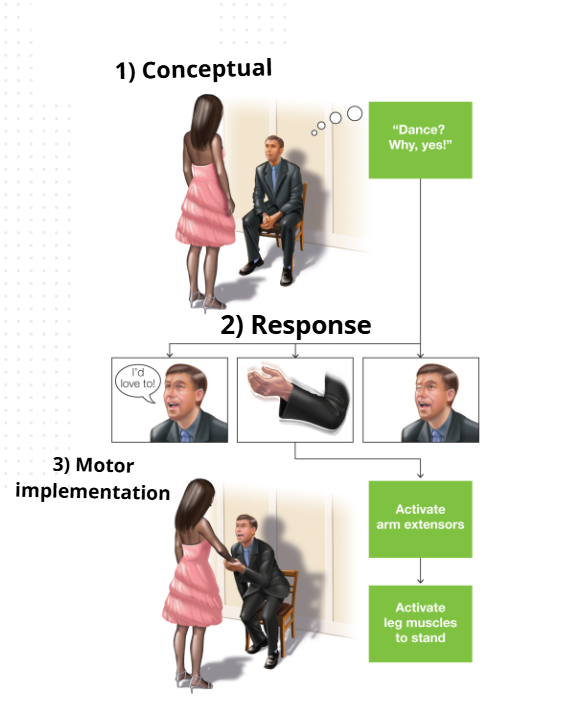
3 levels of hierarchical representation of action sequences
organize movement elements into integrated chunks
1) Conceptual; representation of the goal of the action
2) Response; goal is translated into an effector system
3) Motor implementation; translate movement plans into muscular activation patterns
Deafferentation
the loss of sensory input travelling from the body to the CNS
What is endpoint control and which experiment proved it?
endpoint control; controlling a movement by its goal location
Bizzi deafferentated monkey’s & applied opposing force that prevented arm movement
Once this force was removed, the limb rapidly moved to the correct target location (= monkey generated a motor command corresponding to the target)

8.3
Neural coding of movement
Population vector concept
Planning-related activity vs execution-related activity
8.4
Movement planning
Affordance competition hypothesis
Serial processing
Benefit of inter-effector coordination
Repetition suppression effect
8.5
Regaining movement after motor cortex loss
Brain-machine interface
Benefits of BMI
8.6
Two output nuclei of the basal ganglia
Direct vs indirect pathways of the basal ganglia
Dopamine pathway
Computanional model of basal ganglia and movement
Reinforcement contingency
Relationship between movement and the basal ganglia
Basal ganglia disorders
8.7
Learning stages of movement
9.1