Lecture 1: Epigenetics + control of the genome
 Call Kai
 Learn
 Practice Test
 Spaced Repetition
 Match
 Flashcards
 Knowt Play
1/47

There's no tags or description
Looks like no tags are added yet.
48 Terms

Explaining all inheritance and phenotype by the transmission
of variation in DNA sequence is incomplete and raises
more questions
what are these questions (probs not too important, just setting the stage)
1. Why don’t all inbred strains have exactly the same lifespan, and responses to stress, disease etc?
2. Why do some diseases appear to be linked to a locus in some families and we simply can’t find a mutation?
3. Why has it been so hard in some instances to identify the genetic elements underlying a condition?

Implications of these question on epigenetics?
*****History of epigenetics: What are the 4 ideas that didn’t start out together but came together to form what we know as epigenetics today?
LAMARK + his giraffes
The term epigenetics + definition
G.R. Wyatt + Methylation
Paternal and maternal contributions to embryotic development can be functionally different
*****Elaborate on LAMRK + His giraffes. What was his proposal? What theory was termed?
Theory of Inheritance of Acquired characters: Characteristics can be AQUIRED during the life time and PASSED on to offspring

*****How was the term Epigenetics historically used + described?
Term was used to describe events that could not be explained by normal genetic principles (over the years many inexplicable biological phenomena have been lumped into the epigenetics category)
Conrad Waddington = coined the term + defined it as => the branch of biology which studies the causal interactions between genes and their products which bring the phenotype into being
Because genes and their products constantly interact 1 gene = many possible outcomes
same DNA, Different Cell Types

**Many things that couldn’t be explained until more recently were lumped into the “must be epigenetics” category: What are some examples?
Prader willi/Angelman syndromes + parent dependent outcomes of inherited 15q deletions
Fragile X - Sherman paradox (likelihood of clinical symptoms and severity increase across generations), laird hypothesis
X chr. inactivation - Barr bodies
*******What is the MODERN definition of epigenetics?
The study of reversible heritable changes in gene function or other cell phenotype that occur without a change in DNA sequence (Genotype)
****Work of G.R. Wyatt, what he discovered, HOW and its relation to Epigenetics?
First identified and measured 5-methylcytosine in DNA and discovered METHYLATION of DNA
uncovered the exact chemical tag that acts as one of the primary physical mechanisms behind epigenetics.
HOW
Earlier scientists noticed that DNA always has equal amounts of Adenine and Thymine (A:T) and equal amounts of Guanine and Cytosine (G:C), known as Chargaff's rules. However, in some samples, the amount of Guanine slightly exceeded regular Cytosine.
Wyatt proved that the "missing" Cytosine was actually a modified version called 5-methylcytosine (a regular Cytosine with a small chemical methyl group attached). When he added regular Cytosine and 5-methylcytosine together, the G:C ratio balanced out perfectly
*****Elaborate on maternal and paternal genomes are not functionally equivalent
maternal and paternal genomes are not functionally equivalent during mammalian development. Even when a fertilized egg has a complete set of chromosomes, it requires DNA from both a mother and a father to survive.
Has to do with genomic imprinting
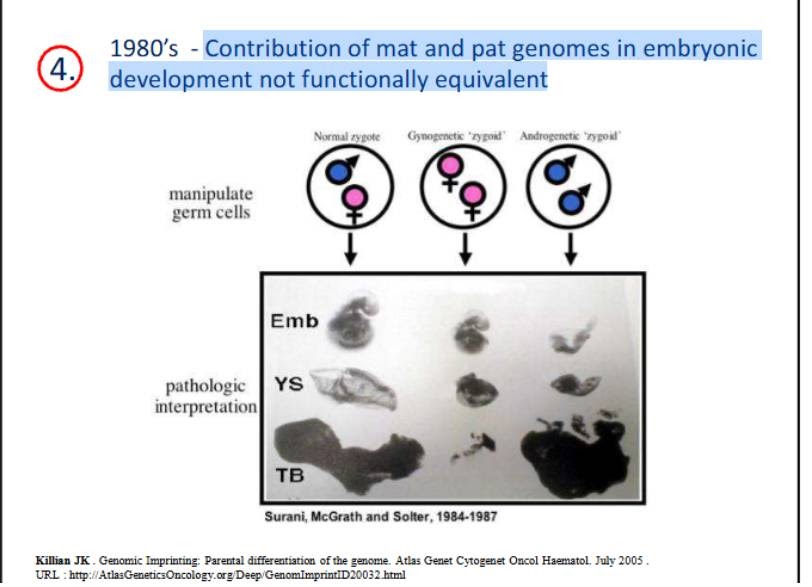

****Compare an contrast embryo development between normal zygote, Gynogenetic zygoid (maternal genome only) and Androgenetic zygoid (paternal only)
NORMAL = yes embryo, yes yolk sack, yes placenta
GYNO = yes embryo NO placenta
ANDRO = NO embryo yes MASSIVE placenta

*****What is the clinical relevance of maternal and paternal genomes are not functionally equivalent
what is the medical term/disease that results due to mat only or pat only genome
Gynogenetic = results TERATOMAS (aggressive cancer in the ovary)
Androgenetic = results in HYDATIDIFORM moles (large, grape-like mass of abnormal placental tissue that carries a risk of becoming cancerous)

*****Recap on the four foundational historical ideas that combined to form the modern science of epigenetics
2. Outcomes of genes and their products
Historical concept: This summarizes Conrad Waddington's 1942 definition and his epigenetic landscape.
Epigenetic connection: A single gene does not lock an organism into one rigid outcome. Instead, interactions between genes, their protein products, and cellular signals guide cells down different developmental "valleys" to create varied traits.
4. Paternal and Maternal contributions can be functionally different
Epigenetic connection: Even when chromosomes carry the exact same genes, parents apply different epigenetic tags during egg and sperm formation (genomic imprinting). Both maternal and paternal tags are required for normal development.

*******Define the EPIGENOTYPE vs. EPIGENOME
21st century
equivalent to genotype and genome

******What are the THREE epigenetic modifications
2 MAJOR forms and 1 NEW

****What type of epigenetic marks result in a transcriptionally ACTIVE vs. INACTIVE chromatin?
ACTIVE: DNA is wrapped loosely around histones. Cellular machinery can easily access the DNA and read the gene (Transcription proceeds).
YES Acetyl tags (Green "Ac" flags) = keeps DNA open (affects histones)
Unmethylated DNA (White circles)
INACTIVE: histone are packed tightly together, hiding the DNA sequence
Methylated tags (Red "Me" circles): Both the DNA strand and the histone tails are covered in red
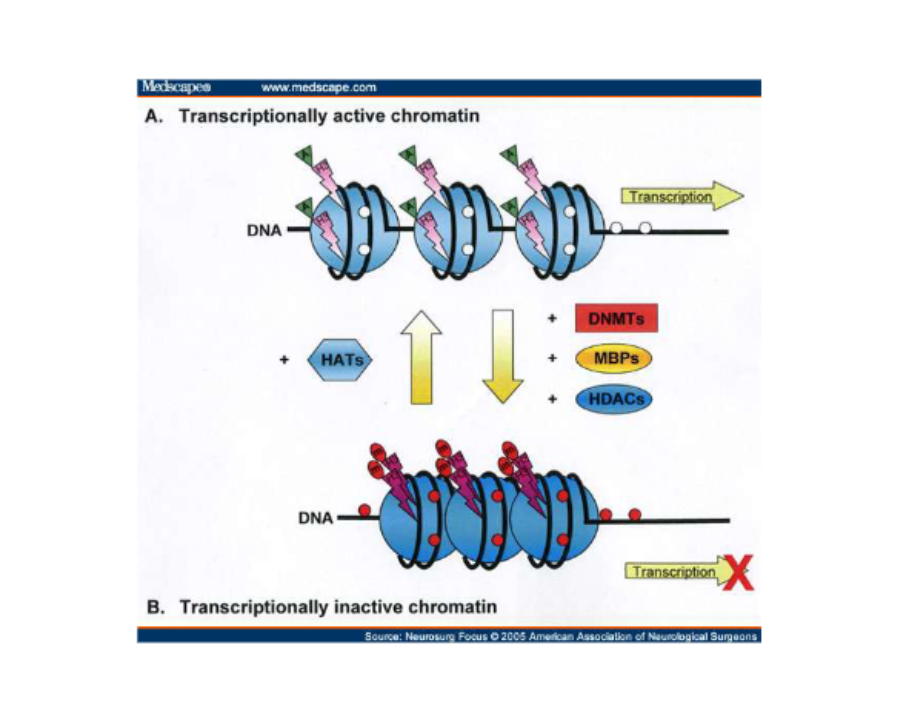
(unsure how important to memorize) What enzymes are related to the ACTIVE vs. INACTIVE
Turning genes OFF (Downward arrow):
DNMTs (DNA Methyltransferases): Enzymes that attach red methyl groups directly onto the DNA.
MBPs (Methyl-CpG-Binding Proteins): Proteins that recognize those methyl tags on DNA and recruit silencing complexes.
HDACs (Histone Deacetylases): Enzymes that strip away the green acetyl groups from histones, allowing the spools to pack tightly shut.
Turning genes ON (Upward arrow):
HATs (Histone Acetyltransferases): Enzymes that add green acetyl groups back onto the histone tails, loosening the chromatin so the gene can be read again.
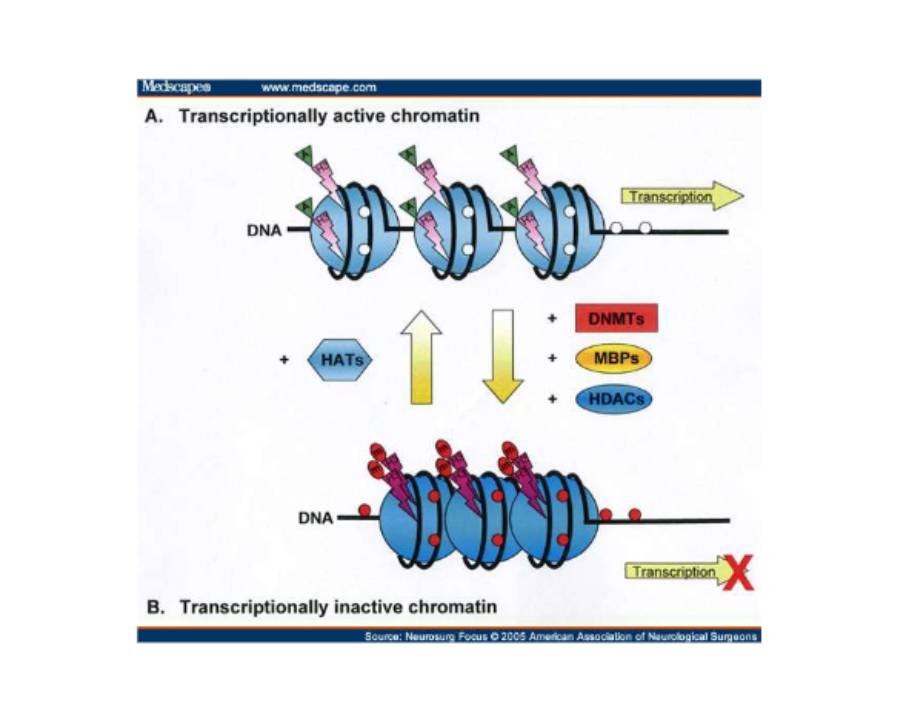
What comes first
Does methylation come first, followed by chromatin modification
Or is the chromatin modified and then the DNA is methylated?
HISTORICALLY it (Chromatin structure) was thought to be unidirectional Influenced by methylation state of DNA
however…
RESEARCH now suggests Neither always comes first because the relationship is bidirectional (a two-way street).
Methylation state influences chromatin structure however, the REVERSE IS ALSO TRUE, recent research shows that Chromatin disruptions can also influence methylation
******Describe the examples that showed Chromatin disruptions can also influence methylation
Methylation is bi-directional not unidirectional
In mice loss of SNF2 helicase involved in chromatin remodeling results in loss of methylation
In humans, mutations in ATRX, a member of the SWi/SNF chromatin remodeling family leads to defects in DNA methylation – hemoglobinopathy/MR
PML-RAR fusion proteins in leukemia can lead to de novo methylation of genes adjacent to its target sequences.
Abnormal proteins recruit methylation: In leukemia, the PML-RAR fusion protein binds to chromatin and alters its local structure first, which then recruits enzymes to add brand-new (de novo) DNA methylation to nearby genes.
******METHYLATION vs. CHROMATIN STRUCTURE, which came first as controller of gene activity?
What is the reason behind this answer?
Chromatin inactivation may COME FIRST → as organisms like S. cerevisiae do not have DNA methylation.
Methylation occurs after initiation of X chromosome inactivation.
*****Why have BOTH Methylation AND chromatin structure as a way to control gene activity?
Both are Self reinforcing, preventing drift, may be important in long lived species.
*****Elaborate on the different stages of Epigenetic patterns through the life cycle
When are DNA methylation and histone marks established
What happens in intrauterine growth, growth phase and adult life?
Inheritance of acquired epigenetic marks + effects?
(Right) Marks are established during EMBRYONIC DEVELOPMENT (intrauterine growth) to maintain cell lineage commitment and control development and differentiation
2 + 3. (bottom + left) AFTER BIRTH the chromatin is DYNAMIC. EPIGENETIC DRIFT (changes of chromatin marks within a gene locus) occurs in response to Nutritional, environmental, or pathological signals and are part of homeostatic adaptations
help the body adapt to nutrition, metabolism, environment, and disease (center arrows). Over time, small changes accumulate (shown as yellow and red circles replacing blue ones), a process called epigenetic drift.
AGING = when adverse epigenetic drift builds up and alters a cells capacity to respond to disease. Cells lose proper control over gene transcription. This breakdown increases susceptibility to age-related conditions and diseases like cancer.
Adverse epigenetic drift happens gradually and somewhat randomly (stochastically)
NORMALLY in the GERM LINE the epigenome is REPROGRAMED(Reset)
But… some marks may escape reprogramming during gametogenesis and be inherited by subsequent generations.
Transgenerational inheritance of epigenetic regulation would contribute to disease susceptibility by transmitting an acquired epigenetic predisposition to the next generation

****Where do we Look for methylation differences controlling expression of genes. (Aka. where is methylation located)
CpG sites - where a Cytosine (C) sits right next to a Guanine (G) on the same strand
**Why are CpG sites depleted across most of the genome?
Methylated cytosines are chemically unstable and undergo spontaneous deamination into Thymine (T) over evolutionary time, leaving dense CpG clusters mostly around coding sequences.
*****Describe the DISTRIBUTION of CpG’s across the chromosome and genes. (Hints: 4our CpG genomic zones)
WHERE ARE MOST ASSOCIATED?
Distribution of CpG varies acress chromosome and genes with most associated with CODING SEQUENCE
CpG’s are often found in CpG rich sites known as
CpG Islands (certain statistic define these loci as especially CpG rich, size determined by statistics)
The next 2 Kb flanking the CpG island is known are the CpG island shores
2 more Kb out from the shores = the CpG shelves
anymore out from here is known as the open sea
As you move out from the Islands to the open sea the distribution of CpG becomes increasingly sparse
For a long time, researchers assumed most gene-silencing methylation happened directly inside the CpG island itself. However, studies (revealed that CpG islands usually stay unmethylated in normal tissues. Instead, methylation changes in the CpG shores and thus given the name. Additionally the selves also were also found to be involved and thus given the name

What percent of the CpG is found in the CpG island region?
30%
*****How does CpG density and METHYLATION STATUS vary across a gene?
Active Promoters are often unmethylated the GENE BODY tends to be methylated
CpG islands are very CpG dense and usually unmethylated compared to the Gene body

****What CpG regions is the main source of variability in expression?
The CpG island SHORES
has very variable methylation (mix of blue and white) depending on tissue type and disease, acting as strong expression regulators.
****How do methylation patterns in CpG islands and CpG island shores differ between normal cells and diseased cells, and what is the effect on transcription?
DNA methylation can occur in different regions of the genome. The alteration of these patterns leads to disease
(a) CpG ISLANDS at promoters of genes are normally unmethylated, allowing transcription. Aberrant hypermethylation leads to transcriptional inactivation.
(b) The same pattern is observed when studying island SHORES , which are located up to 2 kb upstream of the CpG island.

*****What is the normal methylation state of a gene body, what purpose does it serve, and what goes wrong when it changes in disease?
NORMAL: The gene body is normally methylated. This facilitates clean transcription by blocking spurious (false) transcription initiations
inside the middle of the gene.
Disease State: The gene body undergoes demethylation (loses methyl tags), allowing RNA polymerase to start transcribing at multiple incorrect internal sites.

****What is the normal methylation pattern for repetitive sequences compare to disease state
NOMRALLY = hypermethylated and the gene is turned off because we don’t want them transcribed, preventing chromosomal instability, translocations and gene disruption through the reactivation of endoparasitic sequences. This pattern is altered in disease leading to abnormalities

*****What are DNA METHYLATION CANYONDS/VALLEYS?
Active process of exclusion of de novo methylation + demethylation occurs
DMVs are unusually wide, unmethylated stretches of DNA that span across entire critical developmental genes and keep them actively protected from being silenced.
unmethylated beyond the promoter, across the gene body, and into surrounding intergenic regions ==> forming an "insulated" and "self-interacting" domain.
to ensure they are unmethylated and ensure transcription occurs
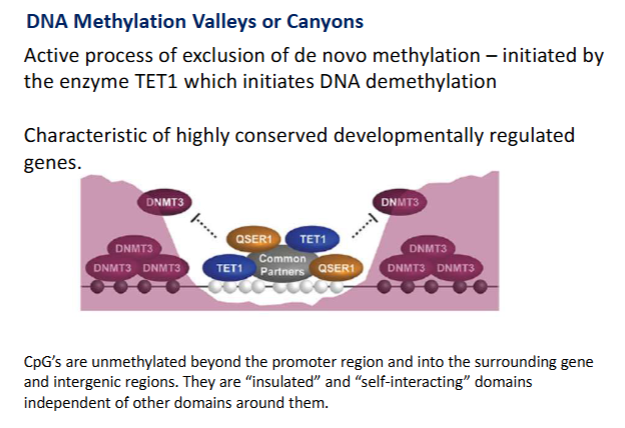
****Where are DNA Methylation valleys or canyons COMMON/characteristic of what genes?
They are Characteristic of HIGHER CONSERVED + DEVELOPMENTALLY REGULATED GENES
*****What are some ENZYMES involved in the generation + maintenance of DNA methylation valleys or canyons?
What roles do they play?
TET1 = initiates demethylation
QSER1 = safe guards the valleys from de novo methylation
What can remove the TET demethylation pathway? (unsure how important)
Removed either actively via DNA repair mechanisms or passively during DNA replication.
*****What were the 2 special cases of epigenetics talked about in class?
Imprinting
X-inactivation
**********What is genomic imprinting,
Epigenetic regulation where DNA methylation and gene expression depend on the parent of origin (mother vs. father), even though the underlying Watson-Crick DNA sequence is homologous/identical.
results in parent-specific epigenetic differentiation and monoallelic gene expression. (Only one allele (either the maternal or paternal copy) is expressed, while the other parent's copy is epigenetically silenced.)
It is cis acting and can function bidirectionally and over long distances
*****When are Genomic Imprints established?
Imprints are established during gametogenesis (egg and sperm formation) and maintained from embryogenesis into adulthood
*****What are the 2 possible scenarios of LOSS OF IMPRINTING
regardless of the scenario what is the RESULT for both situations?
Either the maternal imprint is lost and genes are expressed following the
paternal pattern of expression
Or
The paternal imprint is lost and genes are expressed following the maternal
pattern of expression
Both can result in disease depending on the function of the genes whose
expression is altered.
****Is the disease that can arise from loss of mater or paternal imprinting the SAME CONDITION?
NO
Different conditions can result from either the loss
of maternal or paternal imprinting of genes in the same chromosomal
region.

*********Explain this figure (come back to this)
A. Normal Imprinting: One maternal and one paternal chromosome with opposite methylation tags, giving one active copy of each gene.
B. Imprinted Gene Mutation (Deletion or Point Mutation): Methylation tags are normal, but the DNA sequence of the single active allele is deleted or mutated, resulting in loss of functional protein.
C. Uniparental Disomy (UPD): Both chromosomes are inherited from one parent (e.g., two maternal or two paternal). DNA sequences are normal, but one gene is overexpressed (2x) while the other is completely silenced (0x).
D. Epimutation: an abnormal methylation tag silences the normally active allele resulting in no active genes from one parent (or activates a silenced one).
*****Explain how Uniparental disomy can arise?
Trisomy rescue → cell try to save itself (as cells with 2 chr. is selected over those with 3)

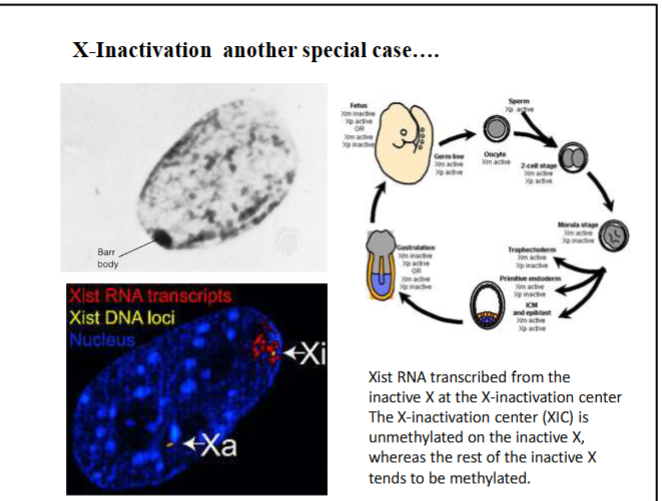
HOW is X-inactivation a special case of epigenetic regulation?
it silences an entire chromosome rather than a single gene, and it relies on random choice
*****How does X inactivation occur? What occurs on the Inactivated X for it to be inactivated?
What shuts it off? and how?
Xist RNA is transcribed from the inactive X at the XIC = > Xist RNA coats the entire Xi chromosome and recruits enzymes so the rest of Xi becomes heavily methylated and condensed.
The XIC (X inactivation center) is UNMETHYLATED on the INACTIVATED X chr.
Active X (Xa): The XIC/Xist locus is methylated (silenced), so no Xist RNA is produced and the rest of the chromosome remains active.
*******Get back to Slide 35 + 36 on the notes: I dont really get what the main focus is
*******What are the 5 assumptions as to the cause of Females with X LINKED RECESSIVE DISORDERS?
Skewed X-inactivation – normal chromosome randomly ends up being inactivated more than the chromosome carrying the abnormality- more common, often less severe phenotype than affected male
Rarely, female with two copies of an X-linked gene each having a pathogenic variant
Defect of X-inactivation causing an X-chromosome with a pathogenic variant to preferentially be left active. May not involve the entire chromosome
X-chromosome aneuploidy, 45,X or mosaic for the loss of an X chromosome – karyotyping is performed to check on this
Structural rearrangement involving the X-chromosome - karyotyping to check
******How does TRANSLOCATIONS on the X chromosome IMPACT X-inactivation?
X-inactivation adapts to protect the cell, the INACTIVATION occurs so that the result is a NORMAL AUTOSOMAL BALANCE
*******Compare the X-Inactivation that occurs in a BALANCED vs. UNBALANCED autosomal translocation onto the X chromosome
which chromosome is inactivated vs. activated
BALANCED: will chose to NON-RANDOMLY inactivate the normal X to result in an overall BALANCED AUTOSOME as we are very intolerant of autosomal imbalances
UNBALANCED: Will choose to NON-RANDOMLY inactivate the DERIVATIVE X (has the translocated autosomal portion) to result in a normal X
