Exam 1: Chemistry 102
 Call Kai
 Learn
 Practice Test
 Spaced Repetition
 Match
 Flashcards
 Knowt Play
1/67

There's no tags or description
Looks like no tags are added yet.
68 Terms
femto
e-15
f
pico
p
e-12
nano
n
e-9
micro
e-6
µ
milli
m
e-3
centi
c
e-2
deci
d
e-1
kilo
k
e3
mega
M
e6
giga
e9
G
tera
T
e12
peta
P
e15
Density unit
g/ml or g/cm3
Element
Collection of atoms (Au, Li, H)
what is a compound? what is its relationship to a molecule?
Combine two or more different elements (H2O)
every compound is a molecule
Molecule
Two or more elements (same or different) ( O2 is two O molecules)
Homogenous mixture
Composition is uniform/same throughout
ex: air, blood
Heterogeneous mixture
Composition is not uniform
ex: salad
physical change
-does not change the formula of compounds/elements
-changes physical state of matter
chemical change
Involves making/breaking chemical bonds
DALTON’S ATOMIC THEORY
Matter is composed of exceedingly small indivisible particles called atoms
An element consists of identical (one type of) atoms that have a mass that is characteristic of the element and is the same for all atoms of that element.
Atoms of one element differ in properties from atoms of all other elements.
Atoms combine in simple whole number ratios to form compounds
5. Atoms are neither created nor destroyed in a chemical reaction. They are re-arranged to yield substances that are different from those present before the reaction / change.
Chemical element
is a pure substance made of only one type of atom
Isotopes
atoms of the same element can have different numbers of neutrons
Atomic mass is the average of all the isotopes
Law of definite proportions:
a specific chemical compound always contains that exact same elements in the exact same proportions by mass no matter where it comes from or how big the sample is
Ex: CuO 1:1
law of conservation
Mass is never created or destroyed in a closed system in a chemical reaction. They are rearranged to yield substances that are different from those present before the reaction
law of multiple proportions
When the same two elements form more than one compound, the masses of one element that combine with a fixed mass of the other element are in a ratio of small whole numbers
Cathode ray experiment
Scientist: thompson
Findings:
Negative charged electron and its mass
Charge ratio
Oil drop experiment
Scientist: millikan
Findings:
Exact charge of electron
Gold foil experiment
scientist: Rutherford’s
finding:
Nucleus
protons
Radioactivity experiment
scientists:
Chadwick
Curie
Beuerel
findings:
Neutron
isotopes
Atomic mass
total mass of a single atom in relationship to hydrogen
Atomic charge
number of protons minus number of electrons
Anion
negative charge (ions)
gaining electrons
cation
positive charge (ions)
losing electrons
Mass number/atomic mass
number of protons and neutrons
Chemical formula
The representation of a molecule that uses chemical symbols to indicate the types of atoms filled by subscripts to show the number of atoms of each type in the molecule
structural formula
gives the same information as its molecular formula (the type and numbers of atoms in the molcanecule) but also shows how the atoms are connected in the molecule
Empirical formula
The most reduced or simplest ratio of elements. For example, the empirical formula of glucose (C₆H₁₂O₆) is CH₂O.
period vs group on periodic table
period: is a horizontal row on the periodic table
group: is a vertical column on the periodic table
Atomic number
number of protons
What does the wavelength measure? What is the unit?
Measure: Distance between 2 consecutive peaks or troughs
Unit: length (m)

What does the frequency measure? What is the unit?
Measures: the number of wave cycles that pass a fixed point in one second
Unit: Hertz or Sec-1

amplitude
the maximum height or displacement of a wave from its center rest position

Wave particle duality theory
the concept in quantum mechanics that light and matter exhibit both wave-like and particle-like properties depending on how they are measure

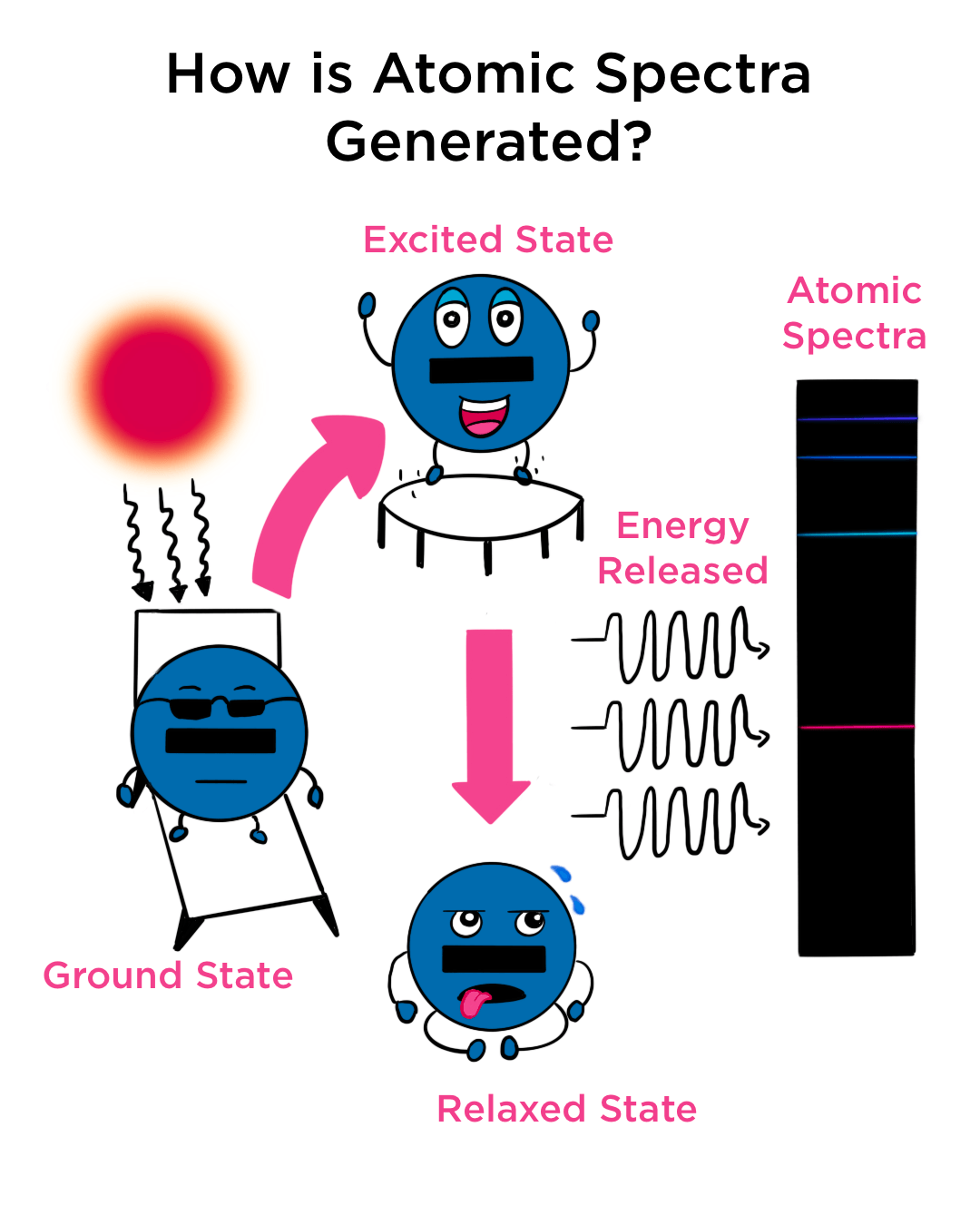
line spectra
distinct patterns of narrow, sharp lines of specific wavelengths (or frequencies) of light emitted or absorbed by atoms and molecules, serving as unique atomic fingerprints
Electron configuration? Quantum numbers? how many electrons can each sub shell hold?
the arrangement of electrons in specific atomic orbitals around the nucleus
Quantum numbers: n, l, ml no 2 electrons have the same set of quantum numbers
n: Shell number/quantum level
Cursive l: determines shape of the orbital (s,p,d)
S subshell=holds 2 electrons (L=0)
P subshell holds 6 electrons (L=1)
D subshell holds 10 electrons (L=2)
ML: determines the orientation of the orbitals (up arrows electron spin is + ½ and more down arrows electron spin is - ½)
Aufbau principle
Fill the lowest energy orbital with electrons before electrons move to a higher energy orbital
Hund's rule
Within orbitals with the same energy, electrons fill up degenerate non paired orbitals before being paired up
Periodic trend: ionization energy
What are the anomalies?
Ionization energy: energy to remove electron
ionization energy increases as you move right and up the periodic table because the atomic radius decreases as there are less energy levels and the electrons are closer to the nucleus with the increased protons so it makes it more difficult to remove an electron.
Bringing n to infinity
Anomalies: boron, oxygen, sulfur, and aluminum
Periodic trend: Electron Affinity
Electron affinity: energy available to add electron
Increases as you move right and up the periodic table because the atomic radius decreases as there are less energy levels and the electrons are closer to the nucleus with the increased protons so it makes it more difficult to add an electron
Periodic trend: Atomic radius
Atomic radius:
Higher atomic radius as you move left and down periodic table because as you move down there are more energy levels and as you move left there are less protons which means there is less of a pull of the electrons to the nucleus
Isometric series
Having the same electron configuration
ex: P3-,S2-,Cl-,Ar,K+,Ca2+ all have 1s2 2s2 2p6 3s2 3p6
Wavelength, frequency and energy relationships
Frequency and energy: Directly related (if one is high so is the other)
Energy and wavelength: Inversely related (if one is high the other is low)
Wavelength and frequency: Inverse relationship (if one is high the other is low)
Higher frequency=lower wavelength=higher energy
Lower frequency=high wavelength=lower energy
Excitation of an electron
moves from lower energy level (closer to nucleus) to higher energy level (further from the nucleus)
An Absortion of energy
Relaxation of electron
moves from higher energy level to lower energy level
Energy is Released
Color light spectrum? What has the highest energy vs lowest? What are the colors visible in between?
visible in between ultraviolet and infarred
Highest energy is violet
lowest energy is red

electromagnetic spectrum

Ionic bonds
The unequal sharing of electrons between atoms resulting in a polar charge (electronegativity between two elements is >1.8)
Covalent Bonds (2 types)
The equal sharing of electrons between non metal and non metal
Pure (non polar) bonds: the two molecules have relatively the same electronegativity (below .4) usually same elements (O2, H2)
Polar covalent bonds: the two molecules have an unequal sharing of the electrons despite the promise to equally share. (Electronegativity is between .4 and 1.8)
Naming Binary Ionic compounds ( 2 types)
Type 1: end in “-ide”
Use this type when the 2 molecules being named have set charges and are not transition metals (ex: Na, Cl, Br)
Example naming: sodium bromide, magnesium chloride
Type 2: end in “-ide”but also include the Roman numerical of the charge for the transition or non regularly charged metal
Use this when there is an element with a changing charge (ex: Fe, Pb, Sn)
Example naming: Iron (III) chloride, Iron (II) chloride, Lead (II) Oxide
Naming binary covalent compounds (3 types)
Covalent bonds that are not acids: end in “-ide”, but also have the prefix for number of the element in front of element name “mono-, di-, tri-“
Example: Carbon monoxide, Dinotrogen trioxide
Covalent bonds that are acids WITHOUT an oxygen:
Begin with “Hydro-“ end in “-ic” and include acid
Example naming: HCL “Hydrochloric acid”
Covalent bonds WITH oxygen:
If the anion ends with “-ate”, then name it ending in “-ic”
Example naming: HNO3 Nitric acid (anion name is Nitrate), H3SO4 Sulfuric acid (anion name is sulfate)
If the anion ends with “-ite”, then name is ending in “-ous”
Example naming: HNO2 Nitrous acid, H2SO3 Sulfurous acid
fahrenheit to celsius
(F-32)x(5/9)
Formal charge equation? What makes a molecule more clean?
Equation: Formal charge= Valence electrons — (number of Bonds + number of dots)
*The molecules with the most 0 for their formal charge is the most clean*
How to find overall charge?
The sum of all the formal charges should equal to the overall charge
How many bonds does C, N, O, and F like to form?
C: 4
N: 3
O: 2
F: 1
Electron configuration exceptions (4)
Electron deficient molecules (Fewer than 8 electrons):
B and Be can have fewer than 8 electrons (6 electrons) when bonded to H or F
Can NOT exceed 8 electrons:
C,N,O,F
Hypervalent molecules (Exceed 8 electrons):
Possible for elements 3rd period and below to have up to 18e- due to the D
Odd number of electrons:
Give the more electrons to the more electronegative element
Vespr chart

Pauli exclusion principal
No two electrons in the same atom can share the exact same set of quantum numbers
an atomic orbital can hold maximum 2 electrons
when two electrons share an orbital they must have opposite spins