Econ for public policy week 3
 Call Kai
 Learn
 Practice Test
 Spaced Repetition
 Match
 Flashcards
 Knowt Play
1/8

There's no tags or description
Looks like no tags are added yet.
9 Terms
Implications of lower earnings by females
gender inequalities also reduce social efficiency and hence social welfare
womens talents are not mobilised for economics production in the market sector to the same degree as men’s
They work less and make less investments that are productive in work in expectation of lower future return
care work taht women do is largely unpaid, so not accounted for in GDP e.g a parent looking after their own child does not add to GDP while a parent that pays someone else to do that is measure in GDP
What policies could potentiall reduce gender inequalities?
regulation- such as discrimination rules and parental leave rules
subsidies to cost and provision of children- weve seen that gender pay gap increases markedly after childbirth
changes in social norms around home production childcare and housework.
How much redistribution does policy do in the UK- social security
Social security is spending that provided mainly cash benefits to help the poorest and most vulnerable in society, most social security is means tested
types of social security in the UK:
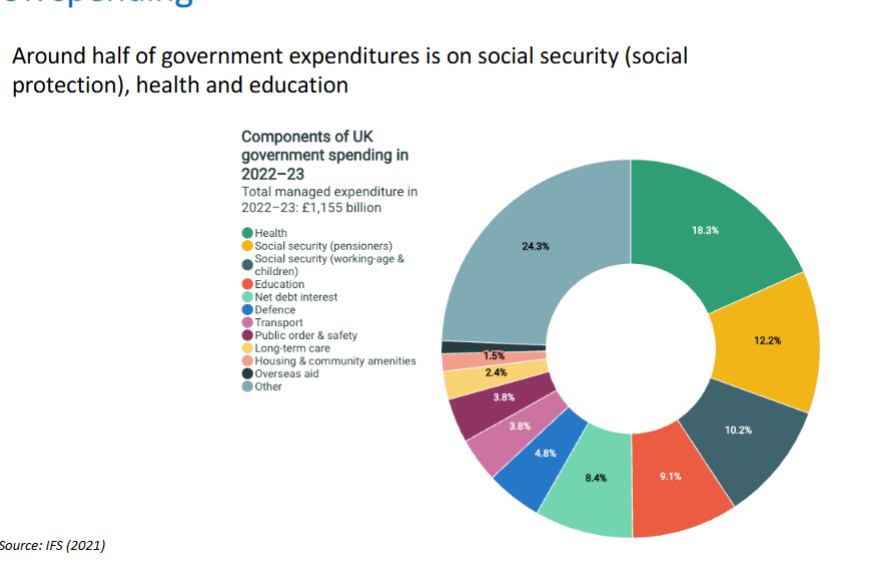
social security (pensioners) 12.2% spending e.g state pension, system is changing now mainly based on past work history, now has more of a means-tested component
social security (working-age and children)- 10.2% spending - includes benefits for families with children, benefits for unemployed people, benefits for people on low incomes, benefits for sick and disabled people.
How much does existing policy redistribute?
A policy is progressive if:
Higher income households pay proportionally more (or benefit less) than lower income households: this redistributes resources and might reduce poverty and does reduce income inequality
A policy is regressive if:
lower income households, pay proportionally more more (or benefit less) than higher income households
this redistributes resources and does not decrease relative poverty and increases income inequality.
What type of policies are progressive
tax: income tax, VAT and other sales taxes, property and wealth taxes
Benefits: means-tested cash benefits, universal cash benefits, tax credits
spending: healthcare, education, state pension
regulation: minimum wages, rent controls, price caps on essentials
two types of taxes
taxes on income (direct taxes): account for the largest part of government tax revenue (57%)
taxes on goods and services (indirect taxes): VAT, duties on alcohol, tobacco, fuel
various other
27% of tax revenue
types of benefits
means-tested benefits: available to households on low income, when their income rises the value of the benefits decline e.g. unemployment benefits, income support and housing benefit
means tested and targeted at specific groups: child tax credit, disability living allowance, state pension
universal benefits: available to everyone regardless of income, no cash benefits in the UK are universal although child benefit and disability benefit (available up to a high level of income), spending such as healthcare and education are universal.
pros and cons of means tested versus universal benefits
means-tested benefits pros:
good at targeting low-income households
means-tested benefits cons:
provide disincentive to work (moral hazard problem)
might stigmatise recipients
sometimes people dont take up means-tested benefits
universal benefits pros:
they dont have the problem of stigmatising recipients
take up tends to be higher
universal benefits cons:
not well targeted at low income households
usually very expensive and have high deadweight costs
expalin how taxes and benefits are redistributive
they reduce the income of high earners and increase the income of low earners
peopled and households earn less at some points in time and more at other times
they also use public services more at some times (education when young, healthcare when old) thus a large part of the effect of taxes and benefits is to redistribute across a persons lifetime
this helps people to smooth consumption over their life time