Biology - D2.1 Cell and nuclear division
 Call Kai
 Learn
Learn Practice Test
 Spaced Repetition
 Match
Match Flashcards
 Knowt Play
1/68

There's no tags or description
Looks like no tags are added yet.
Name | Mastery | Learn | Test | Matching | Spaced | Call with Kai | Chat |
|---|
No analytics yet
Send a link to your students to track their progress
69 Terms
Purpose of cell division
To grow, replace and asexually reproduce cells
Definition
Splitting of cytoplasm in a parent cell between daughter cells
How does cytokinesis occur in animal cells?
1) Ring of conctractile proteins (myosin and actin) form just inside the plasma membrane
2) Pulls the plasma membrane inwards at the equator by contracting and pinching inwards
3) Cleavage furrow is created
4) Cleavage furrow reaches the center and splits, so the cells are pulled apart

Cytokinesis in plant cells
Plants have cells walls so its more difficult
1) Vesiscles move towards the equator and fuse, forming 2 new plasma membranes = cell plate
2) other vesicle fuse releasing pectin through exocytosis which then makes up the middle lamella
3) 3rd set of vesicles releases cellulase making a cell wall

Why and when is cytokinesis equal?
To survive and grow, both daughter cells need a nucleus and at least 1 complex organelle not made by components of the cell (e.g. chloroplasts or mitochondria)
Equal cytokinesis is during most cell divisions
Examples of unequal cytokinesis
Budding in yeast
Oogenesis in humans (production of eggs), bc when one is too small (the polar body) to survive it dies, leaving only one egg, which is what you want
How does unequal cytokinesis occur?
A smaller cell buds off from the other cell, hence unequal
½ DNA into one cell and ½ DNA into the other
Sometimes smaller one dies

What is the middle lamella
It is the area that forms when the second set of vesicle fuses at the cell plate releasing proteins in a plant cell during cytokinesis
What is the cell plate
It is the two new plasma membranes that form (temporarily) because the first set of vesicles has fused at the equator
Role of mitosis and meiosis in eukaryotes
They are methods of nuclear division
It is necessary to divide nucleus before cell division to avoid anucleate cells
Differences between mitosis and meiosis
Mitosis: maintains chromosome number and genome of cells, for growth, repair and asexual reproduction, 2 daughter cells
Meiosis: halves the chromosome number and generates genetic diversity, production of gametes
How many chromosomes normally
23 types of chromosomes, and 2 of each type for diploid cells
(y&x is male, x&x is female)

Definition homologous chromosomes
Same type of chromosomes with the same length and code for the same genes
Importance of DNA replication
DNA replication is a prerequisite for both mitosis and meiosis
Double the DNA, but still 2 homologous chromosomes bc still just 2 types
Copy and original are identical
Sister chromatids held together until anaphase

Condensation of chromosomes
Chromosomes condense to become visible, avoid breakages and tangling up
Includes histones to supercoil
Occurs before both mitosis and meiosis
Cohesin role with sister chromatids
Sister chromatids are held together by loops of a protein complex called cohesin (cohesin loops)
Occurs in both mitosis and meiosis

How do the chromosomes move during anaphase?
Chromatids are separated and move towards poles
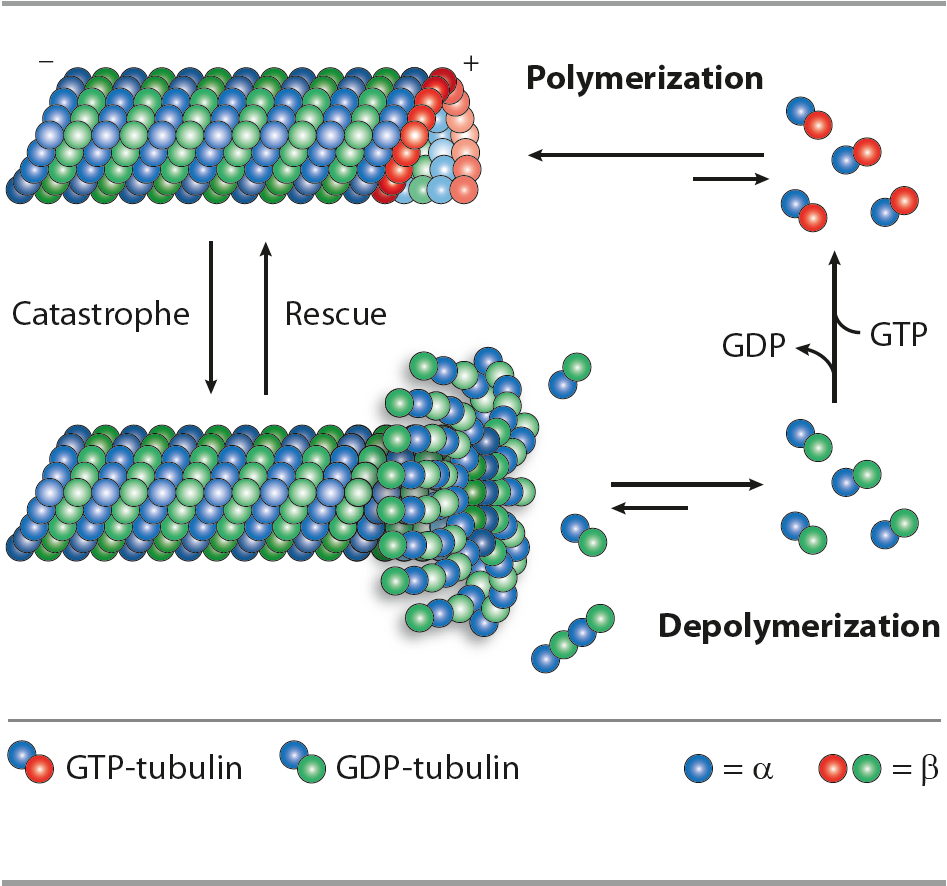
Microtubules are hollow cylinders made with proteins called tubulin
Microtubules are attached to both the kinetochore and the poles of the cell at the microtubule organizing center
Tubulin is removed from microtubules through depolymerisation, shrinking the microtubule
The microtubule stays attached to both sides but gets shorts so pulls chromatid towards poles

Definition kinetochore
The middle of the chromosome, where the microtubules attach
Explanation microtubules
Microtubules are made of many tubulins and break down (shrink, depolymerisation) or grow (polymerisation) and attach to kinetochore
What are the phases of mitosis?
Prophase, metaphase, anaphase and telophase
With interphase beforehand (although it is not a part of mitosis nuclear division)
What happens during prophase in mitosis?
Supercoiling, condensation of chromosomes
Microtubules start to grow from microtubule organisation centres at poles of cell
Nucleolus breaks down
Nuclear membrane breaks down

What happens during interphase?
DNA replication to form sister chromatids
Chromosomes are still long and thin

What happens during metaphase in mitosis?
Microtubules from the poles attach to the kinetochore
Chromosomes, consisting of sister chromatids are aligned at the equator

Anaphase mitosis
Cohesin loops holding the sister chromatids together are cut
Sister chromatids seperate
Kinetochore shortens the microtubules by removing tubulin, pulling the sister chromatids/chromosomes to opposite poles

Telophase mitosis
Chromosomes reach poles in a tight group around MTOCs
Nuclear envelope forms
Chromosomes decondense
Nucleolus reforms
Cytokinesis usually happens at the end of this phase

Why is meiosis necessary?
Enables variation as a result of sexual reproduction, conserves number of chromosomes particular to that species by making haploid gametes
What is reduction division?
Number of chromosomes are halved when making new cells, e.g. meiosis
Haploid and diploid definitions
Haploid: one of each type of chromosomes (so only the 23, and one of each)
Diploid: two of each type of chromosomes (so 46 chromosomes, 23 pairs)
What is the process of meiosis?
Prophase 1, metaphase 1, anaphase 1, telophase 1
Everything again in meiosis II which is similar to mitosis (prophase II, metaphase II, anaphase II and telophase II)
Prophase I, meiosis
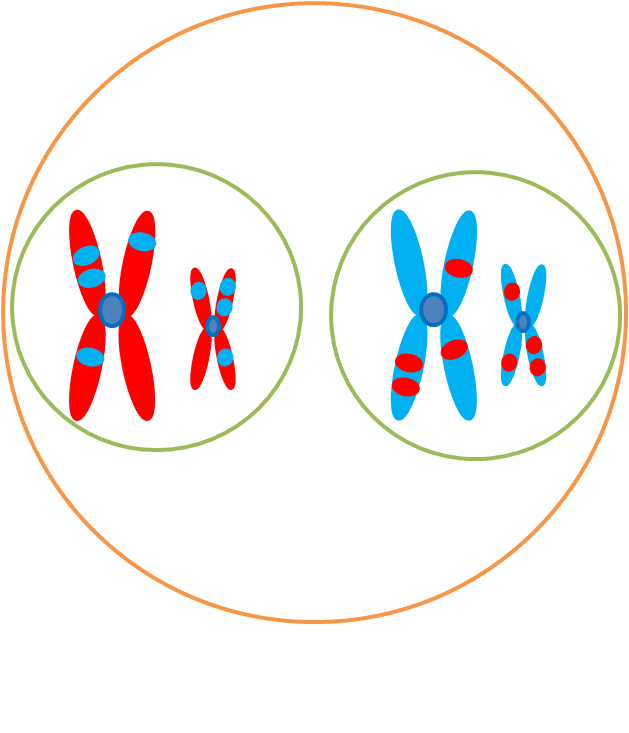
Homologous chromosomes pair up in synapsis = bivalent or tetrad formation
Crossing over occurs between homologous pairs
Spindles start to form
Nucleolus and nuclear envelope break down

Metaphase I, meiosis
Bivalents line up a the equator and attach to the spindle microtubules
Can align in 2^(number of pairs) ways by switching sides

Anaphase I, meiosis
Kinetochores shorten the microtubules by removing tubulin, pulling the pairs towards poles

Telophase 1, meiosis
Homologous chromosomes reach opposite poles
Nuclear envelope and nucleolus reform
Chromosomes decondense
Cytokinesis (after)
Cells are now haploid with one of each type per cell
What happens in meiosis II?
Same stages and steps as mitosis
Sister chromatids are a when cohesin loops are cut
Cells remain haploid
How many cells are there after one meiosis division cycle?
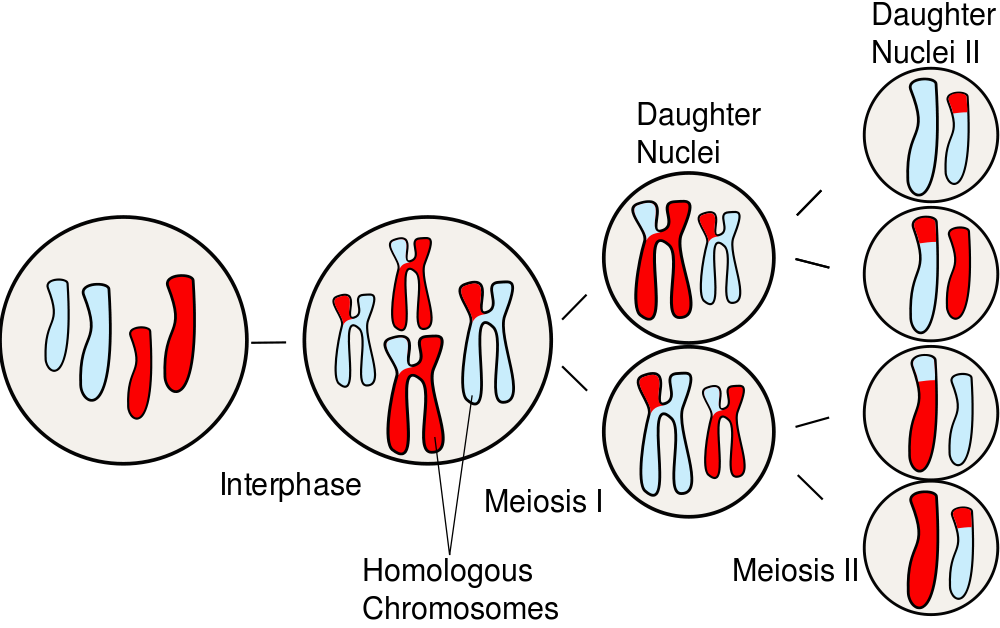
From 1 parent cell there are 4 daughter cells
What is the bivalent or tetrad formation?
After interphase or DNA replication, the homologous pairs of chromosomes are bonded together for meiosis 1

What are the ways in which meiosis causes genetic variation, and why?
Crossing over during prophase 1 and random orientation during metaphase 1
Genetic variation is crucial for natural selection and evolution
How does crossing over occur?
When the homologous chromosomes have come together through synapsis to form a tetrad or a bivalent, crossing over can take place
Parts of a chromatid move and wind around the equivalent parts of non-sister chromatid
DNA at these locations break off and reattach to the different chromatids
The locations are called chiasmata
The new combinations, if they are different to either parent are called recombinants

What are chiasmata?
The points at which the bivalents are held together and the point at which the genetic material is exchanged

What are recombinants?
When crossing over has occurred and new combinations, combinations that are different than that of the parents, are created
Random orientation for genetic variation during meiosis
During metaphase 1 the homologous pairs line up, but can face either direction and the chance is random
Assorted independently as the orientation of one homologous pair doesn’t affect that of the other one
Is 2^(number of pairs) possibilities, 2²³ = 8 million

Definition non-disjunction
If the chromosomes don’t separate correctly during anaphase I or anaphase II, and gametes receive one extra or one too few chromosomes

Consequences of non-disjunction
Leads to chromosomal abnormalities, most common being down syndrome with an extra 21st chromosome
There are other conditions, but most lead to the death of the haploid cell
Definition cell proliferation
Rapid increase in the number of cells, with mitosis
Where the number of new cells is greater than the number of cells dying
Uses of cell proliferation
For growth, cell replacement or tissue repair
Growth and cell proliferation examples
Embryo has a lot of cell proliferation to grow
Juvenile animals/children have growth at bone growth plates
In plants only the meristem regions grow
Shoot apical meristem which is at the leaves and buds
Root apical meristem, at the roots
Lateral meristem for increase in diameter

Examples of cell replacement cell proliferation
On the skin there are dead cells that are lost (at the epidermis, bc cells produce keratin so cells dry out and reach surface)
At dermis the new cells are produced, and rate is high
Whole skin is not cell proliferation bc new cells is not greater than number of cells dying

Example of tissue repair through cell proliferation
Skin is good at tissue repair and wound healing bc of cell proliferation
Cell cycle function
Cell proliferation is achieved through the use of the cell cycle
3 general phases of cell cycle
Interphase wich is a metabolically active phase, mitosis to split the nucleus and then cytokinesis to split the cytoplasm

Phases within interphase
Gap1 (G1) phase, Synthesis (S) phase, Gap2 (G2) phase

What happens during G1 phase
Cell growth through protein synthesis, number of organelles increases, and there is the production of cell components
Can be a very long period
What happens during S phase
DNA replication and synthesis to prepare for another division
g2 phase
Checking chromosomes for errors and fixing those mistakes
Making sure there are enough mitochondria and chloroplasts
Might start the condensation of DNA
What is the G0 phase?
G0 is after cytokinesis, the cell cycle can stop
The cell stops dividing and differentiates and becomes specialised by turning genes on and off

How is the cell cycle controlled?
Through the use of cyclins, which are dif proteins that when the threshold level is reached move to that stage

What are cyclins
Proteins used to go from phase to phase of the cell cycle, have threshold levels
What kind of genes also control cell division and the cell cycle?
Proto-oncogenes and Tumour-suppressor genes
What does a mutation in proto-oncogenes cause?
Causes it to mutate into oncogenes who don’t control the cell cycle but promote cell proliferation
like just pressing the gas pedal, flooring it
What do mutations in tumour-suppressor genes cause?
The checks that tumour-suppressor genes exercise on DNA to correct faulty DNA no longer occurs
No brakes, no checks to make sure its ok and no taking it slow
Definition tumour
The accumulation of an abnormal mass of cells as the consequence of uncontrolled cell division
Different kinds of tumours
Benign tumours and malignant tumours (primary and secondary)
Benign tumours definition and behavior
The growth of abnormal cells that are not cancerous
The cells grow closely and don’t spread to other parts of the body therefore don’t cause harm unless are pressing into neighbouring organs
In rare cases large benign tumours can turn into malignant tumours if very large
Malignant tumours def and behaviour
Cells that divide and grow more rapidly than benign tumours, cancerous
Don’t have well-defined borders
More likely caused by cells with hormonal stimulation to divide cells (e.g. breasts, ovaries, tested)
Definition metastasis
The process of the spread of malignant tumours to other parts of the body through the bloodstream and or the lymphatic system
Primary tumours
Primary tumours are original malignant tumours before metastasis
Secondary tumours
Malignant tumours after spreading throughout the whole body through a process called metastasis
More difficult to reach and more widespread, so a more advanced stage
How to calculate mitotic index
Number of cells in mitosis / number of cells in picture

Use of mitotic index
The ratio of cells undergoing mitosis to the total number of cells in that tissue can be a measure of cell division and can be prognostic tool for predicting response to chemotherapy