Cognition and Perception
 Call Kai
 Learn
 Practice Test
 Spaced Repetition
 Match
 Flashcards
 Knowt Play
1/260

There's no tags or description
Looks like no tags are added yet.
261 Terms
main points of behaviorism
observable behaviors are the primary means of understanding the mind
behavior is learned through interaction with the environment
functionalism: what purpose is served by this behavior? how is the organism rewarded so that this behavior arises?
black box
important names in behaviorism
John B. Watson
B.F. Skinner
Edward Thorndike
primary learning mechanisms in behaviorism
classical and operant conditioning
black box
metaphor in behaviorism
stimuli enters → [ what happens inside here is uninteresting for psychologists ] → response
the cognitive revolution
increasing interest in studies of mental processes and states (i.e. what’s going on in the black box) in the 1950s and -60s
mind as a computer metaphor
(not exactly a revolution though since behaviorism wasn’t as dominant as one might think and has not been replaced, and there were plenty of cognitive research before the -50s)
key developments of the cognitive revolution
Noam Chomsky’s critique of behaviorist theories of language acquisition
George Miller’s research on working memory and information processing
Newell and Simon’s work on problem-solving and artificial intelligence
the mind as a computer metaphor
the mind is seen as an information processing model with mental processes viewed as a series of computations
key concepts:
input = sensory information from the environment
processing = mental operations performed on input
output = behavioral responses based on processed information
memory = storage and retrieval of information
implications of the cognitive revolution
shift from functional to mechanistic explanations
new methods to study mental processes (e.g. reaction time, eye-tracking, neuroimaging)
development of new theories such as schema theory, cognitive dissonance, dual-process theories
interdisciplinary applications of the cognitive revolution
artificial intelligence and cognitive computing
cognitive neuroscience and the study of brain-behavior relationships
cognitive therapy and interventions for mental health
definition of cognition
processes involved in acquiring, processing, and understanding knowledge and information (information is a common theme among all cognitive perspectives)
different cognitive processes
memory = storing and recalling information
attention = selectively focusing on specific stimuli
problem solving = identifying solutions to complex situations
decision making = evaluating alternatives and selecting the best course of action
decision making under risk = when the safety is uncertain and we need to consider if the decision is coherent with our interests and goals
language processing = comprehending and producing spoken and written language
definition of perception
the process through which our sensory systems gather and interpret information from the environment
visual, auditory, olfactory, gustatory, tactile
visual perception
interpreting light signals received by the eyes to create a visual experience
auditory perception
processing sound waves captured by the ears
olfactory perception
recognizing and distinguishing odors through the nose
gustatory perception
ability to perceive taste sensations through the tongue
tactile perception
interpreting physical contact on the skin to identity texture, temperature, shape, and hardness of objects
attention
hard to define, but basically selective choice of allocation of cognitive resources to an object or a task
basic capacity that is necessary for many cognitive processes
bridges cognition and perception. subject of a lot of the early research on cognition
research indicate that it is shaped by active inferences (top down), affected by correlated attributes (bottom up), processed in parallel, and subject to late selection
the stroop test
behavioral measure of cognitive processes that exemplifies interference in attention – one dimension of a stimulus competes with another simultaneously displayed dimension
actualizes questions about how perceptual information is processes
example: identify and tell the color of the letters in a color word (e.g. identify that the word RED is written in blue letters)
inattentional blindness
we do not consciously perceive everything we see (e.g. seeing but not perceiving the gorilla in the basketball video) – a demonstration of that perception doesn’t only take place in the sensory organs
actualizes questions of early vs. late selection (when does the gorilla disappear?)
focusing on one part of an event will make us “miss” other
important questions in attentional research
sequential vs. parallel processing
temporal gaps and neurological activation indicate that color and text are processed in parallel
crosstalk between the processes (not sure what this means?)
early vs. late selection (nowadays more support for late)
studies on for example priming indicate that unattended stimuli are still processed
identifying the gorilla faster if asked to identify animals on different pictures after watching the gorilla video although we did not notice the gorilla in the video (kinda, not real experiment)
less suport for wheter the primed stimuli actually influences our behavior
top down vs. bottom up
research indicate that attention is shaped by active inferences
correlated physical properties facilitates grouping of stimuli
attention directed by goals (who I want to listen to?) vs. types of stimuli (e.g. dropping a phone calls for more attention than dropping an eraser)
relationship between attention and consciousness
the mind is clearly processing information outside of our awareness (perception) – compare with reflexes and automated behavior)
debatable what this tells us about the role of the unconscious (maybe Freud actually had a point?…)
some argue that attention and consciousness are entirely separate processes. a bit contraintuitive though since it’s hard to distinguish between attention and consciousness on the daily (we can choose where to direct our attention, e.g. basketball instead of gorilla)
the 2×2 matrix of attention and consciousness
framework designed to prove that top-down selective attention and conscious awareness are distinct processes rather than the same phenomenon

definition of judgment
the mental process of forming opinions or evaluations
definition of decision making
the process of choosing between multiple alternatives, often based on judgment
knightian risk/uncertainty dichotomy
distinction of risk and uncertainty as different “scenarios”
risk = probabilities and outcomes are known, e.g. gambling since we can make mathematical predictions
uncertainty = probabilities and outcomes are NOT known
what is risk/uncertainty is often dependent on your knowledge
critisized for forcing binary: it’s never solely one or the other (?)
judgment and decision making under risk and uncertainty
the world is inherently uncertain – making judgment and decisions in an uncertain world is difficult – most of our choices can be viewed as a gamble with uncertain outcomes
the lottery paradigm
experimental method of studying judgment and decision making under risk and uncertainty
example: a lottery guaranteed to win 500 € and a lottery with 50/50 chance of winning 1000 € or nothing have the same mathematical value, yet people act differently
the st. petersburg paradox
illustrates by flipping a coin as many times as is necessary to produce heads for the first time. the payout is 2^n (numbers of flips it takes to get heads).
the game has infinite value – in theory you could flip tails infinitely – but yet people are only willing to pay small amounts to enter = a paradox that maximized expected value can’t explain
old expected utility theory
logarithmic model with a concave utility function – U(x) = ln(x) – for choosing between uncertain alternatives by calculating the probability-weighted average of your subjective satisfaction
implies that infinate value ≠ infinate utility
diminishing marginal utility = each extra item (material and non-material) you use or consume gives you less satisfaction than the one before
limitations of old expected utility theory
no principled way to measure utility – utility is an abstract construct without a unit
unclear WHY it would be rational to behave that way
newer expected utility theory
suggested solution based on revealed preferences
based on four axioms: completeness, transitivity, continuity, independence.
when the axioms are followed, it is possible to define a utility function, utility is maximised, and the behavior is rational (debatable?)
it was soon discovered however, that people´s choices systematically (i.e. in an predictable way) violate all of the axioms…
completeness in expected utility theory
axiom 1
for any choice between A and B, three scenarios are possible:
either A is preferred over B (pears are tastier than apples)
or B is preferred over A (apples are tastier than pears)
or both are seen as equally attractive (pears and apples are equally tasty or euw)
basically: you need to have an opinion, but the opinion can be not having an opinion
transitivity in expected utility theory
axiom 2
if A is preferred over B (pears are tastier than apples)
and B is preferred over C (apples are tastier than oranges)
then A needs to be preferred over C (pears are tastier than oranges)
continuity in expected utility theory
axiom 3
if receiving A is preferred over receiving B (I would rather have a pear than an apple)
and if receiving B is preferred over receiving C (I would rather have an apple than an orange)
there exists some probability that gambling with A and C is equally attractive as certainly receiving B (gambling about receiving either a pear or an orange is just as reasonable as receiving an apple without gambling)
independence in expected utility theory
axiom 4
if A is preferred over B (I prefer 30 % chance of receiving a pear to 40 % chance of receiving an apple)
A and C must be preferred over B and C (I must also prefer 30 % chance of receiving a pear and 50 % chance of receiving an orange to 40 % chance of receiving an apple and 50 % chance of receiving an orange)
the certainty effect
contradicts the idea of a stable utility function
the choices between
80 % chance 4000 € (A) and guaranteed 3000 € (B)
20 % chance of 4000 € (A) and 25 % chance of 3000 € (B)
should be the the same, but they aren’t
in 1, 20 % chose A and 50 % B
in 2, 65 % chose A and 35 % chose B
Conclusion: we have a preference for certain outcomes!
cumulative prospect theory
adds weighting functions to outcomes and probabilities
implies two step decision making: (1) editing (so it makes sense to us) and (2) evaluation

implications for cumulative prospect theory
reference dependence: the utility of money will probably be very different for a millionaire compared to a student
loss aversion: losing 100 € makes us more sad than winning 100 € makes us happy
diminishing sensitivity: we are mor sensitive to changes near our reference point
the Linda problem
conjunction fallacy where we make statistically impossible predictions
we have a tendency to think that her being a bank teller and a feminist is more likely than her being a bank teller
can be explained by the representativeness heuristic (if you believe in that label…): we substitute likelihood with representativeness
heuristic
mental shortcut
generally works by ignoring some information or substituting a difficult question with an easier one
bias
a systematic pattern of thought or behavior inconsistent with available information and logic
often a consequence of heuristics
dual process theories
multiple different theories based on a framework of two modes of thinking: intuitive and analytic
critisised for being reductive (are there really just two systems?), using circular reasoning (are the theories really falsifyable?), and not explaining the overlap between the modes
system 1
the intuitive mode in dual process theories
fast, automatic, and often biased. associated with bias and heuristics.
system 2
the analytic mode of dual process theories
slow, deliberate (has to be manually “turned on”), often unbiased
bounded rationality
emphasizes the limitations of the mind and its interplay with the environment (we act as well as we can in the environment we’re in)
classical rationality
rationality based on adherence to logical rules
e.g. expected value, expected utility, cumulative prospect theory
the adaptive toolbox
emphsizes recological rationality (i.e. real world context), where the probabilities are unknown, we have limited time and cognitive resources, and no need to maximize utility
kinda implies that other theories (expected value, utility, …) are useless since their mathematical functions don’t exist in our minds.
proposes that we adaptively choose from a toolbox of heuristics, by prioritizing one attribute (taking the best), ranking after importance, or go by recommendation. this is useful since it allows us to make decisions without having to bother functions we don’t even have.
implications for the adaptive toolbox
less is more effects (overfit): sometimes less effort is better in the long run
accuracy before coherence
mismatch between experiments and the real world
base rate neglect
reasoning fallacy in which we underweigh or ignore general statistical facts/relevant background information (the base rate) and overweigh diagnostic information, when judging a specific case
example: screening positive for a rare disease makes you convinced that you’re sick (my fever could be caused by the ebola virus), although the majority of people who test positive doesn’t actually have it (ebola virus is very rare)
artifact of mismatched information formats. when the problem is translated into natural frequencies, the neglect largely vanishes
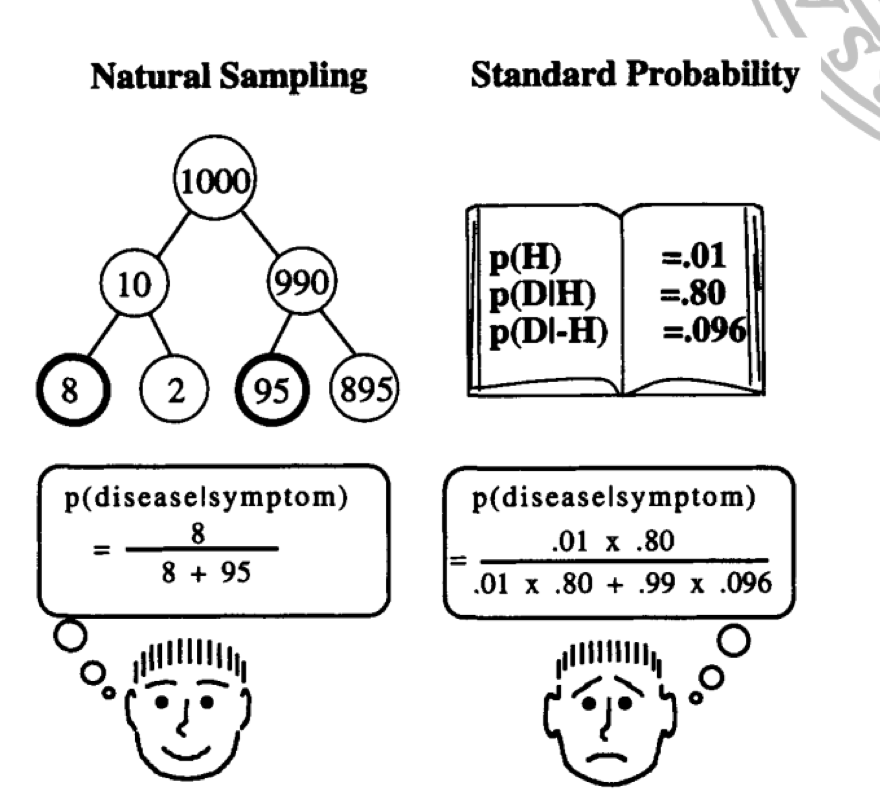
bayes theorem
a mathematical equation describing how to update an existing probability based on new information
it seems like we make such inferences in many situations
issues with the idea of the bayesian brain
people are often not bayesian in probabilistic judgment
bayesian inference is often mathematically intractable, i.e. you can’t actually calculate it
bayesian brain hypothesis
idea of the central nervous system functioning as a statistical inference engine that combines prior expectations with noisy sensory data to perceive the world and guide action
because exact bayesian calculations are computationally intractable for biological tissue, the brain relies on diverse approximation schemes to make probabilistic computation fast and metabolically viable. we might approximate bayesian inference through e.g. sampling. not explicitly but on neural level by using our memory
probabilty matching
evidence for how the brain implement bayesian approximations
people tend to choose options in proportions to the probability of reward, not to maximize. this makes little sense unless we assume that we draw small samples for making decisions
the bayesian brain hypothesis explains this by suggesting that the brain saves energy by drawing a small number of random samples from its internal probability model rather than calculating the absolute mathematical maximum
a truly bayesian brain assumes a dynamic world. by occasionally choosing the lower-probability option, the brain actively explores the environment to gather new data and update its beliefs, preventing it from missing a shift where the worse option suddenly becomes the better one
definition of social cognition
the manner in which we interpret, analyse, and remember information about the social world
“real world” cognition – a lot of cognition is social!
combination of cognitive and social psychology, for example memory and learning, categorizations, social motivations, and groups
also includes some non-social research that has been popular in social psychology but not taken seriously in cognitive psychology, e.g. unconscious decision making and goals
definition of cognitive psychology
older: all processes by which the sensory input is transformed, reduced, elaborated, stored, recovered, used
newer: study of higher mental processes such as attention, language use, memory, perception, problem solving, thinking
definition of social psychology
how the thoughts, feelings, and behaviors of individuals are influenced by the actual, imagined, or implied presence of others
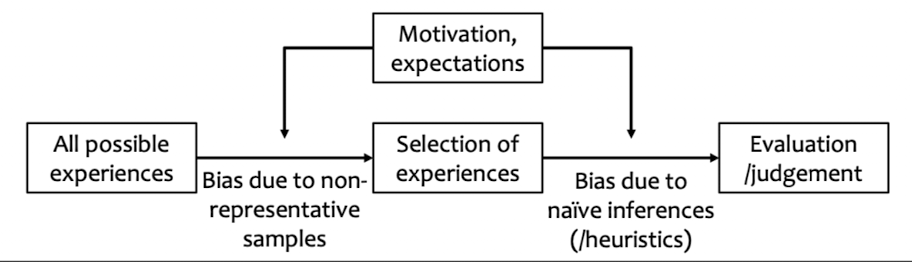
biases in motivated cognition
biases in learning and memory that appear because we prefer input that matches our prior beliefs, i.e. we believe what suits us
our evaluations/judgments are driven by our motivations and expectations, which are bias due to self-interest, competition, self-esteem etc.

learning and memory bias due to non-representative samples and naive inferences/heuristics
our judgments/evaluations aren’t based on all possible experiences, only a selection (kinda like sampling but with experiences instead of research subjects) of them. although this selection of experiences won’t be representable, we are unaware of how our samples are scewed.
basically: we tend to act like our samples are representative, even though we don’t know if that’s the case (it’s probably not)

social framing
depending on how you present (“mathematically” equal) data, people will act/think differently
example: presenting the same overall message about climate change in different wording (temperature going up vs. changing; global warming vs. climate change) might reason better with people “in denial”
social framing + social motivations
just presenting facts probably won’t help convincing “uninterested” people, but if you frame the initial message of the facts with something else you might be able to reason better with them
example: people who think climate change is a hoax won’t be convinced by your data, but if you frame it with the negative consequences for the economy they might find understand the importance
uncertainty about whether or not this is the case!
genuinly stochastic
something that is pure chance, no matter how we build our model
socially motivated biases
people arrive at different conclusions depending on social group
not driven by data. the conclusions differ because of motivation (what matters to us/to our group)
could be caused by cognitive dissonance: it is uncomfortable with new information that contradict how you see yourself
could also be caused by biased assimilation: when presented with mixed evidence, we accept what supports our group’s stance and are critical against opposing data
example: people with different political views arrive at fundamentally different conclusions about climate change from observing the same data/being served with the exact same information
information biases
we are usually exposed to a mere fraction of all available data, often depending on our group affiliations. groups will therefore receive different samples, sometimes heavily skewed in opposite directions
example: people consuming news about the same political debate from different channels will be presented with different samples, possibly receiving opposite information about who “won” the debate
motivated information biases
many samples of information reflect motivated choices, meaning our motivation leads to be presented with information consistent with those views
example: we tend to choose the news channel associated with our political views, and are thereby receiving skewed information
group-motivated sampling
what kind of information we choose depends on our group affiliations, although the groups are assigned randomly
we tend to believe our own group is more honest
innocent bystander effect
a witness identifying another (innocent) witness as the perpetrator
lineup demand
when witnesses are expected to point someone out in a lineup, they tend to do so even if they don’t know
telling the witness that no one in the lineup has to be pointed out helps with this
weapon-focus effect
when weapons are involved in a crime scene, eyewitnesses tend to more or less fixate on the weapon which decreases their capabilities of identifying the perpetrators
disrupters of eyewitness testimonies
leading questions
attentional focus/inattentional blindness
confidence vs. accuracy
innocent bystander effect
lineup demand
weapon-focus effect
confirmation bias
the misinformation effect
recovered memories
recollection of traumatic events that the person was unaware of until they suddenly surfaced later in life
an extremely controversial topic, where the general consensus is that it’s highly questionable
example cases: the satanic panic, Sture Bergwall/Tomas Quick
issues with recovered memories (in legal systems)
it is possible to forget and then remember with the help of cues, but we are less likely to forget traumatic events than other events
episodic memory is vulnerable to inference and subject to change over time
it is possible to create false memories, intentionally and unintentionally – usually no way to prove whether a memory is retrieved or falsely created
only concrete (forensic) evidence can determine the veracity of a memory
the satanic panic
“moral panic” in the U.S. with widespread allegations of satanic ritual child abuse, initiated by a book about a woman who’s rambling in therapy was put together as repressed memories (that had been blocked out due to trauma) of her mother offering her to a satanic cult. this led to repressed memories being solidified as valid science
children’s said blocked memories led to daycare employees/caregivers being accused of bizarre and sometimes impossible scenarios (e.g. child being flushed down a toilet to be taken to satanic rituals)
the blocked memories were most likely planted false memories (but ofc we can’t be completely sure), and there was no “real” evidence, but yet it resulted in several wrongful convictions
the case of Sture Bergwall/Thomas Quick
a Swedish patient treated for severe psychiatric illness and addiction in a mental hospital confessed being guilty of more than 30 murders and convicted for 8 of them (although there was no physical evidence), but was many years later found innocent
leading questions from his therapists and police investigators made him construct false stories to please the therapist and gain attention
the innocent project
non-profit legal organization working with securing the freedom for people who have been wrongfully convicted based on for example eyewitness misidentification or false confessions, by presenting evidence of innocence from for example DNA testing
important factors in police investigations
risk of witnesses misidentifying perpetrators (almost exclusively limited to crimes committed by strangers. we are not likely to misidentify someone we know)
recall vs. recognition: it’s harder to recreate (episodically recall) a face after an event than to recognize faces (e.g. in an lineup) that have been “semantized” in your mind
observer expectancy effect: the beliefs of the investigator can alter the behavior of the witness/suspect in multiple ways, for example by confessing who the main suspect is to the witness, or sending subconscious cues towards the suspect making him/her act defensive or hostile although he/she is innocent and then interpreting this as an indicator of guilt
“recovered” memories: we know that episodic memories can be false (e.g. planted or guided through leading questions), but we can’t treat them all as such. how much is reasonable doubt? how much should we trust the victims/witnesses? we don’t want victims/witnesses to stay silent in fear of not being believed, but we also don’t want to convict innocent people
cognitive interview techniques
ways of improving the accuracy of eyewitness testimonies
context reinstatement: witness start with describing the context. how did you get there? what did you do during the day? encoding specificity principle matters: the context of learning (experiencing/witnessing an event) will be a cue in recall
reporting everything: witness report everything he/she remembers
variety of perspectives: e.g. ask witness “how would this be seen from a bystander perspective?”
different temporal orders: witness describes the event in different orders. what happened last? what happened before that?

examples of general guidelines of cognitive interview
build a report
the witness controls the flow of information
active listening
remind the witness not to guess
open ended questions
the weak evidence effect
when a positive (points to a specific hypothesis/suspect) and typically weak piece of evidence lowers the evidential strenght
it’s still evidence towards the suspect’s guilt, but the overall belief towards the suspect is lowered
logical flaw – we don’t want this in court! but it does happen…
example:
a strong DNA-trace is presented in court (level +3 evidence strength)
the court judges guilt likely (90 %)
a diffuse shoe print (level +1 evidence strength) is presented in court
the court judges guilt less likely (70 %) ← this is wrong since +1 should either strengthen or not affect the overall evidence strength
the order matters: if the less strong (+1) piece of evidence is presented before the stronger (+3), the effect seems to be much smaller or non-existent
potential mechanisms in the weak evidence effect
pragmatic expectation: it is expected that only the most pursuasive evidence is presented. if that is weak, it implies that the overall case is weak
sequential belief updating: in multiple cue judgment, behavior is often consistent with additive weighting which is often equivalent to weighted averaging → we evaluate the strength based on this instead of cumulative/highest evidence strength
Bayesian Methods in Criminal Evidence
some propose it should be used more explicitly when evaluating criminal evidence – it would help with how to update your evaluation when new evidence is presented – since evaluation of evidential strength is often subject to faults and biases
there are multiple problems though:
lack of training in bayesian statistics among law professionals
unclear limits of applicability: can we put numbers on everything?
the prior: what should the initial view be in a court case? innocent until proven guilty doesn’t work since the initial probability mathematically can’t be 0. should we consider group level statistics such as gender and employment status? no, that would be profiling
homo heuristics
idea of the human mind relying on heuristics because they are (more or equally) accurate in inference
contradicting the conventional view of heuristics as explanations to why we are not smart
question the three ideas of heuristics as always second-best, something we use only because of our cognitive limitations, and always inferior to more complex computational procedures with more information and time – these are said to be based on the (incorrect) idea of accuracy-effort trade-off
(Gigerenzer & Brighton, 2008)
accuracy-effort trade-off
considered a general law of cognition that basically says that investing less computational effort/time comes with the cost of lower accuracy of predictions
contradicted by less-is-more effects
less-is-more effects
discovered that this accuracy-effort trade-off does not generally hold, since heuristics can lead to more accurate inferences than more computationally complex processes, even when information and computation are completely free.
basically: the mind wont gain anything from from relying on more complex strategies even if no extra effort was needed. less information and computation can result in higher accuracy without the mind even needing to make trade-offs
important to note that it doesn’t mean that the less information one uses, the better the performance
multiple effects, but broad definition = phenomena in which the accuracy-effort trade-off doesn’t hold
(Gigerenzer & Brighton, 2008)
optimization-under-constrains theories
in the real world, searching for information requires a lot of effort of some sort → we need to optimize
evolved from critique against the view of more information always leading to better predictions and not including all available information being irrational – there must be a point were the costs of further search are no longer justified
the belief was still though that more information leads to better predictions, but that including all information is not realistic
heuristics seen as less accurate strategies we use as trade-offs
(Gigerenzer & Brighton, 2008)
tallying
a way for homo heuristicus to simplify prediction making by ignoring the information required to compute weights.
counts the number of positive cues instead of estimating their weights.
has been seen to predict equally or more accurately than multiple regression.
most successful in conditions with low predictability of criterion, small samples relative to the number of cues, and correlated cues – these seem quite frequent in natural environments
(Gigerenzer & Brighton, 2008)
one-good-reason family of heuristics
way for homo heuristicus to simplify prediction making, by ignoring cues/variables
order cues, finds the first one that allows a decision to be made, and then just stop and ignore the other cues
includes for example the take-the-best heuristic and the priority heuristic
has been seen as signs of irrationality, but some research found that it could be more accurate than both multiple regression and tallying
(Gigerenzer & Brighton, 2008)
take-the-best heuristic
type of one-good-reason heuristic in the adaptive toolbox, that simplifies decision making by stopping after the first value cue and ordering cues unconditionally by validity
consists of three building blocks:
search rule: search cues in order of their validity
stopping rule: stop on finding the first cue that discriminates between the objects (i.e. cue values are 1 and 0) – this makes it a part of the one-good-reason family
decision rule: infer that the object with value 1 has the higher criterion value
seems to be successful due to the fact that ignoring dependencies between cues is an adaptive processing policy when observations are sparse, and that this works because ignoring these dependencies is likely to result in low variance.
(Gigerenzer & Brighton, 2008)
Gigerenzer & Brighton, 2008 view of the relationship between heuristics and biases
not fans of the conventional view of biases as a flaws of the mind, the difference between human judgment and a conventionally “rational” norm, and the assumption that overcoming biases would result in better decisions
say that simple heuristics might be better understood from the perspective of pattern recognition and machine learning, where there are multiple examples of how biased algorithms are more accurate than unbiased ones in predictions
argue that seeking low bias won’t always be functional for an organism – bias is not the only thing causing prediction errors, variance is said to be a second important cause
bias-variance dilemma
fundamental problem in statistical inference
to achieve low prediction errors and combat high bias on a diverse class of problems, a model must be very flexible. this comes with the price of higher variance and higher likelihood of inaccurate predictions
the more uncertain the criterion is, or the smaller sample size, the more a cognitive system needs to protect itself from either variance or bias over the other, leadning to more prediction errors. a mind operating with simple heuristics can therefore be more efficient both in the sense of less effort and not having to weigh avioding bias and variance with each other → the mind might be better off with an adaptive toolbox of specialized heuristics even though they are biased, according to Gigerenzer & Brighton, 2008
“mirror view” of adaptive cognition
views the relationship between the mind and environment as successful/ideal when the cognitive system is identical to the properties of the world/when there’s no bias
contradicted by the fact that a biased heuristic can outperform more complex strategies
Gigerenzer & Brighton, 2008 explanains this overperformance by stating that predicitve performance is heavily based on lower variance – bias is not the only thing that matters!
selection principles of the adaptive toolbox
memory constrains
feedback
structure of environment
(Gigerenzer & Brighton, 2008)
misconceptions about heuristics according to Gigerenzer & Brighton, 2008
they are always second-best
we use them only because of our cognitive limitations
more information, more computation, and more time would always be better
Gigerenzer & Brighton, 2008 critique of labels of heuristics
they can’t be proved or disproved
they are immune to improvement
can be starting points, but must evolve into models
‘representativeness’ and ‘availability’ can account for everything and nothing
ecological rationality in heuristics
asks the question “in which environments will a given heuristic succeed, and in which will it fail?
all inductive processes make bets → a heuristic is not inherently good/accurate or bad/inaccurate
the accuracy is always relative to the structure of the environment
(Gigerenzer & Brighton, 2008)
binary environment vs guttman environment (Gigerenzer & Brighton, 2008)
examination of take-the-best heuristic and when consuming fewer processing resources is likely to be functional
revealed three important findings:
unbiased take-the-best is not necessarily pointing to the cases in which take-the-best performs well
another strategy achieving a better fit than take-the-best does not necessarily mean it has higher predictive accuracy
variance is very important in predictive accuracy. bias plays almost no role in explaining the difference.
research into the adaptive toolbox
attempts to formulate a theory by identifying the heuristics that humans and other animals use, the building blocks that can be used to generate new ones, and the evolved capacities that these building blocks exploit
(Gigerenzer & Brighton, 2008)
memory constrains as selection principle of the adaptive toolbox
creates specific cognitive niches for different heuristics
selects heuristics in a way that makes it easier and faster to apply a heuristic when it’s likely to yield accurate decisions
tennis example:
if you have heard about one of the tennis players but not the other, predict that the one you recognize will win the game → recognition heuristic
if both players are known, predict that the one you though of first will win → fluency heuristic:
if you know various facts about both players, use knowledge-based heuristics → likely take-the-best heuristic (could also be fluency)
if you know nothing about any of the players, bet on the player on whom most others bet → imitate the majority (social heuristic)
(Gigerenzer & Brighton, 2008)
feedback as a selection principle of the adaptive toolbox
strategy driven by reinforcement learning, that learns over time by trial-and-error
if a chosen heuristic works well, the probability of choosing it again rises, and vice versa
(Gigerenzer & Brighton, 2008)
structure of the environment as selection principle of the adaptive toolbox
driven by ecological rationality, where the physical or social setup dictates which heuristic is chosen
examples:
to answer the question about which city is largest in north america, one might use media coverage as an indicator. a city frequent in media should be large and will probably come to your mind faster than cities with less media coverage → fluency heuristic. (in this case it would probably result in an incorrect answer such as NYC or LA since these are more frequent in media than Mexico City which is actually the biggest)
Finding an apartment in Stockholm’s chaotic housing market is very difficult. Alternatives are scarce and can dissapear very quickly. I know that I need two bedrooms and my budget is maximum 15 000 kr/month. When I find and get an offer on an apartment meeting those criteria, I sign immediately – i.e. my aspiration level is two bedrooms ≤ 15 000 kr, I search through alternatives and choose the first one that meets or satisfies those aspirations → satisficing heurustic
(Gigerenzer & Brighton, 2008)