Milk & dairy products
 Call Kai
 Learn
 Practice Test
 Spaced Repetition
 Match
 Flashcards
 Knowt Play
1/43

There's no tags or description
Looks like no tags are added yet.
44 Terms
What are some dairy products?

What are some milk alternatives?
Colloidal suspensions or emulsions:
Cereal-based —> soy, rice, corn, spelled
Legumes-based —> soy, peanut, lupin, cowpea
Nut-based —> almond, coconut, hazelnut, sunflower
Pseudocereals-based —> quinoa, teff, amaranth
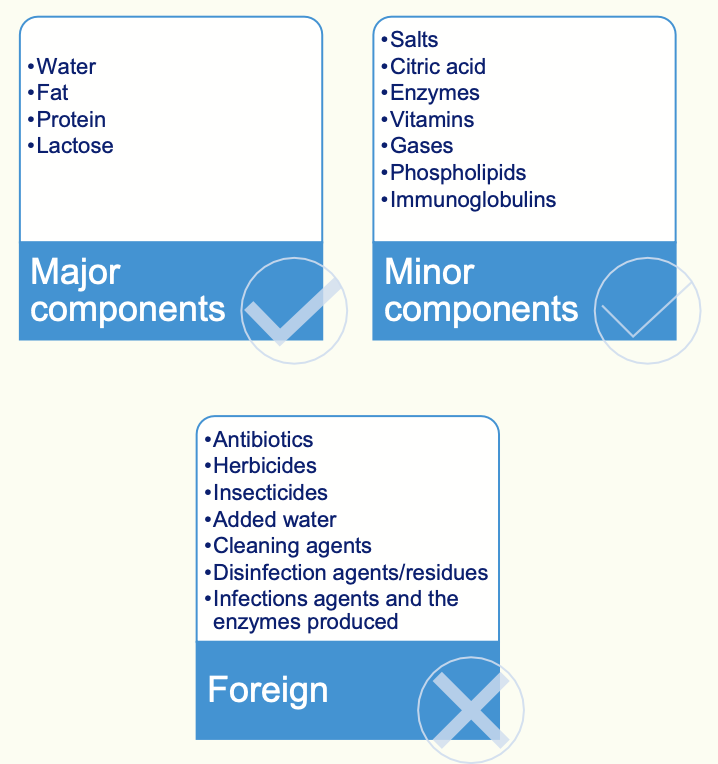
List the major, minor and foreign components of animal milk
Compare skimmed vs 1% fat milk
Skimmed —> contains slightly more calcium than whole milk, lower levels of fat-soluble vitamins (vitamin A esp)
1% fat milk —> contains 40% less total & saturated fat than standard semi-skimmed, slightly lower levels of Vit A & E, higher Ca content
commonly used in flavoured milks
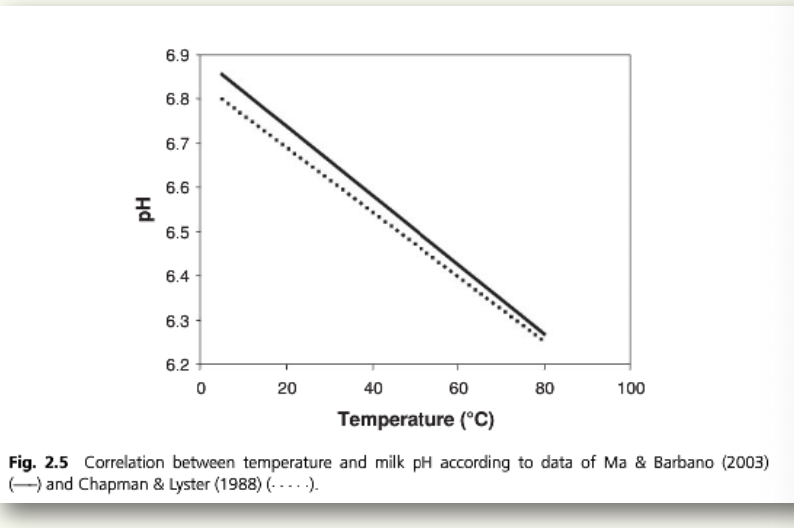
What is the pH of milk, butter and cheese?
Milk —> 6.4-6.8
Butter —> 6.1-6.4
Cheese (big variation) —> 4.8-7.4
What are the consequences of decr in pH & incr in pH of fresh milk?
Decr in pH:
Microorganisms if lactose fermenting
Extensive lipolysis
Increasing temperature
Incr in pH :
Physiological stress
Decreasing temperature
What is Aw (water activity)?
How much water is available —> generally incr w/ incr temp & pressure
What is the Aw of whole milk?
aw> 0.9
(This means that yeasts & moulds are most likely to grow)
What can happen in processing of milk that will incr likelihood of a high load of bacteria?
Contam of product (at parlour, transport & processing)
Inadquate storage temps throughout (from milk parlour → transport → processing → retail)
Inefficient / deficient txs (during processing) —> e.g. heat tx / filtering
What bacteria ass. w/ mastitis can cause infectious agents in dairy products?
Contagious —> spread during milking
Staphylococcus aureus
Streptococcus dysgalactiae/agalactiae
Corynebacterium bovis
Mycoplasma sp.
Environmental (generally > Bactoscan)
Streptococcus uberis
Escherichia coli
Klebsiella sp.
Ass. w/ Summer:
e.g. Hydrotaea irritans & Arcanobacterium pyogenes
Fungi
What bacteria ass. w/ systemic infections can cause infectious agents in dairy products?
Tubercullosis
Q-fever
Leptospirosis
Salmonellosis
List the important food safety pathogens ass. w/ dairy products?
Campylobacter jejuni
Listeria monocytogenes
Mycobacterium paratuberculosis
Salmonella spp.
Staphylococcus aureus
List the important spoilage organisms ass. w/ dairy products?
Bacillus sporothermodurans
Butyric acid bacteria
Pseudomonas spp.
Streptococcus thermophilus
Which pathogens exhibit a dual role of pathogenic & spoilage organisms in dairy products?
Bacillus cereus
Escherichia coli
P. aeruginosa
What is the EU legislation required temp for storgae of milk?
<8°C if collected daily
<6°C if not daily collection
During transport <10°C
No refrigeration if collection within 2 hrs of milking
What are the organisations behind the regulation of milk production?
Local authorities
Hygiene & enforcement on dairy plants & retailers
EHO —> environmental health officers
Food standards agency, VMD, APHA
EU
International dairy federation
What standards must raw cow's milk intended for human consumption meet?
Plate count (Total Viable Count TVC) @ 30°C ≤100,000 cfu/ml
Average over a period of two months with @ least two samples per month
SCC ≤400,000 cfu/ml
Avg over a period of 3 months w/ @ least one sample per month unless authority specifies otherwise
At the manufacture of dairy products and before processing is initiated what should the plate count be for raw vs processed milk?
If milk raw:
Plate count (TVC) @ 30 °C: < 300,000 cfu/ml
If milk processed:
Plate count (TVC) @ 30 °C: < 100,000cfu/ml
Can raw milk be sold to the consumer?
Not in Scotland & Northern Ireland
In England & Wales:
Yes but TB & brucellosis free herd
Health warning on the label
Comply w/ hygiene rules
Inspections & samples
Recall what the D value is?
heat resistance of an organism —> time @ given temp required to reduce population by 1 log10 (90%)
Recall what the Z value is?
Temp change required to alter D value by factor of 10
What bacteria is pastereurisation currently set against?
Coxiella burnetti
What are the diff methods of pasteurisation?
Low Temp Long Time —> LTLT ”holding method”
63.5°C for 30 min
High Temp Short Time (HTST)
@ least 71.7°C for min of 15 sec
Regulatory requirement since 2006
72°C for min of 15 sec
Flash pasteurisation
88°C for 1 sec
What are the diff heat txs for milk?
Sterilisation
UHT
What are the features of sterilisation of milk?
Not legally defined process
Efficient against most heat resistant spores, pre heat followed by homogenisation
Air tight bottles filled through steam chamber
110-130° for 10-30 mins
Keeps for 6 months w/o refrigeration
When opened lasts 5 days
Sweeter taste
What are the features of UHT of milk?
>135 °C for 1 sec
plus, appropriate holding time to produce ‘commercial sterility’
Opaque containers
Spoilage mainly from heat-stable proteases and lipases produced by psychrotrophic bacteria in the raw milk:
Pseudomonas spp.
Alcaligens spp.
Flavobacterium spp.
Residual activity after UHT sterilisation can be as high as 40%
What are the antimicrobial components of raw milk & the effect of heat tx?

What is the diff between evaporated & condensed milk?
Condensed has added sugar (preserved by sugar content)
What is the diff between filtered & dried milk powder?
Filtered milk = filtered extending shelf life
Dried milk powder = spray dried or roller dried
What is the minimum fat in cream?
10%
What bacteria is produced by fermentation in the production of yoghurt?
Fermentation of milk by lactic acid forming bacteria:
Lactobacillus
Streptococcus
What are the features of butter? What is the minimum water & fat content?
Water-in-fat emulsion (from fat-in water emulsion which is milk)
Min water content —> 16%
Min fat content —> 80%
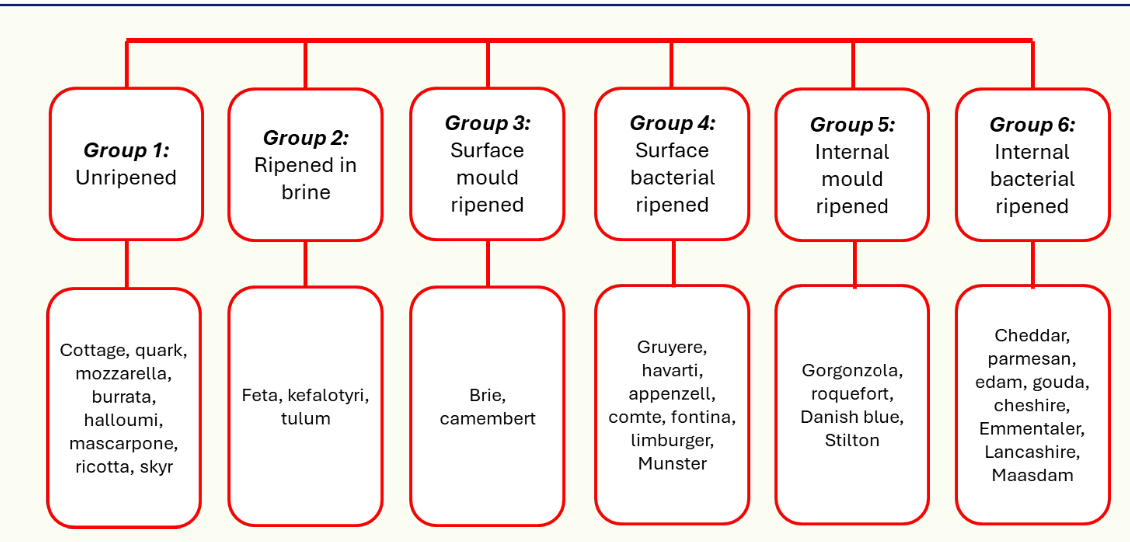
List the different groups of cheeses
Schematic of cheese production
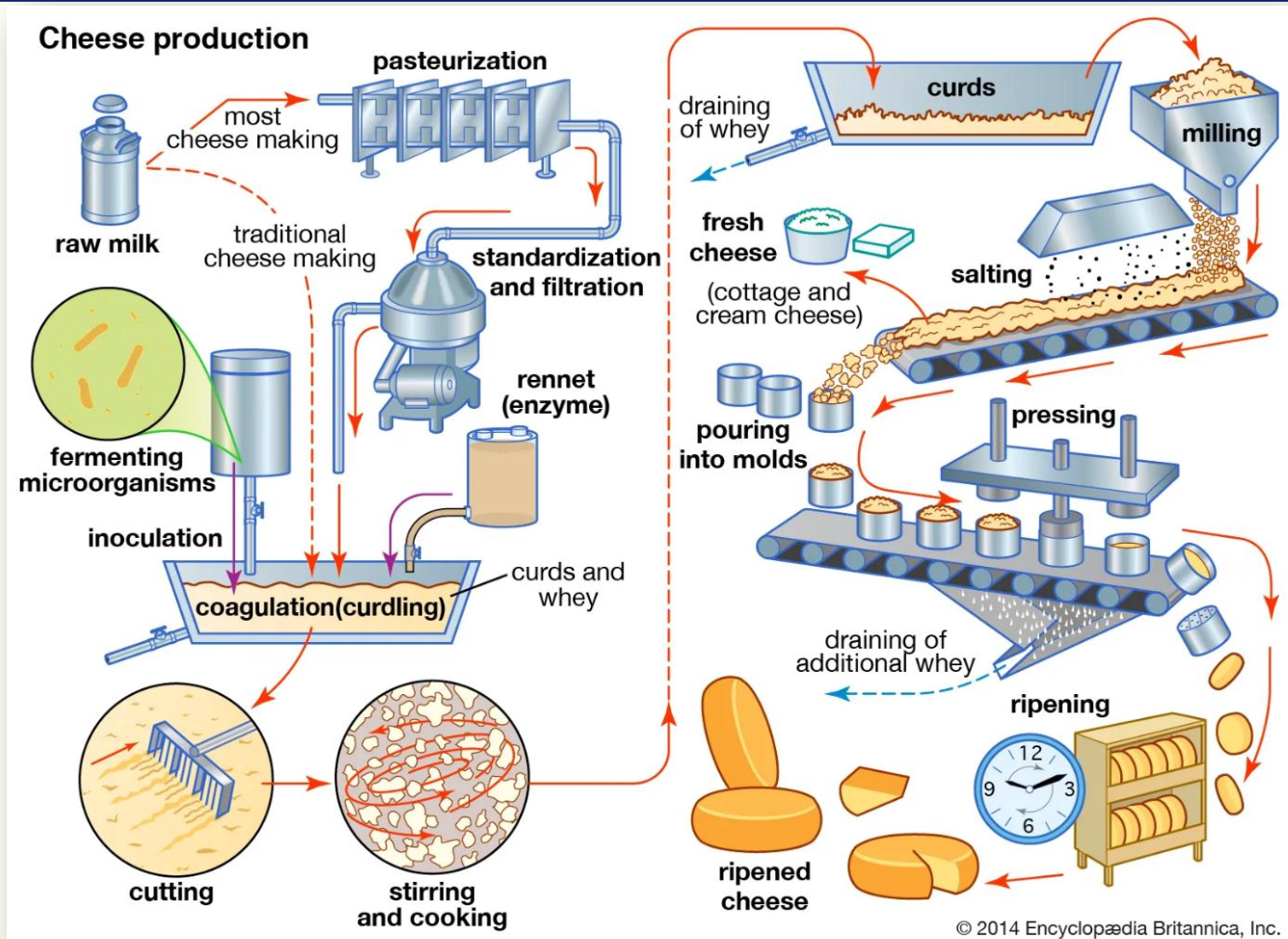
What temp is milk heated to, in order to produce cheese?
>85°C
Explain the molecular production of cheese?
Casein reaction w/ B lacto-globulin
Micelle becomes coarser & open spongy gel that absorbs liquid
-vely charged casein tails sticking out prevents clumping
casein looses its -ve charge and clumps
Fat incorpoated into mesh
Separation from water soluble substances (whey)
What are the diff types of curd formation? What is the optimal temp?
Sour curd —> fermentative bacteria
Also achieved by addition of acid e.g. citric acid
Sweet curd —> addition of rennin / rennet
Optimal temp —> 30/40°C
What are the steps of curd processing?
Salted, seasoned
Coloured
Mixed secondary bacteria/fungus
Condensing & squeezing to form dense curd
How are cheese ripened? (Hard vs Soft ripened cheese)
Hard ripened cheeses (e.g. Cheddar):
Further compression & wrapped in wax/plastic
Prevent contamination, loss of moisture
Incubated (~10oC) to allow bacteria to do its work
Soft ripened cheeses (e.g. Camembert & Limburger):
A microbe (e.g. mould) on surface
Protein-digesting enzyme —> creamier
List the schemes of geographical indications and traditional specialities of cheese
PDO —> protected designation of origin
products produced, processed and prepared within specific geo area
PGI —> protected geographical indication
(same as above)
TSG —> traditional speciality guarantee
products that have traditional / customary names & have feature that distinguish them
What are the three main hazards to public health of dairy products?
'Sterility' of raw product
Hygiene during processing
Heat tx
What are the tests that can be done on milk products to ensure their safety?
Resazurin tests
pH & alcohol test
Singlepath test —> lateral flow assay
What are the steps of pasteurised cheese manufacturing?
Ingredient: Milk pre pasteurised
Add pastuerised milk
Heating
Add vinegar 3%
Ripening and coagulation
Texturing (curd turned and piled)
Draining
Salt 2%
Seasoning and salting
Moulding
Pressing
Storage and maturation
Which bacterium is more likely to grow in chilled milk?
Listeria monocytogenes