Chapters 7-9
 Call Kai
 Learn
Learn Practice Test
 Spaced Repetition
 Match
Match Flashcards
 Knowt Play
1/41

There's no tags or description
Looks like no tags are added yet.
Name | Mastery | Learn | Test | Matching | Spaced | Call with Kai | Chat |
|---|
No analytics yet
Send a link to your students to track their progress
42 Terms
Pareto efficiency
When no one can be made better off without making someone else worse off
Example: When price was set at $20, consumers were made better off, but producers were made worse off
Efficiently allocates goods and services to buyers and sellers, leads to efficient production within an industry, and efficiently allocates resources across industries.
The invisible hand does what
Social surplus
The sum of consumer and producer surplus
pursue their own self-interest. and it results in the most efficient (least cost) production allocation.
The invisible hand directs MANAGERS to do what
Free entry and exit
Allows reallocation of assets to their greatest valued uses, even across industries
Steps to calculate profit
determine optimal quantity (MR=MC)
determine ATC at the optimal quantity
compare P=MR and ATC
When P>ATC, we have economic profits
When P<ATC, we have economic losses
When P=ATC, we have breakeven
A reallocation of resources (to another market)
Economic profits in one sector combined with Economic losses in another will cause what?
The invisible hand
a metaphor created by Adam Smith to describe how self-interest benefits society and the market as a whole. the key to this is price
Deadweight Loss
The reduction in social surplus resulting from a market intervention
Equity
This addresses the issue of a “fair” distribution of resources across a society
Equity and Efficiency (Perfectly Competitive Markets are efficient)
One of the roles of government in our economy is to address efficient outcomes that we may not consider to be equitable

Production possibilities curve (PPC)
shows the relationship between the maximum production of one good for a given level of production of another good.
Comparative advantage
The ability of an individual, firm, or country to produce a certain good at a lower opportunity cost than other producers.
Absolute advantage
The ability of an individual, firm, or country to produce more of a certain good than other competing producers, given the same amount of resources
Terms of trade
The negotiated exchange rate of goods for goods

export
any good that is produced domestically but sold abroad.
import
Any good that is produced abroad but sold domestically.
Net importer
A country which imports are worth more than exports over a given time period.
Free trade
The ability to trade without government hindrance or encouragement
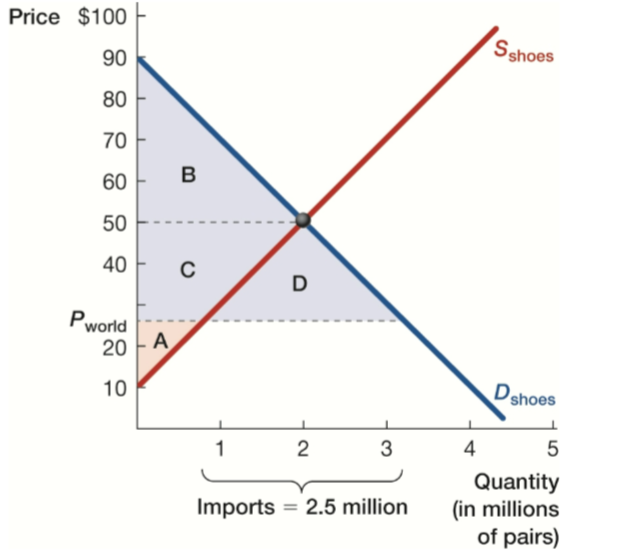
World price
The prevailing price of an item on the world market
Globalization
The shift toward more open, integrated economies that participate in foreign trade and investment.
Protectionism
The idea that free trade can be harmful, and government intervention is necessary to control trade.
tariffs
taxes that are levied on goods and services transported across political boundaries
North American Free Trade Agreement (NAFTA)
an agreement signed by Canada, Mexico, and the United States to create a trilateral trade bloc and reduce trade barriers among the three countries.
Externality
This occurs when economic activity has either a spillover cost or a spillover benefit on a bystander
Pecuniary externality
This occurs when a market transaction affects other people only through market prices.
Internalizing the externality
When agents account for the full costs and benefits of their actions, they are doing this.
Property right
This gives someone ownership of a property or resources.
Coase Theorem
States that private bargaining will result in an efficient allocation of resources.
Transaction costs
The costs of making an economic exchange
Command-and-control regulation
This either directly restricts the level of production or mandates the use of certain technologies.
Market-based regulatory approach
This internalizes externalities by harnessing the power of market forces.
Pigouvian tax
Also known as a corrective tax, this is a tax designed to induce agents who produce negative externalities to reduce quantity toward the socially optimal level.
Non-excludable good
Once this is produced, it is not possible to exclude people from using the good.
Non-rival good
This is a good whose consumption by one person does not prevent consumption by others.
Public goods
This is a good that is both non-rival and non-excludable.
Private good
This is a good that is rival and excludable.
Club good
This is a good that is non-rival but excludable.
Common pool resource goods
There are goods that are rival and non-excludable.
Free-rider problem
This occurs when an individual who has no incentive to pay for a good does not pay for that good because nonpayment does not prevent consumption.
Private provision of public goods
This takes place when private citizens make contributions to the production or maintenance of a public good.
Tragedy of the commons
This results when common pool resources are dramatically overused.