M4 Davis- Species interactions II + III: social ecological dynamics part 1 + 2
 Call Kai
 Learn
 Practice Test
 Spaced Repetition
 Match
 Flashcards
 Knowt Play
1/14

There's no tags or description
Looks like no tags are added yet.
15 Terms
what are social-ecological dynamics?
social ecological dynamics consider how we should manage renewable resources over time to ensure that they are still available for future generations
this is based on the dynamic optimisation problem- anything we do today will affect what we can do in the future (by modulating the population size + growth rate)
we want to maximise the resources/benefits available to a population, but this is subject to the restrictive dynamics of the harvested resource and relevant constraints
harvest (effort and/or output) must depend on the size of the resource stock- to balance the net benefit of the harvest now with the future benefits of having higher stocks
what are the primary renewable resources we’re concerned with? what properties define how these change over time and how we interact with them?
the primary renewable resources in a resource economic context are fish stocks, forests and groundwater basins
these are affected by intrinsic properties: birth, mortality, immigration/emmigration and recharge rates (the rate at which rainfall replenishes an aquifer)
they are also affected by extrinsic properties, like climate and disease, but these are normally excluded from resource management considerations
humans (individuals, firms + governments) obtain benefits from these resources over time, as suppliers and/or consumers
how we interact with resources is based on intrinsic properties: supply + demand, how easy/expensive harvesting is, and the opportunity costs of the time/capital invested
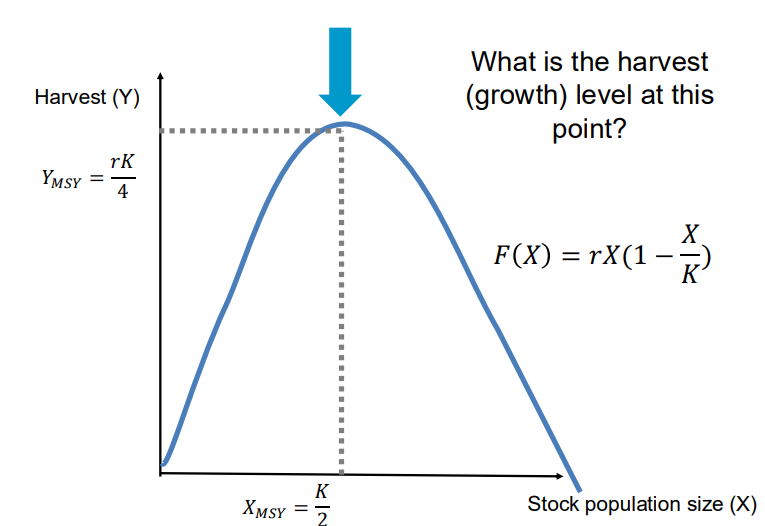
where is the point of maximum sustainable yield for a logistic growth rate? what is the stock size and growth rate at this point?
differentiate the logistic growth curve formula (F(X) = rX(1 - X/K)) to obtain the curve of growth rate against population size, a negative parabola
set this equation (dF/dX = r(1 - 2X/K)) to zero to find the stock population size that corresponds with the maximum growth rate
this is a stock size of half the carrying capacity (X = K/2) → this is equal to the maximum sustainable yield
substitute this into the logistic growth function to find the growth rate at this point (F(X) = rK/4)
what are the problems with harvesting models?
carrying capacity is not fixed in an environment
they ignore species interactions eg. competition
there are data limitations, since the data is often very hard to measure (eg. fish stock estimates are based on catch data)
there is environmental and demographic stochasticity
how can we manage resource extraction to obey to the maximum sustainable yield?
effort/input controls:
seasonal closures (eg. not during breeding)
limits to fishing days
vessel licenses
spatial closures/marine protected areas
number of traps/net size
however, there is a technological creep- improvements in technology can get around the effort controls since efficiency of harvest improves
output/quantity controls (most used, to incentivise efficient fishing):
limiting the total allowable catch (of a species per year/season)
individual quotas/individual transferable quotas
catch shares
bag limits (recreational fishers)
landing/docking limits
however, there bycatch (non-selective fishing gear, eg. bottom trawlers, isn’t necessarily counted) and discards (only retaining the most valuable catch and discarding the rest)
both of these rely on the ability to dedicate resources to enforcement
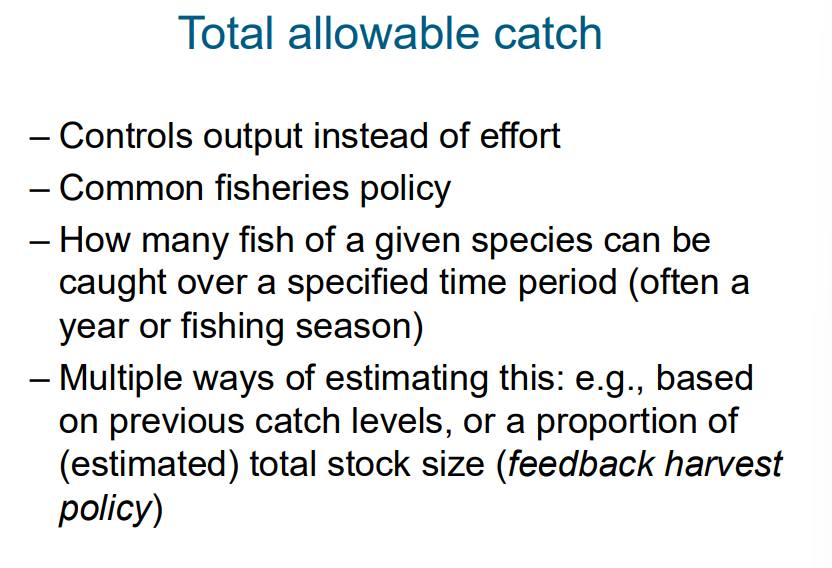
what is the total allowable catch method of regulating harvests?
this is a common policy of fisheries that sets a limit/quota on the total number of fish of a given species that can be caught eg. in a year of season
for fish stocks from shared waters (eg. cod), the total allowable catch is set, and the countries involved in harvesting will agree what share of this stock is allowed for each to harvest
this is a method of regulating output, not effort
how can we use a linear harvest policy for harvesting output regulation?
the change in fish stock between years/seasons is equal to the net growth of the population, F(X) (dependent on its size, X, at time t), minus the amount that has been harvested, Y, at time t
if Yt > F(Xt), the fish stock will decline, whereas if Yt < F(Xt), the fish stock will increase
the total allowable catch (output) is set to a fixed proportion, a, of the fish stock that can be harvested → Yt = aXt
net growth is modelled using logistic growth

what is the result of a linear harvest policy when harvesting above, at, and below the maximum sustainable yield?
when a (the proportion of the fish stock that is harvested) is equal to the maximum sustainable yield, half the carrying capacity, we obtain the greatest harvest
harvesting 50% above and below the MSY yields the same amount, but the stock size that it results in will be very different
the maximum sustainable yield maximises the harvest, but this is usually too dangerous to be practical → it encourages the idea that we can harvest at the maximum, but this puts stocks at risk
this is because: stock sizes are only estimated, we can’t legislate/manage harvests 100% effectively, and the stock is also affected by demographic and environmental stochasticity (and smaller stocks are more vulnerable)
harvesting from smaller stocks is also less efficient in terms of cost
this means normally we harvest below the maximum sustainable yield, to buffer the stock sizes
we can upgrade this to the gordon-schaefer model, where harvesting effort isn’t linear, its a function of catchability

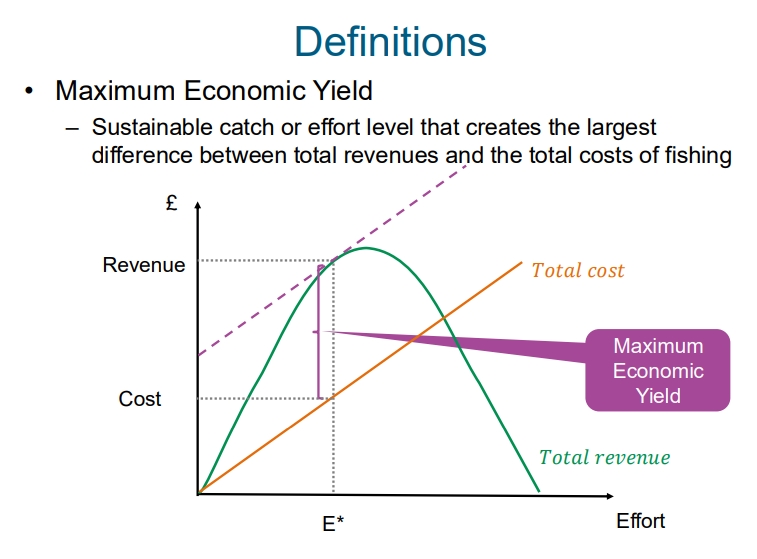
what is the maximum economic yield?
this model measures the profit against the effort to form a revenue curve
profit is proportional to the harvest, when we use a linear model for fish price
effort is inversely proportional to the population size
for this model, we are using a population that has already reached equilibrium with harvesting, after many seasons
the maximum sustainable yield is the sustainable catch level that generates the largest profit (the largest difference between the total revenue curve and the total cost of fishing curve)
this point is below the maximum sustainable yield, so it creates a greater buffer in population size to improve resilience
increasing effort to harvest above the maximum economic yield will cause profits to decrease, because the population size is decreasing, so the costs of fishing outweigh the value of the harvest
how does open access affect the maximum economic yield?
under open access (rivalrous, non-excludable goods) we can’t control fishing effort
in this case the maximum economic yield point is not followed
even though increasing fishing effort will not cause an increase in overall profits (since the costs increase with decreasing population sizes), there is still an incentive to increase effort under open access
this is because additional effort will increase the proportion/share of the total revenue that can be obtained from fishing (competing with other fisheries)
the limit followed under open access (the open access equilibrium) is the point at which the line of total costs meets the curve of total revenue, zero economic profit (increasing effort past this point will mean no fishery can cover its costs)
this point is far past both the maximum economic and maximum sustainable yields, so it puts stocks at risk of collapse- tragedy of the commons
even fishing past this point is observed in reality due to sunk capital and costs that have already been incurred (and government buyback schemes can just encourage the upgrading of equipment)
this can be avoided by territorial user rights fishing, encouraging responsibility for sustainable fishing in an exclusive spatial terriotry

what is the gordon-shaefer model of harvesting?
this is an upgrade on the linear model of harvesting (where the harvest obtained is a fixed proportion of the population, a)
this opens up our harvest term to be a function of catchability
the change in population size is the population growth according to the logistic function, minus the amount harvested (H), qEX
q is the catchability coefficient
E is the amount of effort put in
X is the stock size
the profit is the harvest, qEX, multiplied by p (the price of fish), minus cE (the cost per unit of fishing effort x the effort put in)
the cost per unit of effort and the price of fish are assumed to be constant- not necessarily accurate due to value increasing with demand and rarity, but this stochasticity is buffered better in larger, more integrated market sizes

how can we model the variable costs of harvesting using a linear model?
using a linear model of harvesting (not gordon-schaefer), based on a fixed proportion of the population, a, being removed
cost is made up of fixed elements (boats, licenses, insurance) and variable elements (fuel, labour, bait, ice/refridgeration, maintenance/repairs) that are a function of effort (and therefore stock size)
(low stock size → higher costs, due to having longer/further trips, higher fuel + labor costs, greater vehicle/gear strain, and opportunity costs of the time spent)
instead of the gordon-schaefer model, profit can be modelled as the price per unit x the harvest, minus the cost parameter (eg. exponential, divided by 2, unexplained for now) x harvest squared/stock size (relates cost to stock size)

what is discounting?
discounting is an action that accounts for the fact that benefits in the future are less valuable than benefits in the present, because of:
inflation rates
risk/uncertainty that the benefits can’t be obtained in the future
opportunity costs of the use of the benefits in the present
because of this, when considering events/choices that have effects on the future (eg harvesting), we discount the value of the future benefits
the present value of the future revenue stream is lower than the nominal value because the future is more heavily discounted
this is often set at a governmental rate of 5% to reflect interest rates, but private firms are less buffered from risk and are more profit maximising than welfare maximising, so they set higher discount rates and expect greater future returns
we also use greater discount rates if the future is more uncertain (e.g., politically unstable)
to calculate the current value of a future harvest, we multiply the profits (based on a linear model of harvesting with variable costs based on effort) by the discount factor, 1/(1 + discount rate)^time

how does discounting affect the value of the linear harvest policy at the maximum sustainable yield?
even though the maximum sustainable yield presents the greatest consistent harvest size, and hence nominal value of profits, over time, the value of this harvest in the future is much less (discounted) than in the present, because of:
inflation rates
risk/uncertainty that the benefits can’t be obtained in the future
opportunity costs of the use of the benefits in the present
this reflects the fact that it is far more important for a fishery to be profitable in the first few years
the present value of the future revenue stream is lower than the nominal value because the future is more heavily discounted
this is a problem in harvesting regulation because it encourages over-harvesting now at the expense of future harvests (costs of regulating are incurred upfront and are less heavily discounted)

how can we use escapement policies to regulate harvesting?
instead of setting limits on the effort that can be put in or the output that can be harvested, we can set target escapement policies, setting the stock size, S*, that we want to leave in the sea
this is based on the significant assumption that we can precisely measure stock size and harvest
in this model we only harvest if the stock size is greater than the target escapement level, but if so, we can take everything above this level
in these models, as well as considering the growth of our stock over time, we consider its mortality rate under escapement
