art history final (everything)
0.0(0)
Studied by 0 people Call Kai
 Learn
 Practice Test
 Spaced Repetition
 Match
 Flashcards
 Knowt Play
Card Sorting
1/114

There's no tags or description
Looks like no tags are added yet.
115 Terms
1
New cards
Rococo
An artistic style from the early to mid-18th century reflecting aristocratic leisure, pleasure, romance, and playfulness. Characteristics include pastel colors, soft brushwork, decorative details, and curving forms.
2
New cards
Fête Galante
A painting showing wealthy aristocrats enjoying outdoor entertainment, music, conversation, and romance.
3
New cards

Antoine Watteau, Pilgrimage to Cythera
Shows elegantly dressed couples traveling to or leaving the island of Cythera, associated with Venus and love. Represents romance, leisure, and aristocratic pleasure. An example of a fête galante.

4
New cards

Jean-Honoré Fragonard, The Swing
Shows a young woman swinging while a man watches her from below. Uses pastel colors and loose brushwork to represent flirtation, romance, and aristocratic entertainment.

5
New cards

François Boucher, Cupid a Captive
Shows Cupid, the god of love, being playfully restrained by women. Represents love, romance, and playful Rococo themes.

6
New cards
Neoclassicism
An artistic movement from the late 18th century inspired by ancient Greece and Rome that emphasized reason, order, morality, and civic virtue. Characteristics include clean lines, balanced compositions, idealized figures, and serious subject matter.
7
New cards
Age of Enlightenment
An intellectual movement emphasizing reason, knowledge, science, and progress.
8
New cards
Grand Manner
An elevated, idealized style used to represent important subjects and heroic figures in a dignified way.
9
New cards
Exemplum Virtutis
An example of virtue or moral behavior that encourages viewers to act honorably.
10
New cards

Jacques-Louis David, Oath of the Horatii
Shows three Roman brothers swearing an oath to defend Rome. Represents loyalty, sacrifice, patriotism, and civic duty. Uses strong lines, balance, and a serious subject.

11
New cards

Jacques-Louis David, Napoleon Crossing the Saint Bernard
Shows Napoleon dramatically crossing the Alps on horseback. Presents Napoleon as a powerful, heroic leader through an idealized image.

12
New cards

Thomas Jefferson, Monticello
Jefferson's home in Virginia. Uses classical architectural elements inspired by ancient Roman and Greek buildings. Reflects balance, symmetry, and classical influence.

13
New cards

Benjamin West, The Death of General Wolfe
Shows General Wolfe dying during the Battle of Quebec. Presents a contemporary historical event in a serious, heroic manner and connects sacrifice with patriotism.

14
New cards

Horatio Greenough, George Washington
A sculpture presenting Washington in an idealized, classical style. Represents Washington like an ancient Roman leader, connecting American leadership with classical ideals.

15
New cards
Romanticism
An artistic movement from the early to mid-19th century that reacted against Neoclassicism's emphasis on reason and instead emphasized emotion, imagination, nature, and individual experience. Characteristics include dramatic scenes, powerful emotions, dynamic compositions, and tragedy.
16
New cards
The Sublime
An experience of awe, wonder, or even fear when confronted with something powerful or overwhelming, especially nature.
17
New cards
Hudson River School
A group of American landscape painters influenced by Romanticism who emphasized the beauty and power of the American landscape.
18
New cards

Théodore Géricault, Raft of the Medusa
Shows survivors of a shipwreck stranded on a raft. Based on a real tragedy involving government negligence. Represents desperation, suffering, survival, and social criticism.

19
New cards

Eugène Delacroix, Liberty Leading the People
Represents the 1830 French Revolution. Liberty leads revolutionaries while holding the French flag. Represents freedom, revolution, and sacrifice.

20
New cards

François Rude, Departure of the Volunteers of 1792 (La Marseillaise)
A sculptural relief on the Arc de Triomphe showing volunteers being inspired to defend France. Uses dramatic movement and emotional expressions to represent patriotism.

21
New cards

Caspar David Friedrich, Wanderer Above the Sea of Fog
Shows a lone figure looking over a vast, foggy landscape. Represents individual reflection, isolation, and the sublime.

22
New cards

Thomas Cole, The Oxbow
Shows a dramatic American landscape with contrasting areas of wilderness and cultivated land. Reflects the beauty and power of nature and humanity's relationship with the environment.

23
New cards
Realism
An artistic movement from the mid-to-late 19th century that reacted against Romantic idealism and industrial change by depicting everyday life and ordinary people truthfully. Characteristics include working-class life, labor, social issues, and modern life.
24
New cards

Gustave Courbet, The Stone Breakers
Shows two laborers breaking stones. Focuses on difficult working conditions and working-class life without idealizing the workers.

25
New cards

Jean-François Millet, The Gleaners
Shows three women collecting leftover grain after a harvest. Focuses on rural poverty and ordinary labor.

26
New cards

John Everett Millais, Ophelia
Shows Ophelia floating in a stream surrounded by detailed plants and flowers. Based on Shakespeare's Hamlet. Demonstrates detailed observation of nature and narrative realism.

27
New cards

Thomas Eakins, The Gross Clinic
Shows a surgeon performing an operation in front of students. Represents modern medicine and professional life through realistic details and an unidealized subject.

28
New cards
Impressionism
An artistic movement focused on light, color, visible brushstrokes, and capturing fleeting moments of everyday life. Characteristics include bright colors, loose brushstrokes, changing light, and painting outdoors.
29
New cards
En Plein Air
Painting outdoors rather than inside a studio.
30
New cards

Claude Monet, Impression, Sunrise
Shows a harbor at sunrise. Uses loose brushstrokes and color to capture the atmosphere of a moment. Helped give Impressionism its name.

31
New cards

Pierre-Auguste Renoir, Ball at the Moulin de la Galette
Shows people socializing and dancing outdoors in Paris. Captures everyday leisure and middle-class social life using visible brushstrokes and the effects of light.

32
New cards

Mary Cassatt, The Bath
Shows a woman bathing a child. Focuses on motherhood and women's everyday experiences. Uses flattened space, unusual angles, and patterned surfaces influenced by Japanese prints.

33
New cards

Japonisme
The influence of Japanese art and design, especially Japanese woodblock prints, on European artists. Influenced unusual angles, cropping, flattened space, patterns, strong outlines, and color areas.
34
New cards
Post-Impressionism
An artistic movement that moved beyond Impressionism by using more structure, symbolism, and emotional intensity.
35
New cards

Georges Seurat, A Sunday on La Grande Jatte
Shows people relaxing in a park. Uses Pointillism, applying small dots of color that visually blend when viewed from a distance.

36
New cards

Pointillism
A painting technique that uses small dots of color that blend visually when viewed from a distance.

37
New cards

Paul Cézanne, Basket of Apples
Shows a still life with apples, a basket, and other objects. Uses simplified geometric forms and multiple viewpoints, emphasizing structure rather than simply capturing light.

38
New cards
Symbolism
An artistic movement focused on inner ideas, emotions, imagination, and dreamlike or mystical imagery.
39
New cards

Edvard Munch, The Scream
Shows a figure holding its face against a dramatic landscape. Uses distorted forms and intense colors to represent anxiety, fear, and psychological distress.

40
New cards

Modernism
An artistic movement that challenged traditional artistic rules and experimented with color, perspective, composition, and abstraction.
41
New cards

Fauvism
An artistic movement characterized by bold, unnatural colors, loose brushwork, and emotional expression.
42
New cards

Henri Matisse, The Joy of Life
Shows nude figures in a colorful, dreamlike landscape. Uses bright, unnatural colors and simplified forms. Flattens perspective and celebrates pleasure and harmony between humans and nature.

43
New cards

Expressionism
An artistic movement that uses distortion and intense visual expression to communicate emotions and psychological experiences.
44
New cards

Wassily Kandinsky, Improvisation 28
Uses abstract shapes, colors, and energetic forms rather than realistic representation. Communicates emotion through color and abstraction.

45
New cards

Cubism
An artistic movement that breaks objects and figures into geometric shapes and shows multiple viewpoints at once.

46
New cards

Pablo Picasso, The Women of Avignon (Les Demoiselles d'Avignon)
Shows five women with angular, fragmented bodies and faces. Rejects traditional perspective and realistic proportions. Influenced by African masks and geometric forms. Helped establish Cubism.

47
New cards

Georges Braque, Violin and Palette
Breaks a recognizable object into geometric shapes and fragmented planes. Demonstrates Cubism's rejection of traditional realistic representation.

48
New cards

Analytic Cubism
The first phase of Cubism, characterized by fragmented forms, jagged edges, sharp lines, and multiple viewpoints.

49
New cards

Synthetic Cubism
The later phase of Cubism, characterized by flatter shapes, larger planes, simplified forms, collage, and found materials.

50
New cards

Futurism
An artistic movement that celebrates speed, technology, machines, movement, and modern life.

51
New cards

Umberto Boccioni, Unique Forms of Continuity in Space
A sculpture of a figure appearing to move forward. Uses flowing, abstract forms to communicate movement and speed.

52
New cards

Dada
An artistic movement that rejected traditional artistic values and embraced anti-art, absurdity, chance, and unconventional materials. Developed partly as a reaction to World War I.

53
New cards

Marcel Duchamp, Fountain
A manufactured urinal presented as an artwork. Challenges the definition of art and the importance of traditional artistic skill. An example of a readymade.

54
New cards
Readymade
An ordinary manufactured object presented as a work of art.
55
New cards

Hannah Höch, Cut with the Kitchen Knife
Uses photomontage, combining images from newspapers and magazines. Criticizes politics, society, and traditional gender roles.

56
New cards
Photomontage
An artwork created by combining photographs or images from different sources.
57
New cards

De Stijl
An artistic movement focused on pure abstraction, primary colors, balance, and harmony.
58
New cards

Piet Mondrian, Composition with Yellow, Red, and Blue
Uses horizontal and vertical black lines with primary colors. Reduces art to simple geometric forms and emphasizes balance and harmony.

59
New cards

Surrealism
An artistic movement that explores dreams, the subconscious, and bizarre imagery.
60
New cards

Salvador Dalí, The Persistence of Memory
Shows melting clocks in a strange landscape. Creates a dreamlike environment and challenges the viewer's understanding of time and reality.

61
New cards

Meret Oppenheim, Luncheon in Fur
A teacup, saucer, and spoon covered in animal fur. Combines familiar objects with unexpected materials to create an unusual and unsettling experience.

62
New cards
Regionalism
An artistic movement focused on American identity, recognizable subjects, traditional values, and realistic imagery.
63
New cards
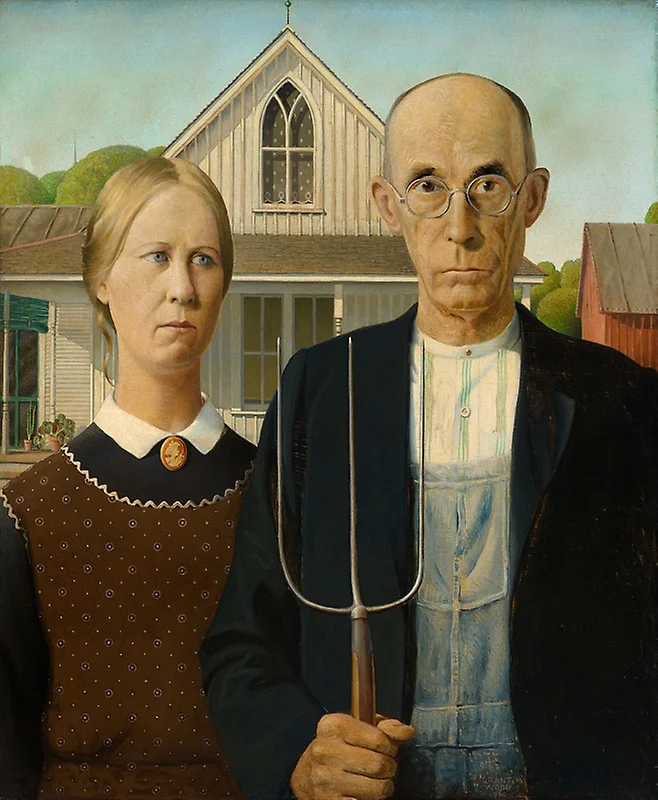
Grant Wood, American Gothic
Shows a farmer holding a pitchfork beside a woman. Represents rural American life through realistic, recognizable figures and a serious composition.
64
New cards
Abstract Expressionism
An artistic movement characterized by large-scale artwork that emphasizes emotional gestures or fields of color.
65
New cards

Jackson Pollock, Number 1, 1950 (Lavender Mist)
Uses dripping and splattering paint across a large canvas. Focuses on movement, gesture, and the physical act of painting. Represents action painting.

66
New cards
Action Painting
A style of painting that emphasizes the physical act of applying paint through gestures, movement, dripping, and splattering.
67
New cards

Mark Rothko, Orange and Yellow
Uses large areas of color to create emotional responses. Represents Color Field painting.

68
New cards
Color Field
An Abstract Expressionist style using large areas of color to create emotional effects.
69
New cards
Pop Art
An artistic movement focused on consumer culture, advertising, celebrity imagery, and mass media.
70
New cards

Andy Warhol, Marilyn Diptych
Repeats images of Marilyn Monroe. Uses celebrity imagery and mass media to connect art with mass production and consumer culture.

71
New cards
Minimalism
An artistic movement characterized by geometric simplicity, industrial materials, and repetition.
72
New cards
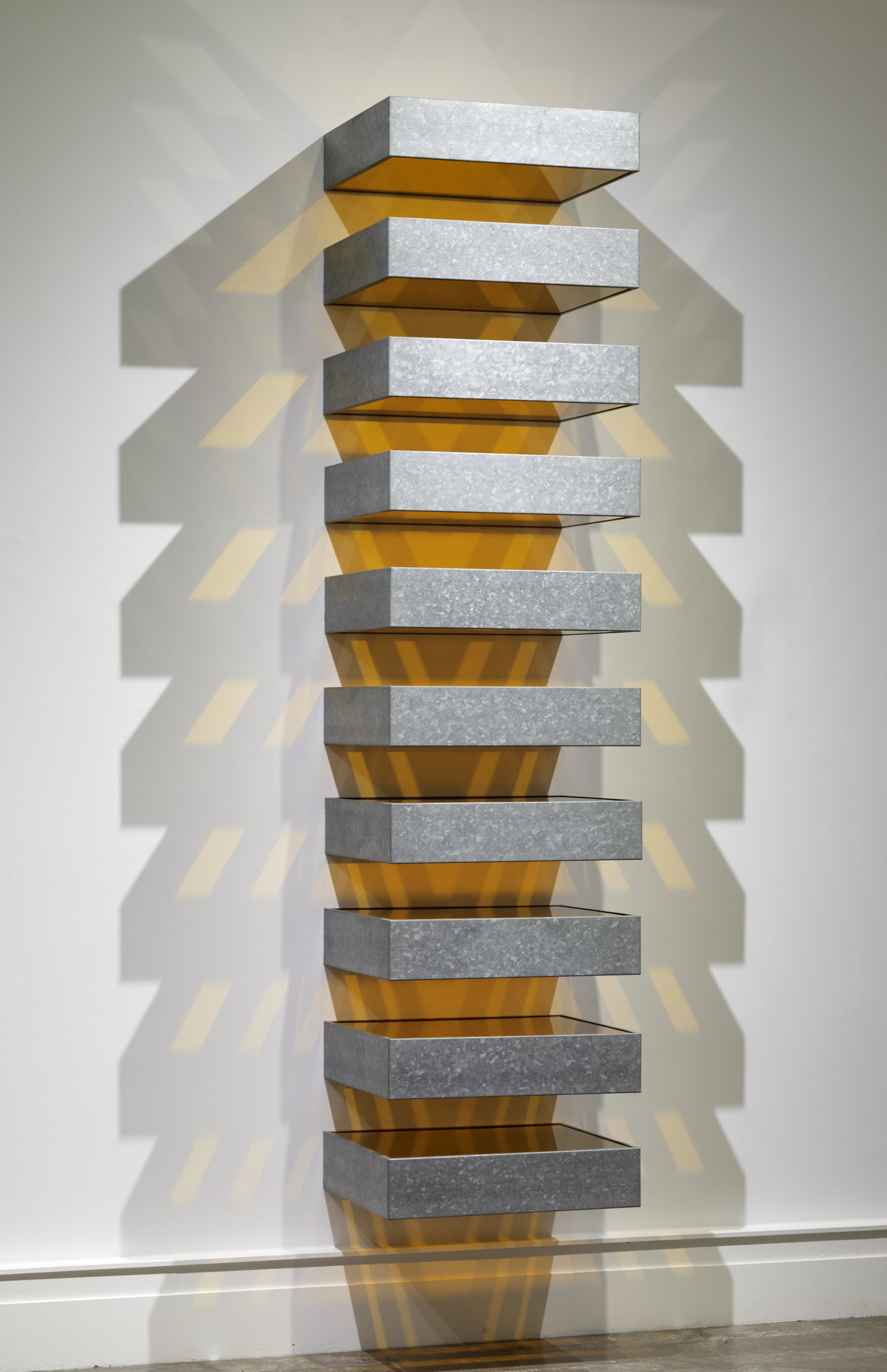
Donald Judd, Untitled
Uses simple geometric forms and industrial materials. Avoids unnecessary decoration and personal expression, emphasizing the physical object itself.
73
New cards
Environmental / Site-Specific Art
Art connected to a natural setting or a specific location, often using large-scale forms and viewer experience.
74
New cards

Robert Smithson, Spiral Jetty
A large spiral-shaped earthwork made from rocks and earth in the Great Salt Lake in Utah. Connects art with nature, the environment, and the viewer's experience of a location.

75
New cards
Postmodern Art
An artistic movement that challenges traditional ideas about originality and artistic meaning through irony, appropriation, and mixing styles.
76
New cards

Cindy Sherman, Untitled Film Still #21
Sherman photographs herself acting as a fictional character. Imitates the appearance of a movie still and explores identity, stereotypes, and how images shape our understanding of people.

77
New cards
Appropriation
The use of existing images, objects, or styles in a new artwork.
78
New cards
Avant-Garde
Artists or movements that are experimental and challenge traditional ideas.
79
New cards

Alexandre-Gustave Eiffel, Eiffel Tower
Built for the 1889 Paris World's Fair. Made of wrought iron and demonstrates new materials, engineering, and modern technology.

80
New cards
Wrought Iron
A type of iron used in construction and decoration, known for its strength and ability to be shaped.
81
New cards

Louis Henry Sullivan, Wainwright Building
Located in St. Louis, Missouri. An early modern office building and example of the Chicago School. Uses a steel skeleton and emphasizes vertical height. Includes a base, body, and cornice.

82
New cards
Chicago School
A group of architects associated with the development of modern skyscrapers, steel-frame construction, and new building technologies.
83
New cards
Form Follows Function
The idea that a building's design should reflect its purpose.
84
New cards
Art Nouveau
A decorative architectural style inspired by nature and organic forms. Characteristics include curving and flowing lines, floral and plant-inspired patterns, elaborate decorative details, and wrought iron.
85
New cards
Victor Horta
An architect associated with Art Nouveau, known for nature-inspired decoration and flowing architectural lines.
86
New cards
Bauhaus Movement
A movement founded by Walter Gropius in Germany in 1919 that combined art, craft, and industrial design. Emphasized function, simplicity, geometric forms, and mass production.
87
New cards
Walter Gropius
Founded the Bauhaus School in Germany in 1919.
88
New cards
International Style
A modern architectural style focused on simplicity, functionality, clean lines, and modern materials such as glass, steel, and ferroconcrete.
89
New cards
Ferroconcrete
Reinforced concrete containing steel.
90
New cards
Cantilever
A projecting structure supported at one end while the other end extends outward.
91
New cards
Machine for Living
Le Corbusier's description of a house designed for efficiency and modern life.
92
New cards

Le Corbusier, Villa Savoye
Located in Poissy, France, and built between 1928 and 1931. The house is lifted off the ground by thin supporting posts and features ribbon windows, an open interior, and a roof patio. Its white exterior represents modern cleanliness and simplicity.

93
New cards
Prairie Style
An architectural style emphasizing harmony between buildings and their environment. Characteristics include horizontal lines, natural materials, and cantilevered structures.
94
New cards
Organic Architecture
Architecture designed to harmonize with nature and its surroundings.
95
New cards

Frank Lloyd Wright, Fallingwater
Built in Pennsylvania between 1935 and 1938. Designed over a waterfall. Uses cantilevered terraces and horizontal lines. Incorporates natural stone and the surrounding landscape to demonstrate harmony between architecture and nature.

96
New cards
Reconstruction and Modernism
An architectural period after World War II focused on rebuilding cities efficiently through functional design, simplicity, and new construction technologies.
97
New cards

Ludwig Mies van der Rohe and Philip Johnson, Seagram Building
Located in New York City and built between 1956 and 1958. Uses steel and glass, clean lines, and a geometric structure. Represents corporate power and modern design.

98
New cards
Postmodernism
An architectural movement that reacted against Modernism by bringing back decoration, color, historical references, irony, and playful designs.
99
New cards
Less Is a Bore
Robert Venturi's phrase challenging the Modernist idea that less is more.
100
New cards

Robert Venturi, Vanna Venturi House
Uses a recognizable traditional house shape, decorative details, and playful geometric forms. Challenges the simplicity of Modernist architecture.
