BIO SCI 41: Bipolar Disorder
 Call Kai
 Learn
Learn Practice Test
 Spaced Repetition
 Match
Match Flashcards
 Knowt Play
1/60

There's no tags or description
Looks like no tags are added yet.
Name | Mastery | Learn | Test | Matching | Spaced | Call with Kai | Chat |
|---|
No analytics yet
Send a link to your students to track their progress
61 Terms
Bipolar Disorder
A mental health condition characterized by extreme mood swings, including emotional highs (mania or hypomania) and lows (depression).
Mania
Extreme highs, characterized by behavioral changes and mood changes.
Behavioral: fast talking, jumpiness, quick thoughts, impulsive behavior, recklessness, feeling grandiose, seeking pleasure
Mood: A period of feeling “high” or an overly happy or outgoing mood; extremely irritable mood, agitation, feeling “jumpy”
Depression
Extreme lows, behavioral and mood changes
Behavioral: sleeping, changed eating, slowed down, can’t concentrate, thoughts of death or suicide
Mood: feeling worried, empty, anhedonia etc
Bipolar I Disorder
One manic or mixed episode that lasts at lease 7 days, usually so severe that they need to be hospitalized. Usually the person also has depressive episodes typically lasting at least two weeks
Bipolar II Disorder
More depressive episodes shifting with manic episodes, but no HYPERmania
Bipolar Not Otherwise Specified (NOS)
A person has symptoms of bipolar but not enough to fit in the diagnostic criteria for BDP I or II
Cyclothymic Disorder (AKA Cyclothymia)
Mild BPD
Rapid Cycling Disorder
When the person goes through multiple manic and depressive cycles within a short period of time (sometimes even within a day).
4 cycles within a year
Hypomania
A mild form of mania that does not require hospitalization, affects sleep and activity
Acute mania
Mild symptoms of psychosis, more severe than hypomania but not as severe as delusional mania yet
Delusional Mania
You start getting delusions of grandeur, feel euphoric, racing thoughts
Delirious Mania
Can be life threatening, the person does not know who they are, where they are, and have a lot of symptoms of mania
Schizoaffective Disorder vs Bipolar Disorder: SIMILARITIES
Both involve episodes of psychosis and manias
Enlarged ventricles
Schizoaffective Disorder vs Bipolar Disorder: DIFFERENCES
Schizoaffective: better tolerated by families, symptoms DON’T cycle so you can usually wait to see if the person calms down
BPD: less consistent = less tolerated, symptoms cycle so if the person does NOT go back to normal, it might be BPD.
Unipolar mania
When you ONLY have manic episodes.
Diagnosing BPD
Ask abt medical history
Ask abt family history
Ask abt recent mood swings
Ask abt any other previous illnesses (lab tests)
Ask family members if they notice mood changes
List manic symptoms
Increased sense of self
Less need for sleep
Racing thoughts
Distracted
Fast talking
Increased goal directed activities
Altman Self-Rating Mania Scale (ASRM)
A self-report measure of mania symptoms and is used to determine the level of mania and look at the severity of symptoms.

What neurobiological changes occur in people with BPD
Increase ventricles
Loss of white matter (myelinated axons)
More hyperintensities (areas of cell death)
Effects of losing white matter?
Loss of connection to brain regions like the amygdala, ACC and PFC.
Associated with suicidality
What types of hyperintensities are associated with BPD?
Right hemisphere of the brain
Frontal lobe and parietal lobe
Deep white and grey matter
What is ENIGMA
a global research group collecting neuroimaging data on BPD
What has ENIGMA found?
Loss of brain tissue in the brain, especially in the hippocampus, amygdala, thalamus (all areas associated with emotional regulation) and orbitofrontal cortex (involved with morals)
What is a first line treatment for bipolar?
Lithium
What does lithium do?
Regulates glutamate levels thus acting as a mood stabilizer
Prevents manic and depressive episodes
Increases cortical thickness
Breaks down uric acid
Limbic system
Amygdala - emotional processing (fear and anxiety)
Hippocampus - memory consolidation but also regulates amygdala
ACC - projection area of emotions, identifying how you feel
Describe differences in amygdala activation in response to facial expressions over the course of development.
Young children: activation in the left amygdala when they see a fearful or happy face. Left = logic so the kid is trying to make sense of what is happening.
Older children: less activation in the amygdala, more focus on trying to figure out how they feel abt it
Adults: activation in the right amygdala when seeing a fearful of happy face. No longer need to use the logic from the left side so you can switch straight to the more emotional side.
Describe Patient SM
Lost their amygdala on both sides of the brain, had very little stress response to threats, also had a hard time reading emotions.
Which brain areas are more active in BPD?
Amygdala and Right Parahippocampal Gyrus
Describe the role of the amygdala and parahippocampal gyrus region as it relates to emotion.
Amygdala: remember the perseverance loop?! Emotional hub, also plays a part in memory formation. BPD people cannot read faces, so the amygdala becomes overactive as gets stuck in a loop while it tries to read faces
Parahippocampal gyrus: helps detect emotional “gist” like sarcasm
What is the O-LIFE?
Oxford-Liverpool Inventory of Feeings and Experiences
Measures your risk for psychosis using 4 categories
Introverted anhedonia (don’t want to socialize)
Cognitive disorganization (distracted, confused)
Unusual experience (belief in magical things)
Impulsive non-conformity (impulsive, antisocial behavior)
Comedians scored higher on all except unusual experiences
Euthymia
slightly elevated mood, not fully manic
Dysthymia
Slightly lowered mood, not fully depressive
List lifetime prevalence rates of BPD globally
BP-I: 0.6%
BP-II: 0.4%
Subtreshold BP: 1.4%
Total prevalence: 2.4%
List 12-month prevalence rates of BPD globally
BP-I: 0.4%
BP-II: 0.3%
Subthreshold BP: 0.8%
Prevalence
The proportion of people who HAVE a disorder at the time/over a period of time
Incidence
The proportion of people who DEVELOP that disorder at the time/over a period of time
Interpret this table

No. tells the number of people in that country with the disorder
% tells the percentage of people in that country with the disorder
SE measures how far the sample mean is likely to be from the population mean (smaller SE means the data is pretty accurate, bigger SE means there may be even MORE people with the disorder)
IE: Brazil has 953 people, or 18.3% with MDE with a standard error of 0.8.
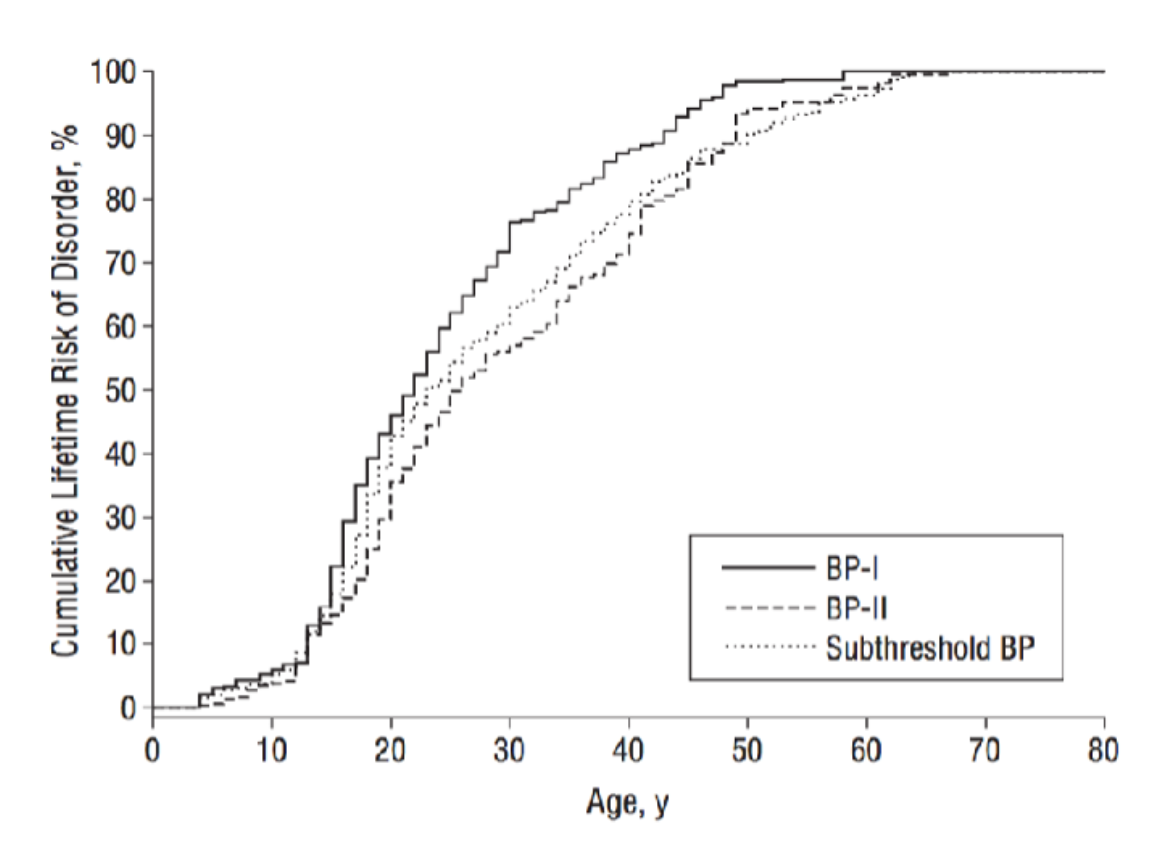
Interpret this graph
The percentages on the y axis tell us what percent of the population has developed BPD.
In other words this means that about 45% of those who will develop BPD in their lifetime will have developed it before by the age 20.
Interpret this graph

For example, 76.5% of individuals with BP-I have some form of anxiety disorder, with an OR of 10.3, indicating they are 10 times more likely to have an anxiety disorder compared to the reference group.
Explain gout
Gout occurs when uric acid crystals accumulate in joints. Uric acid comes from foods like meats (purines) and sugar (fructose)
Explain John Cade’s experiments
Found out that uric acid leads to gout and that lithium is a good mood stabilizer. Injected uric pee and not uric into guinea pigs. Found that uric pee made them sick and that lithium helped by dissolving the crystals.
Glutamate
Excitatory NT, causes hyperactive amygdala and parahippocampal gyrus. Can be good to a certain extent but harmful in excess.
How do antipsychotics work?
AKA Dopamine Antagonists
They block the dopamine receptor D2. This prevents manic episodes that are seen in both bipolar disorder and schizophrenia (can also happen if you consume too much amphetamine)
Side effects of antipsychotics
Weight gain, diabetes, movement issues, sedation, decreased sex drive/function, dyskinesia (writhing movements)
Second line of treatment for depressive episodes?
Atypical antipsychotics or antidepressants in addition to lithium.
Second line of treatment for manic episodes with psychosis?
Atypical antipsychotics, work by blocking dopamine receptors (D2)
Second line of treatment for rapid cycling episodes?
Anti-epileptics (anticonvulsants) Lamotrigine or Valproate.
Lead to less self-harm and suicidal behavior.
Decrease the amount of glutamate in the brain and glutamate increases activity in the brain which is responsible for the rapid cycling.
Regression analysis
Measures how strong of a relationship two variables have (ie uric acid and BPD)
Explain how inflammation contributes to BPD.
Astrocytes and oligodendrocytes get inflamed, so they release cytokines which trigger an immune response, which leads to increased glutamate, which leads to increased excitation, which leads to cell death.
What can corticosteroids do?
They can limit the immune response which limits hyperexcitation and cell death
What do methyl groups do?
Act as stop signs and prevent certain genes from being expressed
Hypermethylation
AKA methylated, more methyl groups, less gene expression, less protein synthesis
Hypomethylation
AKA unmethylated, less methyl groups, more gene expression, more protein synthesis
Promoter regions
Contain histones which roll up DNA bc they contain methyl groups
Basically promoter region has histones which has methyl groups
Epigenetics
Lifestyle patterns, environment, etc can change how genes are expressed. These changes can be passed down to next generations
IE smoking leads to methylation of certain genes, increasing chances of cancer
CPG Sites
Regions before the coding genes for proteins and can be methylated
Describe the serotonin twin study
Bipolar twin had more methylation of the 5-HTTP gene so less serotonin compared to the non-bipolar twin. May relate to the depressive symptoms in BPD
Similar to having the short allele version of 5-HTTP.
What does COX-2 do?
They are proteins that cause inflammation in the brain.
What do Brain-Derived Neurotrophic Factors do?
BDNFs are responsible for helping neurons grow, survive and function.
Explain similarities between Alzheimer’s and BPD
Both have increased methylation in the brain overall
Less methylation of COX-2, leading to more inflammation and thus more cell death
More methylation of BDNFs, leading to less neural growth and functioning.