Trigonometry
 Call Kai
 Learn
 Practice Test
 Spaced Repetition
 Match
 Flashcards
 Knowt Play
1/88

There's no tags or description
Looks like no tags are added yet.
89 Terms
How are sinθ, cosθ and tanθ defined in a right triangle?
sinθ=hypotenuseopposite, cosθ=hypotenuseadjacent, tanθ=adjacentopposite=cosθsinθ.
How are sinθ and cosθ defined on the unit circle?
The point at angle θ (measured counterclockwise from the positive x-axis) on the unit circle is (cosθ,sinθ).
How are cscθ, secθ and cotθ defined?
cscθ=sinθ1, secθ=cosθ1, cotθ=tanθ1=sinθcosθ.
How do you convert between degrees and radians?
180∘=π rad, so θrad=θdeg⋅180π and θdeg=θrad⋅π180.
What are sin, cos and tan of 0?
sin0=0, cos0=1, tan0=0.
What are sin, cos and tan of 6π (30∘)?
sin6π=21, cos6π=23, tan6π=31=33.
What are sin, cos and tan of 4π (45∘)?
sin4π=cos4π=22, tan4π=1.
What are sin, cos and tan of 3π (60∘)?
sin3π=23, cos3π=21, tan3π=3.
What are sin, cos and tan of 2π (90∘)?
sin2π=1, cos2π=0, and tan2π is undefined.
What are sinπ, cosπ, sin23π and cos23π?
sinπ=0, cosπ=−1, sin23π=−1, cos23π=0.
Which trig functions are positive in each quadrant?
Quadrant I: all. Quadrant II: sin (and csc). Quadrant III: tan (and cot). Quadrant IV: cos (and sec). Mnemonic: "All Students Take Calculus".
What is a reference angle and how is it used?
The acute angle between the terminal side of θ and the x-axis. The trig value of θ equals the value at the reference angle, with the sign set by the quadrant.
What are the periods of sin, cos and tan?
sin and cos have period 2π, tan (and cot) has period π.
Which trig functions are even and which are odd?
cos(−x)=cosx and sec(−x)=secx are even. sin(−x)=−sinx, tan(−x)=−tanx, csc and cot are odd.
What are the domain and range of sinx and cosx?
Domain R, range [−1,1].
What are the domain and range of tanx?
Domain: all x=2π+kπ, k∈Z (vertical asymptotes there). Range: R.
For y=Asin(Bx−C)+D, what are the amplitude, period, phase shift and vertical shift?
Amplitude ∣A∣, period ∣B∣2π, phase shift BC (to the right if positive), vertical shift D.
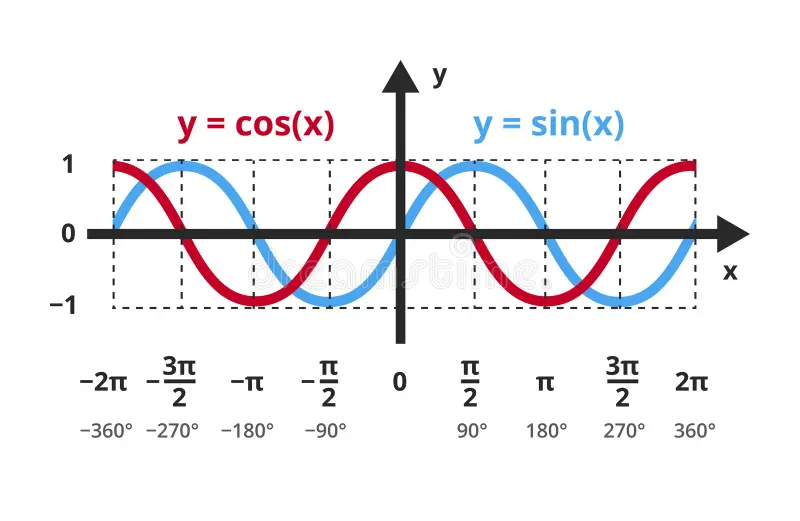
What do the graphs of sinx and cosx look like?
Both are waves between −1 and 1 with period 2π. sinx starts at 0 and rises to 1 at 2π. cosx starts at its maximum 1. cosx=sin(x+2π), so the cosine graph is the sine graph shifted left by 2π.
What are the three Pythagorean identities?
sin2x+cos2x=1, 1+tan2x=sec2x, 1+cot2x=csc2x.
What are the cofunction identities?
sin(2π−x)=cosx, cos(2π−x)=sinx, tan(2π−x)=cotx.
What are sin(π−x), cos(π−x), sin(π+x) and cos(π+x)?
sin(π−x)=sinx, cos(π−x)=−cosx, sin(π+x)=−sinx, cos(π+x)=−cosx.
What is the sum/difference formula for sin(a±b)?
sin(a±b)=sinacosb±cosasinb.
What is the sum/difference formula for cos(a±b)?
cos(a±b)=cosacosb∓sinasinb (note the sign flips).
What is the sum/difference formula for tan(a±b)?
tan(a±b)=1∓tanatanbtana±tanb.
What is the double-angle formula for sin2x?
sin2x=2sinxcosx.
What are the three forms of the double-angle formula for cos2x?
cos2x=cos2x−sin2x=2cos2x−1=1−2sin2x.
What is the double-angle formula for tan2x?
tan2x=1−tan2x2tanx.
What are the power-reduction formulas for sin2x and cos2x?
sin2x=21−cos2x, cos2x=21+cos2x. Essential for integrating even powers of sin and cos.
What are the half-angle formulas for sin2x and cos2x?
sin2x=±21−cosx, cos2x=±21+cosx, with the sign chosen by the quadrant of 2x.
What is the half-angle formula for tan2x (sign-free forms)?
tan2x=1+cosxsinx=sinx1−cosx.
What are the triple-angle formulas for sin3x and cos3x?
sin3x=3sinx−4sin3x, cos3x=4cos3x−3cosx.
What are the product-to-sum formulas?
sinacosb=21[sin(a+b)+sin(a−b)], cosacosb=21[cos(a−b)+cos(a+b)], sinasinb=21[cos(a−b)−cos(a+b)].
What are the sum-to-product formulas for sina±sinb?
sina+sinb=2sin2a+bcos2a−b, sina−sinb=2cos2a+bsin2a−b.
What are the sum-to-product formulas for cosa±cosb?
cosa+cosb=2cos2a+bcos2a−b, cosa−cosb=−2sin2a+bsin2a−b.
How do you write asinx+bcosx as a single sine (harmonic addition)?
asinx+bcosx=Rsin(x+φ), where R=a2+b2, cosφ=Ra, sinφ=Rb. Pick the quadrant of φ from the signs of both cosφ and sinφ, not from tanφ=ab alone.
What is the general solution of sinx=c for −1≤c≤1?
x=arcsinc+2kπ or x=π−arcsinc+2kπ, k∈Z, where arcsinc∈[−2π,2π] is the principal value.
What is the general solution of cosx=c for −1≤c≤1?
x=±arccosc+2kπ, k∈Z, where arccosc∈[0,π] is the principal value.
What is the general solution of tanx=c?
x=arctanc+kπ, k∈Z, where arctanc∈(−2π,2π) is the principal value.
What is the Law of Sines?
In any triangle with sides a,b,c opposite angles A,B,C: sinAa=sinBb=sinCc=2R, where R is the circumradius.
What is the Law of Cosines?
c2=a2+b2−2abcosC (and similarly for the other sides). It reduces to Pythagoras when C=2π.
What is the area of a triangle in terms of two sides and the included angle?
Area=21absinC.
What are the domain and range of arcsinx?
Domain [−1,1], range [−2π,2π].
What are the domain and range of arccosx?
Domain [−1,1], range [0,π].
What are the domain and range of arctanx?
Domain R, range (−2π,2π) (horizontal asymptotes y=±2π).
What is arcsinx+arccosx?
arcsinx+arccosx=2π for all x∈[−1,1].
What is cos(arcsinx) and sin(arccosx)?
Both equal 1−x2, the nonnegative root, because arcsinx∈[−2π,2π] where cos≥0, and arccosx∈[0,π] where sin≥0.
What is sec(arctanx) and sin(arctanx)?
sec(arctanx)=1+x2, sin(arctanx)=1+x2x.
What are the key features of the graphs of arcsinx, arccosx and arctanx?
arcsin: increasing, odd, from (−1,−2π) to (1,2π) through the origin. arccos: decreasing, from (−1,π) to (1,0) through (0,2π). arctan: increasing, odd, horizontal asymptotes y=±2π. Each is the reflection of the restricted original function in y=x.
How do you solve sin(kx)=c on an interval such as [0,2π)?
Let u=kx, so u runs over [0,2kπ). Find every solution for u in that wider interval, then divide by k. Expect up to 2k solutions, not just 2.
How do you solve an equation like 2sin2x−sinx−1=0?
Substitute t=sinx: 2t2−t−1=0 gives t=1 or t=−21. Discard any root outside [−1,1], then solve each: x=2π+2kπ, x=−6π+2kπ, x=67π+2kπ.
How do you solve an equation that mixes cos2x and sinx, such as 2cos2x+3sinx=3?
Use cos2x=1−sin2x to write it in one function: 2sin2x−3sinx+1=0, so sinx=1 or sinx=21. Solutions: x=2π+2kπ, x=6π+2kπ, x=65π+2kπ.
Why should you not divide both sides of a trig equation by sinx or cosx?
You lose the solutions where that factor is zero. Factor instead: sinxcosx=sinx⇒sinx(cosx−1)=0, so sinx=0 or cosx=1.
What is limx→0xsinx?
limx→0xsinx=1 (x in radians).
What is limx→0x1−cosx and limx→0x21−cosx?
limx→0x1−cosx=0 and limx→0x21−cosx=21.
What are the derivatives of sinx, cosx and tanx?
(sinx)′=cosx, (cosx)′=−sinx, (tanx)′=sec2x=1+tan2x.
What are the derivatives of cscx, secx and cotx?
(cscx)′=−cscxcotx, (secx)′=secxtanx, (cotx)′=−csc2x.
What are the derivatives of arcsinx, arccosx and arctanx?
(arcsinx)′=1−x21, (arccosx)′=−1−x21, (arctanx)′=1+x21.
What are ∫sinxdx and ∫cosxdx?
∫sinxdx=−cosx+C, ∫cosxdx=sinx+C.
What are ∫tanxdx and ∫cotxdx?
∫tanxdx=−ln∣cosx∣+C, ∫cotxdx=ln∣sinx∣+C.
What are ∫secxdx and ∫cscxdx?
∫secxdx=ln∣secx+tanx∣+C, ∫cscxdx=−ln∣cscx+cotx∣+C.
What are ∫sin2xdx and ∫cos2xdx?
∫sin2xdx=2x−4sin2x+C, ∫cos2xdx=2x+4sin2x+C.
What are ∫a2−x2dx and ∫a2+x2dx?
∫a2−x2dx=arcsinax+C, ∫a2+x2dx=a1arctanax+C.
Which trig substitution do you use for a2−x2, a2+x2 and x2−a2?
a2−x2: x=asinθ. a2+x2: x=atanθ. x2−a2: x=asecθ.
What is the Weierstrass substitution t=tan2x?
sinx=1+t22t, cosx=1+t21−t2, dx=1+t22dt. It turns rational functions of sin and cos into rational functions of t.
What are the derivatives of sinu, cosu and tanu where u=u(x) (chain rule)?
dxdsinu=cosu⋅u′, dxdcosu=−sinu⋅u′, dxdtanu=sec2u⋅u′.
What are the derivatives of arcsinu, arccosu and arctanu where u=u(x) (chain rule)?
1−u2u′, −1−u2u′, 1+u2u′.
How do you differentiate siny and cos(xy) implicitly with respect to x?
Treat y as a function of x and use the chain rule: dxdsiny=cosy⋅dxdy, dxdcos(xy)=−sin(xy)(y+xdxdy).
How do you integrate ∫sinmxcosnxdx?
Odd power of sin: save one sinx, convert the rest with sin2x=1−cos2x, let u=cosx. Odd power of cos: save one cosx, convert the rest with cos2x=1−sin2x, let u=sinx. Both even: use the power-reduction formulas.
How do you integrate ∫tanmxsecnxdx?
Even power of sec: save sec2x, convert the rest with sec2x=1+tan2x, let u=tanx. Odd power of tan: save secxtanx, convert the rest with tan2x=sec2x−1, let u=secx.
What is ∫uu2−a2du?
∫uu2−a2du=a1arcseca∣u∣+C.
How do you integrate ∫x2+2x+5dx?
Complete the square: x2+2x+5=(x+1)2+4. With u=x+1 this is ∫u2+4du=21arctan2x+1+C.
What is limx→0bxsin(ax)?
ba. Rewrite it as ba⋅axsin(ax) and use limt→0tsint=1.
Which technique fits ∫1+x4xdx?
Substitute u=x2, du=2xdx: 21∫1+u2du=21arctan(x2)+C.
Which technique fits ∫sin3xcos2xdx?
Odd power of sin: write sin3x=(1−cos2x)sinx and let u=cosx: −∫(1−u2)u2du=−3cos3x+5cos5x+C.
Which technique fits ∫9−x2dx?
Trig substitution x=3sinθ, dx=3cosθdθ, 9−x2=3cosθ, giving 9∫cos2θdθ. Power reduction then gives 29arcsin3x+2x9−x2+C.
What are the Taylor series of sinx and cosx about 0?
sinx=x−3!x3+5!x5−⋯=∑n=0∞(2n+1)!(−1)nx2n+1, cosx=1−2!x2+4!x4−⋯=∑n=0∞(2n)!(−1)nx2n.
What are the small-angle approximations?
For small x (radians): sinx≈x, tanx≈x, cosx≈1−2x2.
What is Euler's formula?
eiθ=cosθ+isinθ.
How are cosθ and sinθ expressed with complex exponentials?
cosθ=2eiθ+e−iθ, sinθ=2ieiθ−e−iθ.
What is the polar (trigonometric) form of a complex number z=a+bi?
z=r(cosθ+isinθ)=reiθ, where r=∣z∣=a2+b2 and θ=argz with tanθ=ab (quadrant chosen by the signs of a,b).
What is de Moivre's theorem?
(cosθ+isinθ)n=cosnθ+isinnθ for integer n, equivalently (reiθ)n=rneinθ.
How do you find the n-th roots of z=reiθ?
zk=r1/neinθ+2kπ for k=0,1,…,n−1. They are equally spaced on a circle of radius r1/n.
What is the 2D rotation matrix for a counterclockwise rotation by θ?
R(θ)=(cosθsinθ−sinθcosθ), with detR(θ)=1 and R(θ)−1=R(θ)T=R(−θ).
How is the angle between two vectors u and v found?
cosθ=∥u∥∥v∥u⋅v, and in R3 also ∥u×v∥=∥u∥∥v∥sinθ.
How are Cartesian and polar coordinates related?
x=rcosθ, y=rsinθ, r=x2+y2, tanθ=xy. Choose the quadrant of θ from the signs of x and y.
What are the slope and area formulas for a polar curve r=f(θ)?
Slope: dxdy=r′cosθ−rsinθr′sinθ+rcosθ. Area swept from α to β: A=21∫αβr2dθ.
How do you differentiate a parametric curve x=x(t), y=y(t)?
dxdy=dx/dtdy/dt and dx2d2y=dx/dtdtd(dxdy). Example: for x=cost, y=sint, dxdy=−cott.
How are sinhx and coshx defined, and what is their main identity?
sinhx=2ex−e−x, coshx=2ex+e−x, tanhx=coshxsinhx, and cosh2x−sinh2x=1 (note the minus sign, unlike cos2+sin2).
What are the derivatives of sinhx, coshx and tanhx?
(sinhx)′=coshx, (coshx)′=sinhx (no minus sign), (tanhx)′=sech2x=1−tanh2x.