OMFS 3 - Impacted Teeth (Dr. Stephens)
 Call Kai
 Learn
Learn Practice Test
 Spaced Repetition
 Match
Match Flashcards
 Knowt Play
1/104

There's no tags or description
Looks like no tags are added yet.
Name | Mastery | Learn | Test | Matching | Spaced | Call with Kai | Chat |
|---|
No analytics yet
Send a link to your students to track their progress
105 Terms
- Dysphagia (difficulty swallowing)
- Odynophagia (painful swallowing)
- Dyspnea (shortness of breath)
When a patient comes in with the following HPI, what are additional questions we can ask about?
- Pt reports pain has occurred over the last 6 months
- Pain began on left side when he bit down on an almond, right side he is unsure
- It is located at the posterior aspect of his dentition bilaterally
- It comes and goes and sometimes lasts as long as 1-2 days but has been constant on the right side for about 24hrs
- He describes it as usually dull but occasionally is sharper and has kept him up at night
- It is made worse by chewing and is unsure of anything that makes it feel better
- He reports it is usually a 5/10 on pain scale and in the last week it has become worse, as high as 9/10 on the right side
Impacted tooth
Define the following:
A tooth that fails to fully erupt into the dental arch within the usual range of expected time
Impacted teeth
These are causes of what?
- Abnormal tooth orientation
- Adjacent teeth
- Dense overlying bone
- Excessive soft tissue
- Genetic abnormality
- Inadequate dental arch length and space in which to erupt
Unerupted teeth
Define the following:
Includes impacted teeth and teeth that are in the process of developing and erupting
Maxillary and mandibular 3rd molars
(Last teeth to erupt --> most likely to have inadequate space for complete eruption)
What are the most common impacted teeth?
Maxillary canines
What are the second most common impacted teeth?
Mandibular premolars
What are the third most common impacted teeth?
Failure of rotation from the mesioangular to the vertical direction
(arch-length discrepency)
What is the most common cause of impacted teeth?
The jaw
A cause of impacted teeth is the discrepancy between mesiodistal dimension of teeth versus the length of _________ allow the tooth to erupt into position.
Removal of impacted teeth
These are all indications of what?
- Prevention of Periodontal Disease
- Prevention of pericoronitis
- Prevention of Root resorption
- Prosthesis
- Prevention of cysts and tumors
- Prevention of Jaw fracture
- Orthodontic treatment
Periodontal disease
Teeth adjacent to impacted teeth are predisposed to __________
Distal
Presence of an impacted mandibular third molar decreases the amount of bone on the ______ aspect of an adjacent second molar
Apical
Difficulty cleaning third molars leads to teeth commonly having gingival inflammation with ________ migration of the gingival attachment on the distal aspect of the second molar
Maxillary 2nd molars
What tooth is ESPECIALLY predisposed to periodontal disease associated with impacted 3rd molars, due to their distal furcation?
Periodontal disease
When an extraction is indicated, these reasons for extraction are preventing what?
- Adjacent teeth
- Decreased bone on distal aspect of adjacent second molar
- Difficulty cleaning
- Deep pockets on distal of second molars

Caries
(May occur with no obvious communication between the mouth and the impacted third molar visible)
When an extraction is indicated, these reasons for extraction are preventing what?
- Bacteria distal to the second molar

Pericoronitis
What is an infection of the soft tissue around the crown of a partially impacted tooth?

Normal oral flora
What is periocoronitis usually caused by?
Pericoronitis
When an extraction is indicated, these reasons for extraction are preventing what?
- Repeated trauma from a maxillary 3rd molar
- Entrapment of food under the operculum
Infection
With pericoronitis, when host defenses are compromised, what can this lead to?
Mildest form
What form of pericoronitis?
- Localized tissue swelling and soreness
Irrigation at office and at home
What do you do for a patient with mild pericoronitis?
Severe
What form of pericoronitis?
- Large amount of local soft tissue swelling being traumatized by maxillary 3rd molar
Immediate maxillary 3rd molar extraction, irrigation
What do you do for a patient with severe pericoronitis?
Fascial space infections
What is the concern with pericoronitis?
Root resorption
(Similar to the resorption process primary teeth undergo during the eruptive process of the succedaneous teeth)
When an extraction is indicated, these reasons for extraction are preventing what?
- Sufficient pressure on root of adjacent tooth

odontogentic cysts/tumors
When an extraction is indicated, these reasons for extraction are preventing what?
- Associated follicular sac frequently retained with bony impactions
Odontogentic cysts/tumors
ID the sequelae of this impacted 3rd molar:

Dentigerous cyst
(Unmonitored cysts can reach enormous sizes)
Odontogentic cysts/tumors typically maintains their original size in most patients. Some may undergo cystic degeneration and become a _________
>3mm
If a follicular space around the crown of a tooth is > ___ mm, the pre-op dx is dentigerous cyst
Impacted
Odontogenic cysts can occur around _________ teeth
Epithelium
What part of the dental follicle do odontogenic tumors usually arise from?
Ameloblastoma
What is the most common odontogenic tumor to occur in this region (3rd molar region)?
Excision of overlying soft tissue and portion of mandible
If an ameloblastoma presents, what is the treatment?
Should
If potential benefits > potential complications and risks --> the procedure (should or should not) be performed
Should not
If potential benefits < potential complications and risks --> the procedure (should or should not) be performed
- Extremes of age
- Medical status (ex. Coagulopathies)
- Damage to adjacent structures
What are three common contraindications of impacted tooth extraction?
Advanced age
What is the most common contraindication for the removal of impacted teeth?
Advanced age
These are associated with what contraindication?
- Bone becomes highly calcified
- More bone must be surgically removed to elevate tooth
- Respond less favorably and with more post-op sequelae
False, should NOT be removed
T/F: If a patient is >35 years with an impacted tooth that shows no signs of disease and that has a radiographically detectable layer of overlying bone, the tooth should be removed
>35 years old
What age is more permanant damage more likely to occur with 3rd molar ext (ex. IAN irreversible damage)?
- IAN
- Inferior border of mandible
- Second molar
(Others include max sinus, lingual n)
What are some structures (3) that you should be aware of with 3rd molar extractions?
True
T/F: There is no reliable predictive model on tooth eruption at an early age
18 years
By ____ years, you can reasonably predict adequate room for eruption/ sufficient clearance of the anterior ramus to prevent soft tissue operculum formation
Mandibular impaction classification
What helps to determine degree of difficulty in removal and is best evaluated using panoramic radiograph?
Mesio-angular
What is the most common angulation of mandibular 3rd molars?
Vertical
What is the second most common angulation of mandibular 3rd molars?
Disto-angular
What is the third most common, most difficult angulation of mandibular 3rd molars?
- Horizontal
- Buccal-lingual
What are two, uncommon but possible angulations of mandibular 3rd molars?
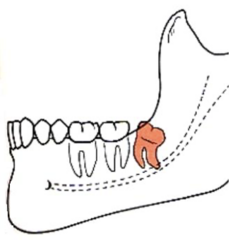
Horizontal impaction
ID the angulation classification of the impacted 3rd molar:

Vertical impaction
ID the angulation classification of the impacted 3rd molar:
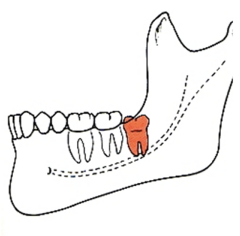
Mesio-angular impaction
ID the angulation classification of the impacted 3rd molar:

Disto-angular impaction
ID the angulation classification of the impacted 3rd molar:
Class 1
Which anterior ramus relationship (Pell&Gregory)?
- Mesiodistal diameter of crown completely anterior to ramus
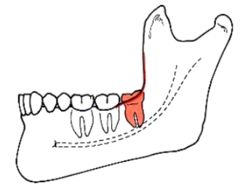
Class 2
Which anterior ramus relationship (Pell&Gregory)?
- One half covered by ramus

Class 3
Which anterior ramus relationship (Pell&Gregory)?
- Completely within the ramus

Class A
Which relationship to occlusal plane (Pell&Gregory)?
- Level with occlusal surface of 2nd molar

Class B
Which relationship to occlusal plane (Pell&Gregory)?
- Between occlusal plane and cervical line of 2nd molar

Class C
Which relationship to occlusal plane (Pell&Gregory)?
- Below the cervical line of 2nd molar

Root morphology
These are all features of what?
- Length
- Fused/distinct
- Curvature
- Direction of curvature
IAN
Roots of third molars are frequently superimposed over what structure?
Buccal
The IAN canal is usually buccal or lingual to roots?
IAN
Damage to what leads to altered sensation (paresthesia/anesthesia) of lower lip and chin - usually brief but can last weeks/months or be permanent?
CBCT
What tool can be used to assess root and IAN canal relationship pre-op?
Soft tissue impaction
What type of impaction?
- CEJ above alveolus

Partial bony impaction
What type of impaction?
- Less than 50% of entire crown (CEJ) is within bone

Full bony impaction
What type of impaction?
- Greater than 50% of entire crown (CEJ), most/all of crown is within bone

Cemento-enamel junction
"Given this definition, the "crown" referenced in these codes' descriptors is the portion of the tooth above the __________. It follows that "part of the crown" should be interpreted as "less than 50% of the entire crown" and "most or all of the crown" should be interpreted as "at least or more than 50% of the entire crown". "

Vertical impaction (63%)
What type of maxillary impaction is most common?
Distoangular impaction (25%)
What type of maxillary impaction is second most common?
Mesioangular (12%)
What type of maxillary impaction is third most common?
Vertical impaction
ID the angulation classification of the impacted 3rd molar:

Distoangular impaction
ID the angulation classification of the impacted 3rd molar:
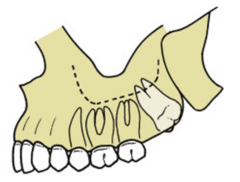
Mesioangular impaction
ID the angulation classification of the impacted 3rd molar:
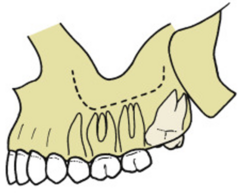
- Tuberosity
- Maxillary sinus
What are two structures to be aware of for maxillary impacted 3rd molars?
Mesioangular impaction
What is the most difficult angulation classification of the impacted maxillary 3rd molar?
Vertical impaction
What is the most common angulation classification of the impacted maxillary 3rd molar?
Removal impacted tooth-soft tissue: D7220
ID the procedure:
- Occlusal surface of tooth covered by soft tissue: requires mucoperiosteal flap elevation
Removal impacted tooth-partially bony: D7230
ID the procedure:
- Part of crown covered by bone; requires mucoperiosteal flap elevation and bone removal
Removal impacted tooth-completely bony: D7240
ID the procedure:
- Most or all of crown covered by bone; requires flap elevation and bone removal
Removal of impacted tooth-completely bony with unusual surgical complications: D7241
ID the procedure:
- Most or all of crown covered by bone; unusually difficult or complicated due to factors, such as nerve dissection required, separate closure of maxillary required, or aberrant tooth position
1. Adequate exposure (flap)
2. Assess bone, remove if necessary
3. Section, divide
4. Elevation, removal
5. Debridement, smoothening, irrigation, suture
Put these steps in order for surgical impacted 3rd molar extraction:
- Elevation, removal
- Section, divide
- Adequate exposure (flap)
- Assess bone, remove if necessary
- Debridement, smoothening, irrigation, suture
Envelope
What is the most common incision for 3rd molar extraction in the mandible?
Posterior extension laterally diverge
How do you avoid injury to lingual nerve when doing an incision for mandibular 3rd molars?
"Disto-buccal hockey stick incision"
(Tissue laterally reflected to expose bone)
The posterior extension, laterally diverging in a mand 3rd molar incision is referred to as what?
Mesial
When a three-cornered flap is made, a releasing incision is made at the ____ aspect of the second molar
Envelope flap
What is the most common incision for 3rd molar extraction in the maxilla?
Vestibule
If tooth in maxilla is deeply implacted, you should release incision into the _____ to gain greater acess
Three-cornered flap
What type of incision releases incision at the mesial aspect of the second molar, provides greater visibility at the apical aspect of surgical field?
- Soft tissue reflected
- Overlying bone removed with a fissure burr
- The bone on the buccodistal aspect of the impacted tooth is then removed with a burr
What does this surgical procedure show?

Maxilla (If needed a periosteal elevator usually sufficient)
Bone removal in not usually necessary in which dental arch?
Mesioangular impaction of mandibular teeth
You would use this procedure to extract a ________:
- Buccodistal bone is removed to expose the crown of the tooth to the cervical line
- Distal aspect of the crown is then sectioned from the tooth
- May be necessary to section the entire tooth into two portions rather than to section the distal portion of the crown only
- Distal portion of the crown has been delivered small straight elevator inserted into the surgically exposed mesial aspect of the crown to deliver the remainder of the tooth as shown.
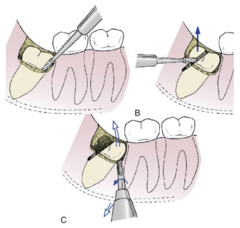
Mandibular tooth with horizontal impaction
You would use this procedure to extract a ________:
- Bone overlying the tooth is removed with a burr
- Crown is then sectioned from the roots of the tooth and delivered from the socket
- Roots are then delivered together or independently by the Cryer elevator used with a rotational motion
- Roots may require separation into two parts; occasionally, a purchase point is made in the root to allow the Cryer elevator to engage it
- The mesial root of the tooth is elevated in a similar fashion

Mandibular tooth w/ vertical impaction
You would use this procedure to extract a ________:
- Bone on the occlusal, buccal, and distal aspects of the crown is removed and the tooth is sectioned into mesial and distal sections.
- If the tooth has a single-fused root, the distal portion of the crown is sectioned off in a manner similar to that depicted for mesioangular impaction
- The posterior aspect of the crown is elevated first with the Cryer elevator inserted into a small purchase point in the distal portion of the tooth
- A small straight No. 301 elevator is then used to elevate the mesial aspect of the tooth by a rotary-and-lever type of motion.

Mandibular tooth with distoangular impaction
You would use this procedure to extract a ________:
- Occlusal, buccal, and distal bone is removed with a burr
- Important to remember that more distal bone must be taken off than for vertical or mesioangular impaction
- The crown of the tooth is sectioned off with a burr, and the crown is delivered with a straight elevator
- The purchase point is put into the remaining root portion of the tooth, and the roots are delivered with the Cryer elevator with a wheel-and-axle type of motion.
- If the roots diverge, it may be necessary, in some cases, to split them into independent portions

- Straight elevator
- Cryer
- Crane pick
Which instruments are most commonly used to deliver an impacted mandibular tooth after adequate bone removal?
Deliver the tooth without intentionally expanding bone
When using an elevator to remove an impacted tooth, what is the primary goal?
Tooth, root, or mandible fracture
Excessive force during delivery of an impacted mandibular tooth can result in which complication?
Small straight elevator
Which instrument is commonly used to deliver a maxillary third molar?
Distobuccally
During delivery of a maxillary third molar, the small straight elevator is used to luxate the tooth in which direction?