Pediatric: Foundations
 Call Kai
 Learn
 Practice Test
 Spaced Repetition
 Match
 Flashcards
 Knowt Play
1/15

There's no tags or description
Looks like no tags are added yet.
Name | Mastery | Learn | Test | Matching | Spaced | Call with Kai | Chat |
|---|
No analytics yet
Send a link to your students to track their progress
16 Terms
OT process
“Really Shouldn’t Eval Going In Really Drunk”
Referral
must know the reason for referral before seeing the child; if the reason is unclear, get clarification from the referring source
COTAs are responsible for
forwarding the referral to the supervising OT
educating the referral source about the scope of OT services
the process of initiating OT referrals
Screening
20-30 mins to determine if a comprehensive eval is needed or not
COTAs can screen as well, but if the screen identifies there is a need for evaluation, the COTA must refer to the OTR, who determines the specific evaluation format or tool
Evaluation
provides a picture of the child
initial step is to develop the occupational profile, i.e.,
information about the child’s developmental and functional strengths and limitations across environments +
family priorities
entry-level OTAs assist with evaluation under the supervision of the OTR
intermediate-advanced-level OTAs can administer standardized tests under the supervision of an OTR after service competency has been established
but OTR has to be the one to select the assessment
standardized assessments require SPECIFIC methods of administration to identify a child’s status
must follow the test protocol or user manual
clearly document if you deviate from protocol
non-standardized assessments don’t have specific protocols or wording
can be customized to match the needs of child and family (e.g., OT adjusting the wording of a question)
rating scales and questionnaires
combining data
standardized tests should not be used alone
to get a full understanding of a child’s delays, we need to combine scores with
clinical judgment
informal/unstructured observation
caregiver interviews
mnemonic
occupational profile —> professor
occupational performance —> perfectly
observation —> observes
assessments —> a(ss)ll
Goal Setting
the OTA, OTR, and family collaborate to develop long-term (LTG) and short-term goals (STG)
Intervention
the OTR develops an intervention plan after the evaluation has been completed
the COTA collaborates with the OTR by sharing knowledge to contribute to intervention planning
intervention implementation
the intervention process improves children’s performance and participation
the OTR carries out the intervention plan and supervises the COTA
the COTA carries out the intervention plan under the supervision of the OTR
Re-eval
the OTR determines whether a reevaluation is indicated
the COTA can suggest a re-eval by reporting any change in the child’s condition
Discharge
the OTR determines when d/c is appropriate
the COTA contributes to d/c by reporting the child’s progress and makes suggestions regarding future needs
happens when the child has met goals or is no longer benefiting from OT
evaluation— top down vs bottom up approach
top-down approach
looks at participation in functional tasks (e.g., ADLs, IADLs, school-related tasks)
OT is usually top-down
bottom-up approach
looks at deficits that hinder performance in functional tasks (e.g., manipulation/fine motor skills, ROM, attention)
evaluation— standardized assessments: norm referenced vs criterion-referenced
norm referenced
compares performance to their peers (or the “average” child of that age)
more for kids who can follow directions well
criterion referenced
compares performance on specific tasks (not compared to peers)
more for kids that have difficulty following instructions
evaluation— scoring: standard deviation
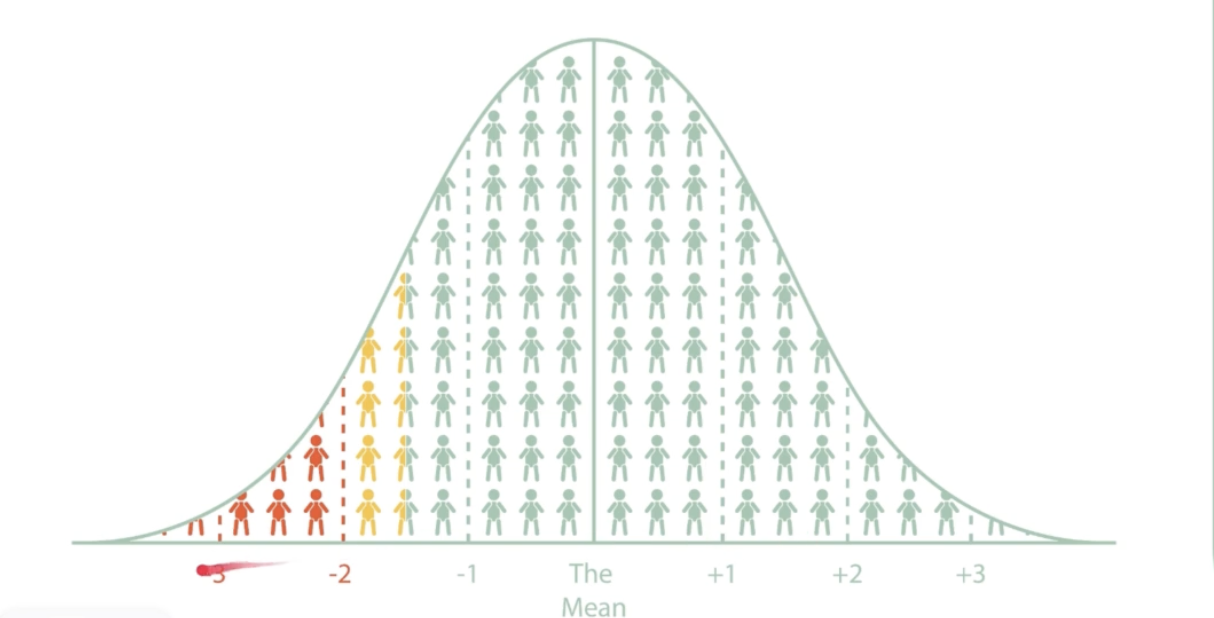
1-1.5 SD below the mean is still okay— minimal delay, and services are not necessarily warranted
2 SD (and lower) below the mean— when OT services are warranted
evaluation— scoring: percentile rank
ranking the performance of kids with percentages (0-100), telling you where kids rank relative to other kids their age

evaluation— scoring: age equivalent
easily understood by parents, but can be misleading and should be used with caution
Piaget’s Theory of Development
stage + milestones
sensorimotor stage: 0-2 yrs
substage 1: 0-1 mo
reflexes are the center of the infant’s cognitive interaction with the world
substage 2: 1-4 mo
coordinates separate actions into single integrated activities
substage 3: 4-8 mo
shifts cognitive horizons beyond the individual and begins to act on the outside world
substage 4: 8-12 mo
uses more calculated approaches to produce a single act
object permanence emerges
substage 5: 12-18 mo
begins to use deliberate variations of actions that bring desirable consequences
substage 6: 18-24 mo
the capacity for mental representation or symbolic thought is achieved
pre-operational stage: 2-7 yrs
use of symbolic thinking grows
mental reasoning emerges
the use of concept increases
concrete operational stage: 7-12 yrs
applies logical operations to concrete problems
formal operational stage: 13 yrs-adult
develops the ability to think abstractly
when this stage is achieved varies

Eriksons’s Theory of Psychosocial Development
stage + age + description
trust vs mistrust
0-18 mo
a sense of trust develops when needs are met by the caregiver
autonomy vs shame and doubt
18 mo-3 yrs
self-sufficiency is achieved if exploration is encouraged, or
doubts about self, lack of independence results
initiative vs guilt
3-6 yrs
one feels a conflict between independence of action and the sometimes negative results of that action or
feeling guilty for actions and thoughts results
industry vs inferiority
6-12 yrs
focus on efforts to attain competence in meeting the challenges presented by parents, peers, school, and the other complexities of the modern world, or
sense of inferiority; no sense of mastery results
identity
13 yrs-adult
adolescent awareness of uniqueness of self, knowledge of roles to be followed, or
inability to identify appropriate roles in life results

ADLs applied to pediatrics —>
individual
group
population
system
individual
child learning to dress independently using compensatory strategies
group
elementary school children eating in the cafeteria
population
helping design accessible showers
system
ensuring proper supports across school district locker rooms for dressing for children and youth with disabilities
IADLs applied to pediatrics —>
individual
group
population
system
individual
adolescent learns to cook a meal
group
life skills class learns how to ride the bus to go shopping
population
helping ensure adaptive cooking materials are available in a community youth setting that has cooking classes
system
working with the school district to set up an apartment for students in the transition program to learn independent living skills
work applied to pediatrics —>
individual
group
population
system
individual
adapting a broom so a student in a transitional program can perform a sweeping task
group
using backward chaining to teach prevocational skills to a group of middle schoolers
population
working with the local hardware store to establish adaptations for students with physical disabilities to be hired to stock shelves
system
working with vocational rehab to establish jobs for high school students with disabilities
play/leisure applied to pediatrics —>
individual
group
population
system
individual
child using a switch to play a cause-and-effect game
group
middle schoolers learning appropriate social skills in preparation for their first school dance
population
helping to design an accessible playground for the community
system
using the Every Moment Counts resources to establish leisure skill activities within the local school district
education applied to pediatrics —>
individual
group
population
system
individual
child learning self-regulation strategies to maintain focus in the classroom
group
leading a weekly small group to help students with autism develop social skills
population
helping a school adopt alternative seating to support classroom engagement for all children
system
working with the school system to adopt a handwriting curriculum to systemically teach handwriting
social participation applied to pediatrics —>
individual
group
population
system
individual
teaching a child with behavior challenges how to greet an unfamiliar adult
group
leading a weekly small group to help students with autism develop social skills
population
developing an adaptive aquatics program for children with physical disabilities at the local YMCA
system
participating in the Positive Behavioral Supports (PBS) team in the school district
health management applied to pediatrics —>
individual
group
population
system
individual
youth with CP learns how to coach a caregiver to transfer the youth safely
group
group of adolescents with eating disorders participate in an OT cooking group
population
OT and physical education teacher develop and put on an obesity awareness fair at their elementary school
system
OT works as a care coordinator at the local pediatric hospital to support occupational engagemgent for inpatient and outpatient children and adolescents
rest and sleep applied to pediatrics —>
individual
group
population
system
individual
parents works with the practitioner to develop a sleep environment that supports their preschooler who is hyper-responsive with sleep challenges
group
sleep hygiene education is provided to parents who have an infant in the NICU before the infant is discharged
population
practitioner works with staff at a camp for children with disabilities to establish healthy and effective routines that support sleep while children are at camp
system
OT participates in a hospital committee addressing rest and sleep habits and routines