accounting -EXAM 2
 Call Kai
 Learn
 Practice Test
 Spaced Repetition
 Match
 Flashcards
 Knowt Play
1/292

Earn XP
Description and Tags
ch 6, 8, 9 and 12
293 Terms
assumptions for ch 6
use actual values for overhead allocation (estimations are correct)
allocation base = actual number of units produced
man costs are constant
no beginning or ending WIP inventory
product vs period cost
product: costs related to making a unit of product - capitalized as an asset on B/S, expensed on I/S as sold
period: everything NOT related to a unit of product - expensed immediately on I/S
MOH
indirect manufacturing costs = overhead
direct costs = easily traceable to a cost object
VMOH = changes based on level of production
FMOH = constant
absorption costing for product costs
all man costs regardless if they r fixed or variable
formula for abs costing for product costs
DM + DL + VMOH + FMOH
absorption costing for period cosst
variable and fixed SG&A
income statement for abs costing
traditional
rev
cogs
_____
gp
sga
____
OI
abs costing requirement
it is required for external financial reporting
variable costing for product costs
ONLY man costs that VARY with output
variable costing for product costs formula
DM + DL + VMOH
variable costsing for period costs
FMOH
SG&A
income statement for variable costing
use contribution margin format
Contribution Margin (Per Unit)
Selling Price per Unit - Variable Cost per Unit
Total Contribution Margin
Total Sales Revenue - Total Variable Costs [1, 2]
Contribution Margin Ratio
(Contribution Margin ÷ Sales Revenue) × 100
difference between absorption and variable costing
the diff accounting treatments for FMOH
what is FMOH treated as for absorption costing
treated as a product cost
what is FMOH treated as for variable costing
FMOH is a period cost
visuals for differences between abs and variable costing

visual overview of variable and absorption costing

difference in OI between variable and fixed costing is EQUAL TO
the FMOH deferred in (released from) invesntory

absorption costing example with these numbers
FMOH = 200,000
COGS / unit = FMOH / units sold
COGS/unit * units = total cogs → goes to the I/S
FMOH - total cogs = VALUE OF INVENTORY THAT IS DEFERRED TO THE B/S

variable costing with these numbers
FMOH is just a period cost → all $200k straight to the I/S
are there differences in OI w absorption and variable costing
yes! bc the OI changes based on if the FMOH goes directly to I/S or some goes to B/S
what is the OI based on
the income statement!!
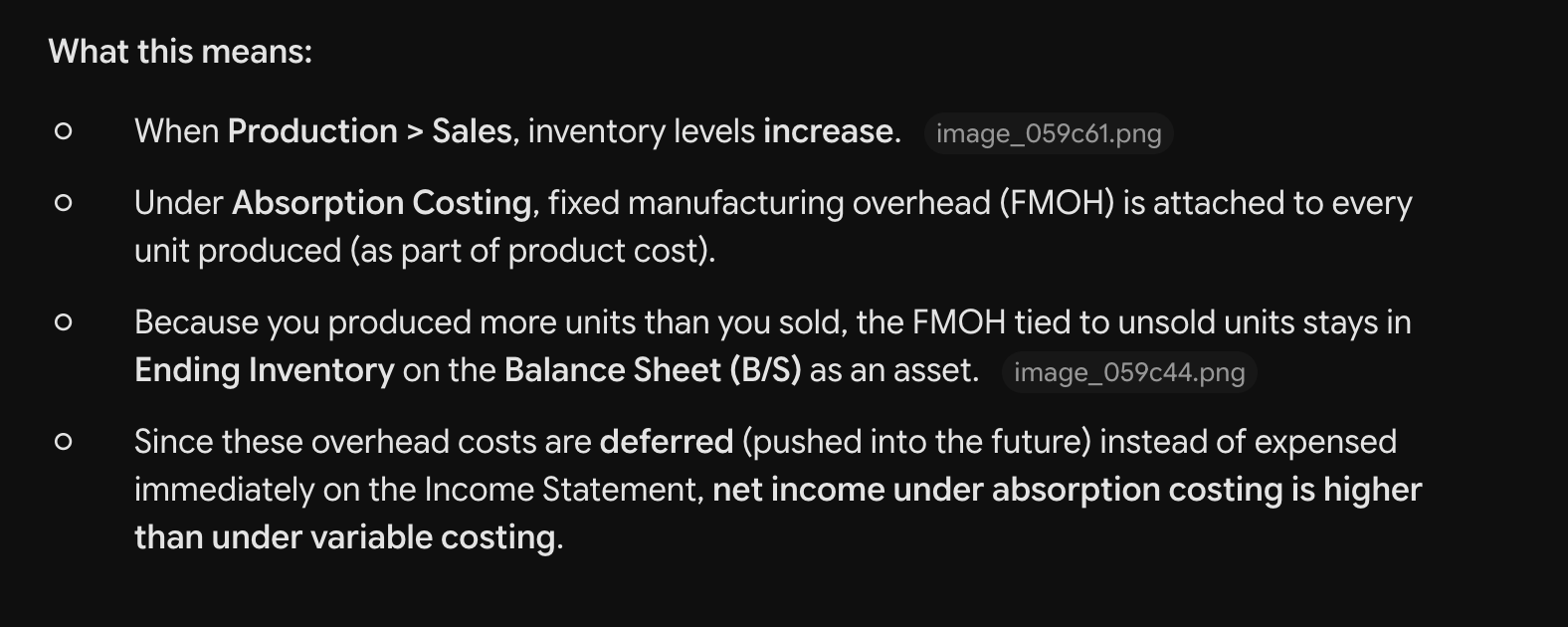
production > sales
inventories _________ under absorption costing
inventories INCREASE under abs costing
FMOH costs are deferred to the B/S under abs costing → increases assets
productuion < sales
inventories ________ under absorption costing
invesntories DECREASE
FMOH are released under abs costing → goes straight to I/S (cogs)

reconciling the difference in incomes

methods on reconciling the difference
inventory snapshot (ending - beginning)
inventory flows (produced - sold)
both talk about: abs costing OI - variable costing OI
method 1 formula

method 2 formula

income statement for variable costing - format
Sales
VC ( man & sga )
___________________
CM
FC (man & sga)
___________________
OI
income statement for absorption costing - format
Sales
COGS
_______________
GP
SGA (variable and fixed)
____________
OI
unit product cost =
VMOH/unit + MOH/unit
MOH/unit = total FMOH / units produced
units produced = units sold for abs costing, what happens to invenstories or OI
no affect on inventories or OI
units produced > units sold
inventories:
inventories INCREASED → FMOH deferred to B/S
OI
abs OI > variable OI
units produced < units sold
inventories:
inventories DECREASED → FMOH is released from B/S to I/S
OI
abs OI < variable OI
what is the variable costing OI affected by
changes in unit sales. not affected by the number of units produced
what is the abs costing OI affected by
affected by changes in unit sales and units of production
how can NOI for abs costing be increased?
simply by producing more units even if they are not sold
why is this true: Fluctuations in absorption costing operating
income can result from both changes in
inventory levels and changes in unit sales
inventory levels → directly related to revenue and to gross margin
unit sales → production> sales = more assets = increase in OI on B/S
unit sales → production < sales = less assets = decrease in OI on B/S
what does abs costing enable managers to do with their FMOH?
defer it to future periods by producing more → inflates current income
when production is higher, what happens to FMOH ?
more FMOH in ending inventory and less FMOH are expensed.
lower current expenses leads to…
higher OI → more bonus for managers → but overproduction destroys long term value
segment
any part of an org or activity about which a manager seeks cost, rev, or profit data
individual store department, service center, sales territory
what formate of income statement is sued for segmented I/S
a CM format, bc it separates fixed from variable costs
I/S uses varibale costing, and COGS is based on VMOH
what other types of fixed costs are separated under segemented I/S
traceable fixed costs = separated form common fixed costs
allows ppl to find segment margin
traceable fixed costs identification

common fixed costs identification

traceability is relative to…
the segment!
the traceable fixed costs of one segment could be a common fixed cost of another segment

segmented finanial info - public companies
GAAP and IFRS require them to include segmented financial data in their reports
what does this do: GAAP and IFRS require them to include segmented financial data in their reports
This requirement can motivate managers to avoid using the contribution approach for internal reporting purposes because if they did, they would be required to:
a. Share this sensitive data with the public.
b. Reconcile these reports with applicable
rules for consolidated reporting purposes.
traceable fixed cost
a fixed cost that is only incurred because of the
existence of the segment
common fixed cost
a fixed cost that supports the operations of more
than one segment but is not traceable to anyone segmen
segment margin

segment margin includes WHAT and makes it useful for WHAT
only those costs that are caused by the segment,which makes it useful for gauging long-run profitability.
segment margin is obtained by…
deducting the traceable fixed costs of a
segment from the segment’s contribution margin.
CM =
sales - variable expenses
how would u split this into segments?
company, consumer, business

variable costing note

what can contribution formate segmented income be used for
decisioj making and break even analysis




what should common costs NOT be used for?
they should not be allocated to segments for decision making

budget 3 characteristics
quantitative plan
forward-looking
specific time period
"aka STRATEGIC ACTION PLAN”
goal of budgtes
planning: developing goals, then preparing budgets to achieve those goals.
control: gathering feedback to ensure that the plan is being executed or modified.
benefits of budgets

control POV of a budget
orgs compare their budgets to actual results to
improve efficiency + effectiveness
evaluate and reward employees
two types of budgeting
top-down and self-imposed
top down budgeting + its limitations
Top management sets budgets and profit targets
limitations:
Top management may lack detailed operational knowledge
• Lower-level managers may feel less motivation to meet targets , they may have less understanding of the company as a WHOLE
self imposed budgeting + limitations
Budgets and profit targets are prepared with the full cooperation of management at
all levels.
limits:
Lower managers may lack broad strategic perspectives
• Budgetary Slack: set low targets to ensure actual results exceed the plan
Budgetary Slack
set low targets to ensure actual results exceed the plan
wells fargo

what is master budget
a collection of COMPONENT budgets, prepped at the beginning of the period
The master budget is the company’s initial plan for
the budget period.
t is a collection of component budgets, which are
separate but interdependent budgets for the
company’s sales, production, and financial activities
how is the master budget composed?
SEQUENTIALLY
order of the sequence of the master budget
Starts with the sales budget: projected sales drive the budgets that follow.
• Ends with three summary budgets:
1. Cash budget (expected cash inflows and outflows),
2. Budgeted income statement
3. Budgeted balance sheet.
questions to ask to determine the sales budget
What are the budgeted unit sales?
What is the budgeted selling price?
What percentage of accounts receivable will be collected in cash in the current and subsequent periods?
sales budget formula
Budgeted Sales x Selling Price = Budgeted Sales
accrual
record revenues when they’re earned and matches expenses to that (not based on cash)
ALL SALES ARE ON…
account (not cash)
expected cash collections - practice

how do you know what the “next” section is?
THE EB OF THE PREVIOUS PERIOD aka the BB of the new period (so “next” period)
production budget
ists the number of units that must be produced to satisfy
sales needs and to provide for the desired ending finished goods inventory.
budget production (units) formula

formula for finding required budgeted production

things needed for Direct Materials budget

dm budget formula

dm purchases formula
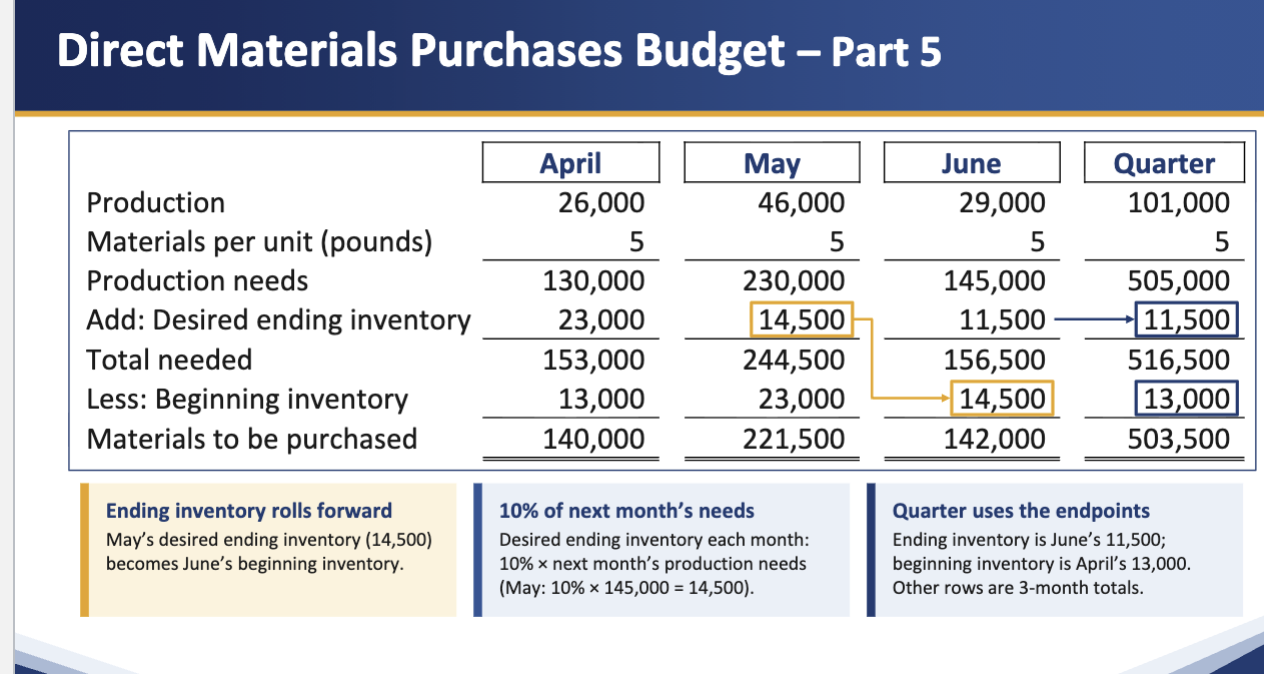
slide 38 of ch 8

what does ending inventory do?
it rolls forward (yellow)

quarter ending inventory
is equal to the ending inventory of the most recent month
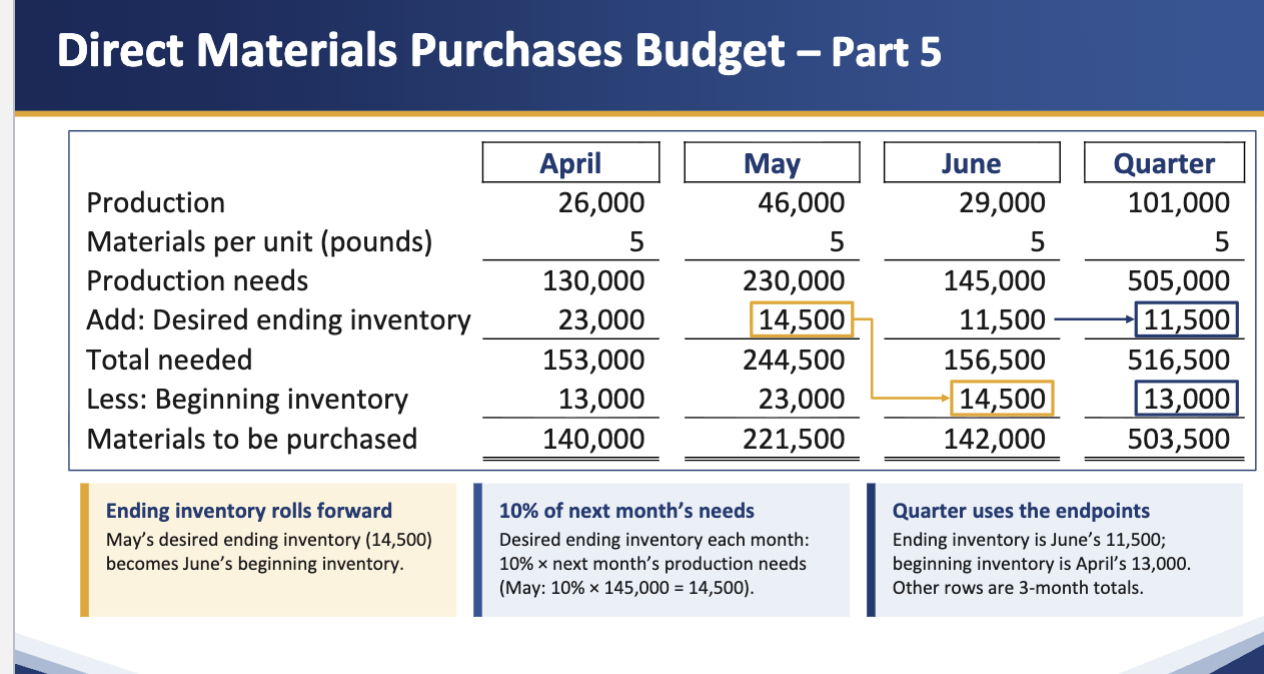
-beginning inventory for the quarter
the beginning inventory of the beginning of the budget
direct labor budget table (to memorize)
budgeted production (units)
x hours required to produce each unit
________________
total number of hours needed
x hourly wage rate
_________________
total wages
what part of the direct labor budget is taken from the production budget?
the UNITS OF PRODUCTION
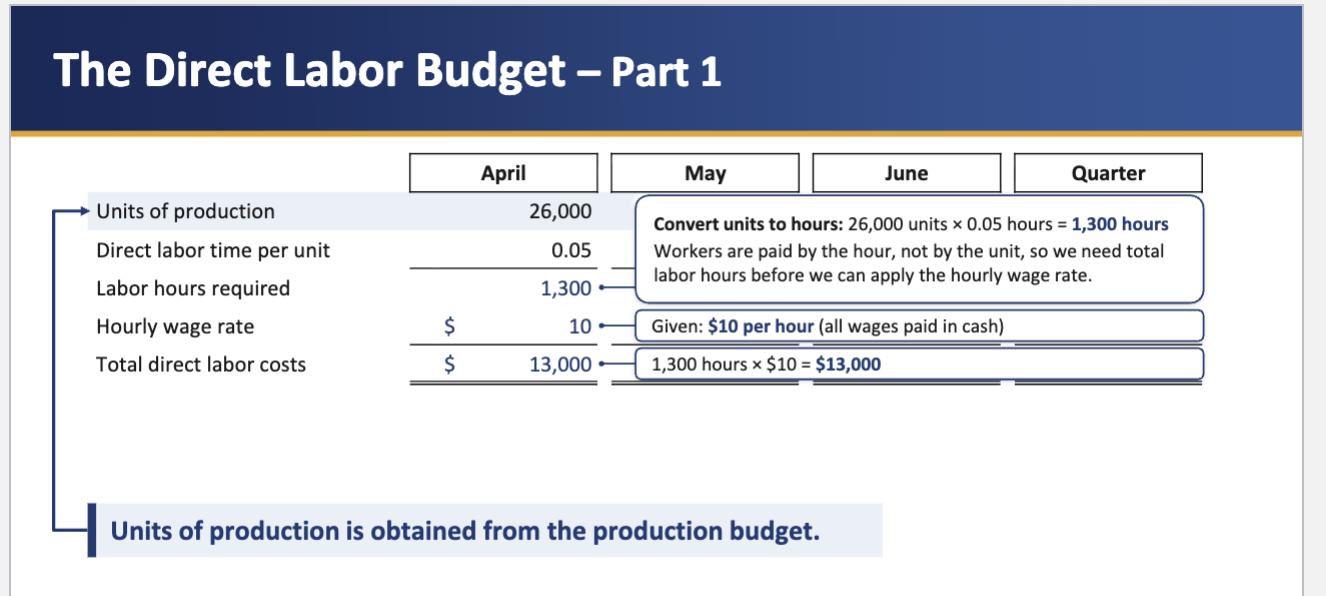
if a company pays all wages in cash, then..
each onths labor cost = also its cash payment

labor costs example

manufacturing overhead budget - what does it address
what is the budgeted variable overhaed cost / unit of the allocation basE?
what is the total budgeted fixed overhead cost per period
what is the budgted depreicatio expense on factory assets per period
MOH Overhead Budget - LINE ITEMS

what is a noncash cost
depreciation
POHR
total budgeted MOH (quarter) / total budgeted allocation base (total DLH for the quarter)
ending finished good inventory budget - what is it
the budgeted cost of finished units at the end of the period
matters - it’s the ending inventoyr on the budget balance shete, and the unit product cost is used to compute cogs on the budgted i/S