Thermodynamics & Metabolism
 Call Kai
 Learn
 Practice Test
 Spaced Repetition
 Match
 Flashcards
 Knowt Play
1/37

There's no tags or description
Looks like no tags are added yet.
38 Terms

What does ΔG°′ mean?
ΔG°′ : The standard biochemical Gibbs free-energy change
‘ = biochemical reference conditions at pH 7
ΔG′: the actual biochemical Gibbs free-energy change under the cell’s current conditions
Sign determines thermodynamically favored direction

What is a central metabolite?
A metabolite such as glucose-6-phosphate (G6P) that can enter multiple pathways
Cells regulate its production and consumption to keep its concentration relatively stable while changing pathway flux to meet needs
What does the prime symbol mean in ΔG′, Q′, and K′?
What are the 5 foundations of living systems?
Cellular
Cells are sructural / functional units of life
Chemical
Carbon-based building blocks
Physical
Cells obey thermodynamic laws + exchange matter/energy
Genetic
DNA stores info that guides cell function
Evolutionary
Populations evolve
What is metabolism in the context of this lecture?

What happens energetically when a covalent bond breaks? What about forms?
Bond breaking requires an energy input
Bond formation releases energy
Why does ΔH′ alone not determine whether a reaction is favorable?
The net ΔH′ includes all bond changes and interactions with water
However, favorability depends on both enthalpy and entropy through ΔG′
Protonation, ion binding, and solvation affect reaction enthalpy
What does entropy represent?
The number of accessible microscopic arrangements of a system and its surroundings.
Entropy change (ΔS′) alone does not explain a favorable reaction
Both ΔH′ and ΔS′ contribute to ΔG′
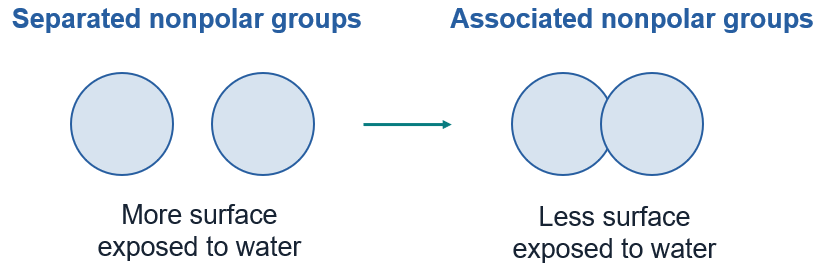
How can association of nonpolar groups increase entropy?
When nonpolar groups associate, less hydrophobic surface contacts water
Ordered hydration water can be released, increasing water’s entropy.
At fixed temperature, pressure, and pH, when is the forward reaction thermodynamically favored?
When ΔG′ is < 0
Describe the different states of ΔH′ and ΔS′ in which the forward reaction is favored.
Within a range where ΔH′ and ΔS′ are approximately constant:
ΔH′ - and ΔS′ + → favored at all temperatures
ΔH′ + and ΔS′ - → favored at no temperature
ΔH′ + and ΔS′ + → favored at higher temperatures
ΔH′ - and ΔS′ - → favored at lower temperatures
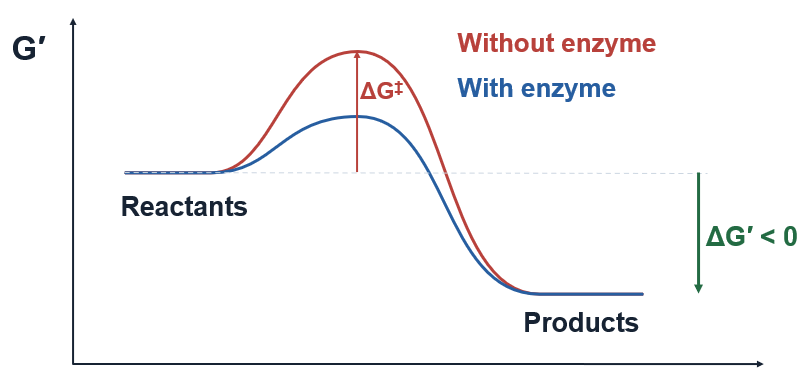
What does ΔG′ tell you about a reaction?
Its thermodynamic direction and driving force under the current conditions
It does not tell you how quickly the reaction occurs

What is the activation barrier, ΔG‡?
The free-energy barrier between reactants and products that affects reaction rate.

How does an enzyme affect a reaction-energy diagram?
It lowers the activation barrier, ΔG‡, increasing rate
It does not change ΔG′ or K′

Why can a thermodynamically favorable reaction still be slow?
A negative ΔG′ does not guarantee a low activation barrier
Rate also depends on the kinetic barrier, enzyme activity, and substrate availability
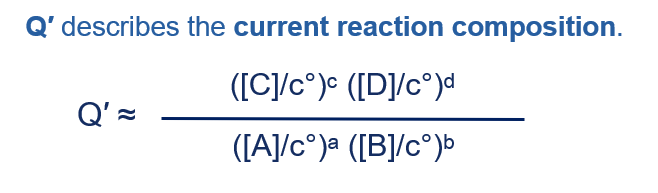
What is Q′?
The reaction quotient
Describes the current reaction composition

What conditions define chemical equilibrium?
Forward and reverse rates are equal
ΔG′ = 0
Q′ = K′

If K′ > 1, what does that mean for ΔG°′ and equilibrium composition?
ΔG°′ is negative
Products are favored at equilibrium.
If K′ < 1, what does that mean for ΔG°′ and equilibrium composition?If K′ > 1, what does that mean for ΔG°′ and equilibrium composition?
ΔG°′ is positive
Reactants are favored at equilibrium
How do Q′ and K′ predict the favored reaction direction?
Q′ < K′ → forward direction is favored
Q′ = K′ → equilibrium
Q′ > K′ → reverse direction is favored
Can ΔG°′ and Q′ establish whether A ⇌ B is fast?
No, they establish thermodynamic favorability, not reaction rate or the activation barrier.
What is the reaction class for G6P hydrolysis, and what enzyme catalyzes it?
Phosphate ester hydrolysis - AKA dephosphorylation
Glucose-6-phosphatase catalyzes it
Write the G6P hydrolysis reaction and its approximate ΔG°′.
G6P + H2O ⇌ glucose + Pi
ΔG°′ ≈ −13.8 kJ mol−1 at 25 °C and pH 7
At Q′ = 1, is G6P hydrolysis favorable?
Yes, at Q′ = 1, ΔG′ equals ΔG°′
So, ΔG′ ≈ −13.8 kJ mol−1 and forward hydrolysis is favored

At Q′ = 1, what is the relationship between ΔG′ and ΔG°′?
They are equal: ΔG′ = ΔG°′
This does not mean the reaction is at equilibrium - that is only true if K′ also equals 1
What happens to ΔG°′ when you reverse a reaction equation?
Its sign reverses
The reverse of G6P hydrolysis has ΔG°′ ≈ +13.8 kJ mol−1
The favored direction is towards glucose + Pi (the reverse direction)
How do cells drive forward reactions?
A reaction can have ΔG°′ > 0 and still participate in forward metabolism
Can change reaction composition
Keep Q′ sufficiently below K′ by supplying reactant or removing product.
Can couple to a favorable process
Linked reaction mechanism can give a total negative ΔG’
Total ΔG′ = ΔG′1 + ΔG′2
How do free-energy changes combine for coupled reactions?
They add: total ΔG′ = ΔG′1 + ΔG′2
A linked overall process can be favorable if the total is negative
Why is glucose phosphorylation by inorganic phosphate alone unfavorable under standard biochemical conditions?
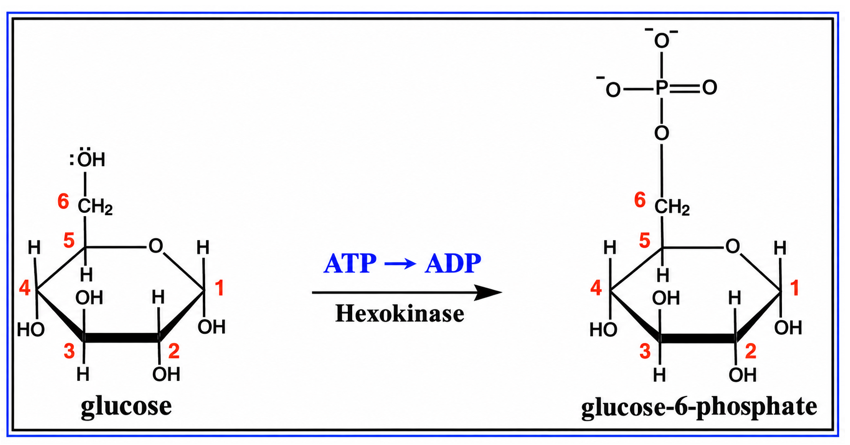
Glucose + Pi ⇌ G6P + H2O has ΔG°′ of about +13.8 kJ mol−1, so it is endergonic.

How does ATP coupling make glucose phosphorylation favorable?
ATP hydrolysis has ΔG°′ ≈ −30.5 kJ mol−1
Adding it to glucose phosphorylation yields glucose + ATP ⇌ G6P + ADP with total ΔG°′ ≈ −16.7 kJ mol−1
What does hexokinase directly transfer to glucose?
ATP’s terminal phosphoryl group
The equations add thermodynamically, free Pi is not a hexokinase intermediate
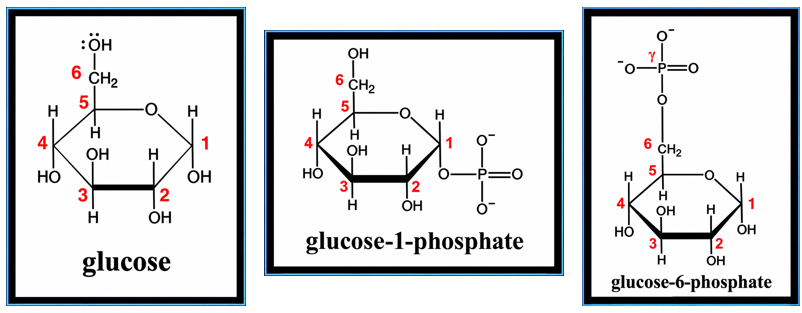
Would G6P ⇌ G1P likely have a large or smaller free-energy change than G6P hydrolysis?
A smaller one
It rearranges the phosphate position within glucose rather than hydrolyzing a phosphate ester bond
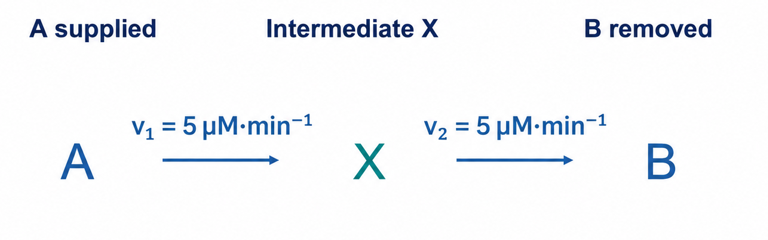
What is a biological steady state?
A condition in which a metabolite concentration remains approximately constant because its formation rate equals its consumption rate
X is formed from A at the same rate that X is consumed to make B
The [ ] stays constant even while material continues to flow through the pathway from A → X → B
What is chemical equilibrium?
A condition in which forward and reverse rates of each reaction are equal
A → X balances X → A
There is no net flow through that reaction

How does enzyme regulation help maintain metabolic steady state?
It balances metabolic supply and demand by adjusting pathway flux
Continued substrate supply and product removal can maintain the driving force for net flux

How does biological steady state differ from chemical equilibrium?
At equilibrium, net flux is zero and ΔG′ = 0 for the reaction
At biological steady state, concentrations can remain approximately constant while net flux continues and ΔG′ for individual steps can be different from zero.
Does a constant metabolite concentration prove equilibrium?
No, constant concentration may result from equal formation and consumption rates in a biological steady state with ongoing flux
It alone does not establish equilibrium