Electron Transport Chain
 Call Kai
 Learn
 Practice Test
 Spaced Repetition
 Match
 Flashcards
 Knowt Play
1/25

There's no tags or description
Looks like no tags are added yet.
26 Terms
Mitochondria Structure
Inner Membrane:
Impermeable (except O2, CO2, & H2O)
Transport proteins for pyruvate, ATP, ADP, & Pi
Outer Membrane:
Porous (porins)
Permeable to molecules < 10 KDa
Inner Membrane Space (Cytosol):
Water-soluble

How is NADH transported into mitochondrion matrix
Malate Aspartate Shuttle:
Extra NADH in cytosol binds oxaloacetate & is converted to malate via malate dehydrogenase & is transported into the matrix where it is converted back to NADH & oxaloacetate via malate dehydrogenase
Glycerophosphate Shuttle
Cytosolic NADH reduces DHAP to 3-PG via 3-phosphoglycerol dehydrogenase
3-PG is oxidized by flavoprotein dehydrogenase into DHAP & FAD is reduced into a matrix FADH2 (2 e- enter ETC)

ETC Overview
Overall delta G = -218 kJ/mol
Making ATP = 30.5kJ/ mol
Complex 1 & 2 are independent of each other
ETC Complexes
Complex 1: NADH-Coenzyme Q Oxidoreductase
Oxidation of NADH by CoQ
Succinate- Coenzyme Q Oxidoreductase
Oxidation of FADH2 by CoQ
Coenzyme Q- Cytochrome C Oxidoreductase
Oxidation of CoQ by Cyt C
Cytochrome C Oxidase
Oxidation of Cyt C by O2
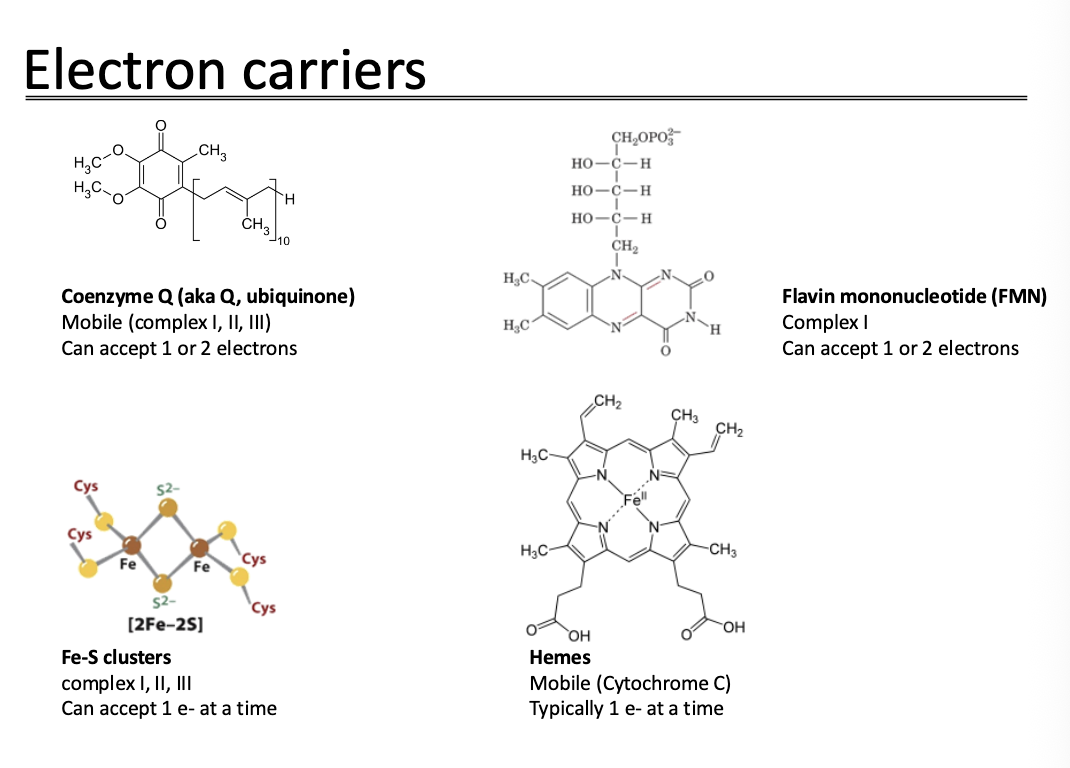
Electron Carriers
Flavin Mononucleotide (FMN)
Inside Complex 1
Can accept 1 or 2 e- (semiquinol form)
Derived from Vitamin B2
Fe-S Clusters
Inside Complex 1,2,3
Accepts 1 e- at a time
Fe2+ to Fe3+
CoQ (Ubiquinone)
Inside the inner membrane
Accepts 1 or 2 e- at a time (semiquinol form)
Mobile Electron acceptor (complexes 1,2,3)
Fat-soluble
Hemes
Inside intermembrane space
Accepts 1 e-
Mobile electron acceptor (Cytochrome C)
Water Soluble
Cu2+
Inside Complex 4
1 e- at a time
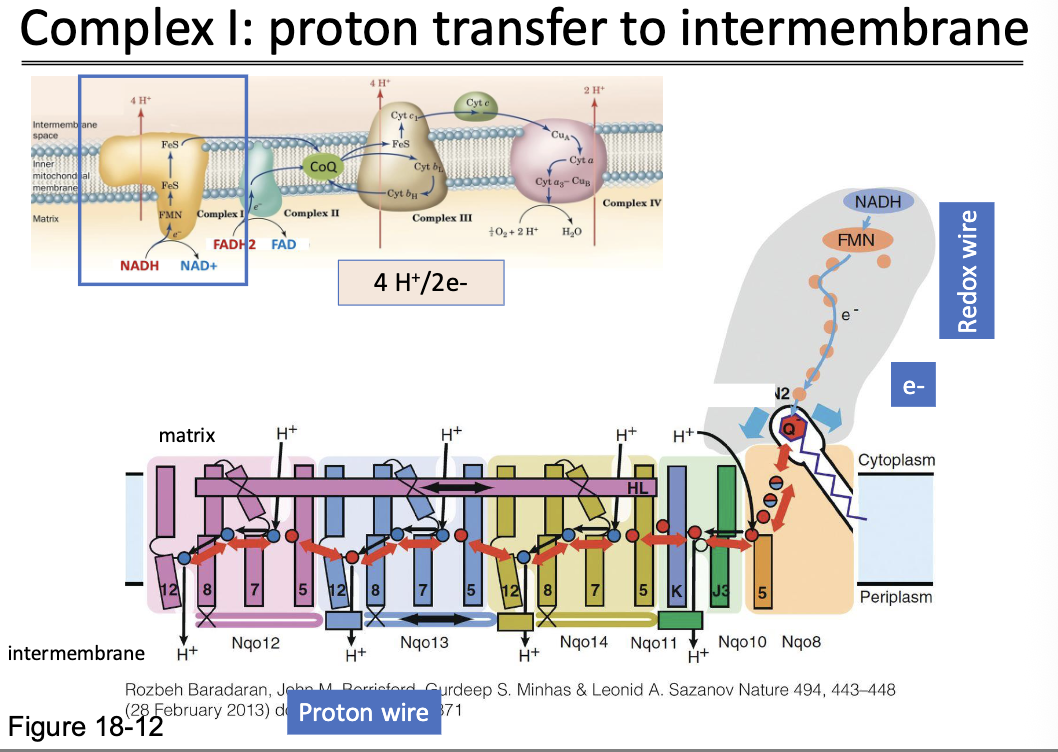
Complex 1 (NADH-CoQ Oxidoreductase)
NADH + UQ + H+ → NAD+ + UQH2
Large membrane protein (980 KDa) w/ 44 subunits
Electron wire:
NADH → FMN → 9 Fe-S clusters → UQ
Proton wire:
Matrix → Intermembrane Space
Protons bind to His/Lys & jump from residue to residue until they enter the intermembrane space
4 H+ are pumped for every 2 e-
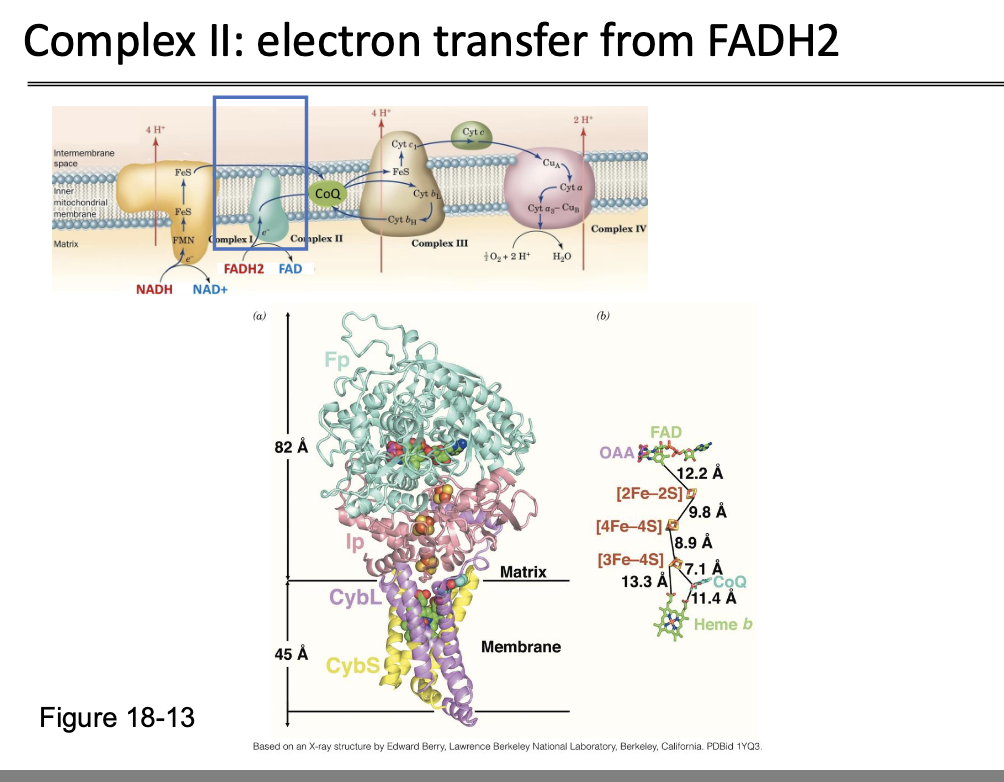
Complex 2 (Succinate Dehydrogenase/ Succinate-Coenzyme Q Oxidoreductase)
Succinate + UQ → Fumarate + UQH2
Soluble protein in matrix w/ a transmembrane portion
Flavin protein:
Binds [FAD}
3 Fe-S Clusters
2Fe-2S
4Fe-4S
3Fe-4S
Heme-B
Stabilizes CoQ
Electron Flow:
Succinate → FAD → Fe-S Clusters → CoQ
No Proton Flow
Complex 3 (Coenzyme Q- Cytochrome C Oxidoreductase)
UQH2 + Cyt C (oxidized) → UQ + Cyt C (reduced)
419 kDa, homodimer
Each Monomer:
9 subunits
12 transmembrane helices
Electron Wire:
Q Cycle
Heme bH (high
Heme bL (low)
Heme c1
2Fe-2S
Proton Wire:
4 H+ are pumped from matrix to inter membrane space for every 2 e-

Q Cycle
Occurs in the inner membrane
Qo: Site for reduced CoQ
Qi: Site for oxidized CoQ
First Half:
Reduced CoQ (from complex 1 or 2) binds at Qo site
Pumps 2 H+ into the intermembrane space
a & b
CoQ converts to semiquinone form
1 e- goes to Iron Sulfur Protein (ISP) then C1 then Cytochrome C
Semiquinone CoQ converts to oxidized form
1 e- goes to bL then bH then oxidized CoQ in the Qi site converting it to semiquinol form
Reaction:
UQ + UQH2 → UQ + UQH*
Second Half:
Reduced CoQ (from complex 1 or 2) binds at Qo site
Pumps 2 H+ into intermembrane space
a & b
CoQ converts to seminquinol form
1 e- is transported to Iron Sulfur Protein (ISP) then Heme c1 then Cytochrome C
Semiquinol CoQ is converted to oxidized form
1 e- is transported to bL then bH then to the semiquinone CoQ in Qi site (along with 2 H+ from the Matrix) converting it to reduced form
Total Reaction:
2H+ + 2 UQH2 + UQ → 4H+ + UQH2 + 2 UQ
Simplified:
2 H+ + UQH2 → 4H+ + UQ

Complex 4 (Cytochrome C Oxidase)
e- reaches the terminal acceptor O2
Cyt C is a soluble protein in the intermembrane space that binds Complex 4
410 kDa homodimer membrane protein
13 subunits, 10 transmembrane subunits, 28 membrane-spanning helices
4 e- binding sites:
CuA, Heme A, Heme A3, CuB
2 H+ are pumped to the intermembrane space per 2e-
Electron Wire:
Cytochrome C → CuA → Heme A → Heme A3 → CuB
Reduces Heme A3 & CuB
Reduced Fe in Heme A3 & CuB bind O2 forming a peroxide bridge
Cytochrome C transfers 2 more e- which pumps 2 more H+ from the Matrix which cleaves peroxide bridge
Fe in Heme A3 & CuB each gain a hydroxyl group
Addition of 2 more H+ causes the release of 2 H2O
Reaction:
O2 + 4H+ + 4e- → 2H2O
½ O2 + 2H+ + 2e- → 1 H2O
Proton Wire:
D pathway: Aspartate
K Pathway: Lysine
Protons hop from 1 H2O molecule to another

ETC Creates a Proton Gradient
Protons are pulled from the matrix to the intermembrane space
Creates a concentration & electrical potential gradient which stores potential energy for use in oxidative phosphorylation
Matrix → intermembrane space (endergonic)
Intermembrane Space → Matrix (exergonic)
Inhibitors of ETC
Complex 1:
Rotenone, Amytal, Demerol
Complex 2:
Atpenins
ATP Synthase:
Oligomycin
Complex 3:
Stigmatellin, Antimycin A
Complex 4:
Cyanide Azide, Carbon Monoxide
Uncoupler:
2,4 dinitrophenol (DNP)
Leaks protons from intermembrane space back to matrix (reduces proton gradient & uncouples ETC w/ oxidative phosphorylation)

ATP Synthase
F1 (a3b3)
Synthesizes ATP
in matrix
a & b subunits
a subunits (inactive)
b subunits (active)
3 conformations
Open (releases ATP)
Loose (binds ADP & Pi)
Tight (Clamps down on ADP & Pi & catalyzes formation of ATP)
F0
Proton flow
Embedded in innermembrane
transfers H+
a, b2, c8-15 subunits
b2 links F0 to F1
C Subunit
2 alpha helices
1 has Asp61
Can become protonated via binding H+
Protonation of D61 causes conformation change that pushes against the a subunit causing F0 to rotate

Proton Movement & F0 Rotation
F0 Rotation causes conformational changes in F1
AB subunits alter 3 conformations
For every full turn of the transmembrane ring (C ring) complex, 3 ATP are released
Humans have 8 C subunits
8H+ → 3 ATP
H+ enters the F0 a subunit then binds to Asp 61 in C ring
Protonated Asp 51 pushes against a subunit rotating C ring
H+ exit a subunit & enters the matrix

ATP Translocase
ATP is produced in matrix and must be transported to cytosol
ADP in cytosol must be transported to matrix to be converted to ATP
Matrix orientation: Binds 1 ATP & releases 1 ADP -1 H+
Cytosol orientation: Binds 1 ADP & releases 1 ATP -1 H+
ATP Yield
1 NADH (Complex 1): 10 H+
1 FADH2 (Complex 2): 6 H+
ATP Synthase + ATP Translocase:
Cost:
8 H+ per turn
3 H+ per translocaton
Yield:
3 ATP
Therefore:
1 FADH2 = 1.5 ATP
1 NADH = 2.5 ATP
Regulation of Oxidative Phosphorylation
Most steps in ETC & oxidative phosphorylation are reversible
Complex 4 is the only irreversible step (rate-limiting)
Main regulators: ATP/ADP & NADH/NAD+ ratios
Supply:
Rate of Complex 4 is dependent on level of reduced cytochrome C (depends on ratio of NADH/NAD+)
More NADH = faster rate
Demand:
During rest, ATP/ADP ratio is high (low demand)
Catabolic processes slow, reduced e- supply to ETC
During exercise, ATP/ADP ratio is low (high demand)
Catabolism increases, translocator transports ADP to matrix to supply ATP Synthase w/ substrate
ATP Synthase dissipates gradient & increases flux through ETC