w6 l1 - turn taking 1
 Call Kai
 Learn
 Practice Test
 Spaced Repetition
 Match
 Flashcards
 Knowt Play
1/25

There's no tags or description
Looks like no tags are added yet.
26 Terms
How did language emerge?
Language is thought to be unique to humans
Fundamental part of the human experience
But we know very little about how it emerged
Two camps of lang evolution
Cog view - eg chomsky, critical for emergence of lang, radical sudden change in our bio make up eg genetics that made lang possible
Social view - gradual process, something that was critical/a precursor was our propensity as a species for social interaction. Fundamental drive or need to communicate with other members of our social group
Arguments for the cognitive view
Cultural difference in early social interactions
Socio-economic differences in amount and quality of linguistic input eg 1-1 vs more people interacting with them
But all children (in the absence of illness or injury) learn to speak
We use language to communicate in interaction
Main use of lang is for social interaction
Two way exchange, can be more than two people
No one is a passive pp, all actively engaging
Social interaction as a fundamental precursor to language learning - Interactionist theory of language acquisition
Socio-cultural theory (Vygotsky)
Social interaction is crucial to language acquisition
Communicative intent comes first - need to want to communicate with other human beings, enables the child to acquire lang
Reciprocity in interaction
Infants expect that their attempts to establish social interaction will be reciprocated
The still face paradigm
Infant tries to get mother to communicate, even in two minutes realises baby isnt responding as usual
Language use affects, and is affected by, social interaction - Speed dating (Ireland et al, 2011)
Got american college students to engage in a speed dating exercise
Recorded conversations and analysed them
Analysed them using a measure called language style matching
Looked at how similar the lang used by two parts of the conservators is
Looks at small words eg articles and prepositions
Higher ling matching score
Highlight places where similarity can be seen
Function words are in bold - considered to provide this support

Lower ling matching score
They go for the short form connecticut, opportunity for matching has been missed

results
Correlation between amount of ling matching and the likelihood that these people will go on to initiate a relationship
Small elements in lang we use link up to our perception of another person, not just during the interaction but also longer time
Fusaroli et al (2014)
Got 2 pps to sit in this arrangement
Looking at separate computer screens, in the same room so could still talk to each other
Shown type of stimuli (bottom row of diagram)
One has a visual contrast
Pps have the same task - press button to decide whether odd ball presented in first or second interval
Individual decisions are discussed, have to explain and come to a joint decision
Then get feedback on whether their decision was correct
ways of lang becoming more similar
Alignment (local, consecutive turns) - present if person b uses a similar expression that person a had just used on their previous term
Convergence (global, across the whole task) - by the end, have the expressions of confidence become more similar than at the beginning of the session
expression of confidence
Expressions of confidence when discussing their answer with the other person; examples:
Very sure
I did not see anything
It was a wild guess
Degree to which these ways of expressing confidence became more similar to each other over the course of the experiment
results
Linguistic alignment and convergence predict collective benefit
Collective benefit is a measure of how much better the performance of the two participants is as a pair, compared to the performance of the best individual in the pair
So when they were together, made better decisions
Relation between amount that people converged on similar lang and the extent to which they performed well as a pair

What is turn-taking and why is it interesting?
Back and forth of social interactions
Who talks next and when
Young children have capacity for back and forth conversation even before ling abilities are fully formed
Sometimes the back and forth of conversation can break down
Implicit rules of turn-taking
Despite conversations looking chaotic and disorganized, there are implicit rules about taking turns (Sacks, Schegloff, & Jefferson, 1974)
“Overwhelmingly in ordinary conversation, speakers organize themselves such that ‘one speaker at a time’ is achieved” (Clift 2016, p. 96)
two possibilities of who speaks next
Current speaker selects next speaker (e.g. with a direct or implied question, or with gaze, or other means) or:
Next speaker self-selects: first starter wins
context and selection
Sometimes the content of a turn helps to select the next speaker
In this example, Sy’s switch from ‘never’ to ‘ever’ selects a different speaker (i.e. not Jim)
With a simple change, they have given the turn to someone else
other characteristics
One person speaking at a time is the norm (overlaps are common, but brief)
Transitions (from one turn to the next) with no gap and no overlap are common; together with transitions characterized by a short gap or a short overlap, they make up the majority of transitions
(Sacks, Schegloff, & Jefferson, 1974)
The surprising smoothness of turn-taking
Statistics of turn transitions in dif languages
Peaks at around 0s
dif languages and turn taking
Looked at dif languages, varied in typologies, spoken in dif societies eg western, non-western
Get the same pattern of 0-0.2s
Surprisingly fast
Planning an utterance
Production planning for a single word, around 600ms
Planning a whole clause can take 1000 or 1500ms
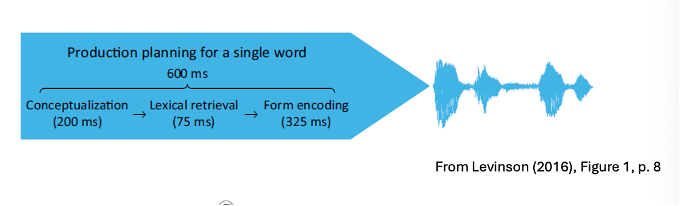
Planning while listening
Slow production system (600 – 1500 ms)
Short transitions between turns (0 – 200 ms)
We have to listen, predict and plan at the same time during conversation!
We have to predict what will be said, and when the turn will end - so suggests two dif processes going on
Recognising speech acts
People are very good at recognising the type of utterance - speech act that someone is using
Eg target utterance - i have a credit card, can be interpreted as many dif speech acts, depending on what comes before
Could be the answer to a question, could be a declination, or could be a pre-offer
When hear the target utterance, within a few hundred ms, able to distinguish between dif speech acts
So based on what has come before, they will realise the type of speech act they are dealing with - allows them to prepare their response for the next turn

Boiteau et al (2014)
Pps had to converse with each other, had to perform a visuo-motor tracking task at the same time, track the dot with the mouse
Would dif points in a conversation pose dif difficulties to the pps as they may be more demanding on attention
Language production is more demanding than language comprehension
Prediction: increased interference in the visuomotor task as participants are transitioning from listening to speaking - increase in planning and monitoring
results
Distance from the cursor, higher distance is worse
Better at tracking the dot when listening
There are different difficulties of the mouse-tracking task - low, medium and high
When preparing to talk, performance was a bit worse than when listening, but worst when talking
“The demands of conversation change dynamically in line with…increases in speech planning and monitoring” (p.302).
“Speech planning is the most resource-demanding aspect of conversation” (p. 306)
