TEAS - Things to remember
 Call Kai
 Learn
 Practice Test
 Spaced Repetition
 Match
 Flashcards
 Knowt Play
1/35

Earn XP
Description and Tags
combo of everything i need to remember for the TEAS
36 Terms
“Strong Arteries Benefit Body’s Performance”
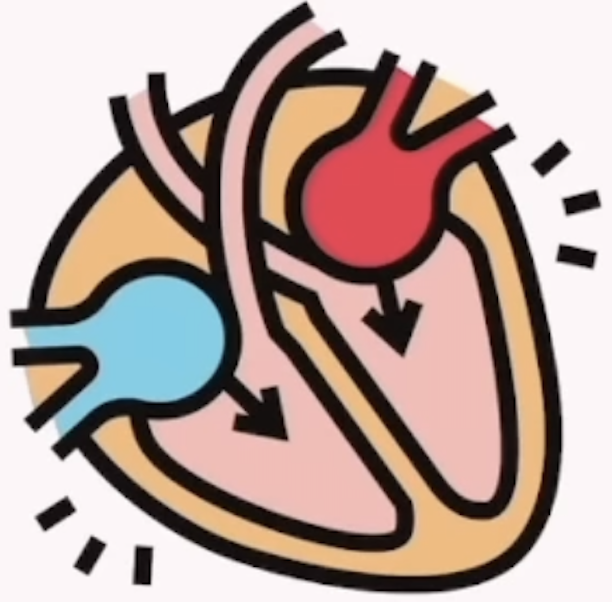
SA Node → AV Node → Bundle of His → Bundle Branches → Purkinje Fibers

ECG Polarizations:
Depolarization = Contraction
Repolarization = Relaxation
Atrial Depolarization → Atrial Contraction
Ventricular Depolarization → Ventricular Contraction
Ventricular Repolarization → Ventricular Relaxation
ECG Basics:
“ABC P-QRS-T”
P WAVE → Atrial Depolarization
QRS COMPLEX → Ventricular Depolarization
T WAVE → Ventricular Repolarization
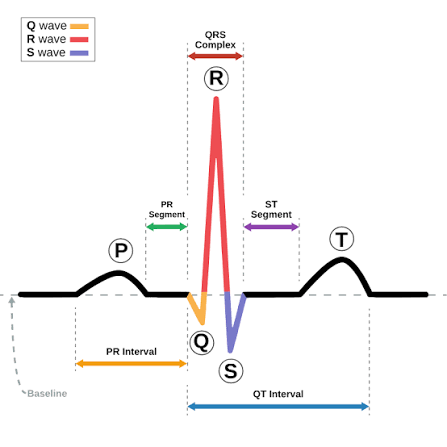
“QRS Complex looks like an inverted V”
V stands for ventricles → Ventricular Depolarization
Systolic Pressure:
“LUB & Squeeze!”
Contraction of the heart
“LUB” sound
Peak pressure in arteries
Lower than 120

Diastolic Pressure:
“DUB & Relax!”
Relaxation of the heart
“DUB” sound
Lowest pressure in arteries
Lower than 80
Hindbrain: “Medulla Manages, Pons Passes, & Cerebellum Coordinates”
Medulla Oblongata → Regulation of breathing, BP, & HR
Pons → Transmit signals btwn forebrain & cerebellum
Cerebellum → balance & movement; coordination

Midbrain: “MID Controls”
Movement
Involvement in the sleep/wake cycle
Detection of auditory & visual reflexes

Forebrain Functions:
“Forehead, Parachute, Optics & Ocular, Tempo”
FRONTAL LOBE: “forehead” → deep though & decision making
PARIETAL LOBE: “parachute” → covering top of head; sensory info
OCCIPITAL LOBE: “optics & ocular” → focusing on vision
TEMPORAL LOBE: “tempo” → hearing & rhythm in speech & memories

Peripheral Nervous System:
“Amazing Spider-man Saves People”
Autonomic Nervous System → Internal temp, regulate GI functions, excretory & endocrine systems; cardiac muscle activity
Somatic Nervous System → Motor functions of skeletal muscles (voluntary & somatic)
↳ Sympathetic: Fight or Flight response → increase HR & RR; slow digestion
↳ Parasympathetic: Rest & Digest → Decrease HR; digestion occurs
Afferent = Admission & Efferent = Exit
Afferent → sensory neurons input (ex: touch hot stove = afferent sensory neurons signal brain smth hot)
Efferent → motor neurons output (ex: brain processes info = efferent motor neurons tell muscle to pull hand away)
“L before P in digestion”
esophagus → Lower Esophageal Sphincter → stomach → Pyloric Sphincter → small intestine

Digestion: Mechanical vs Chemical
MECHANICAL:
stomach churns → bathes contents in gastric juices
↳ turns into chyme → puplu acid fluid passes from stomach into small intestine
CHEMICAL:
hydrochloric acid (HCl(acq)) → strong acidic solution of gas hydrogen chloride (HCI(g)) in H2O
pepsin → chief digestion enzyme in stomach that breaks down proteins & polypeptides
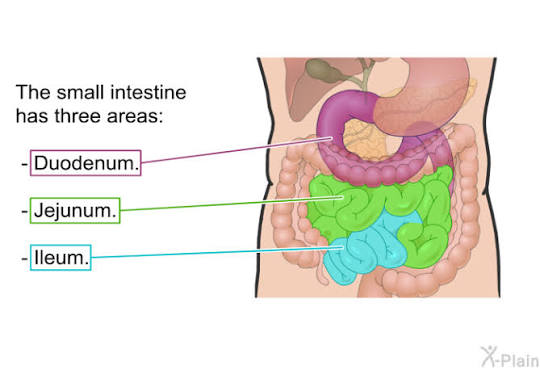
“Digestive Juices Intake”
DUODENUM → chemical digestion of chyme (breaks down fat, proteins, & carbohydrates); absorbs iron & other minerals
JEJUNUM → absorption of nutrients into bloodstream (carbohydrates & proteins)
ILEUM → absorption of nutrients (vitamin B12, bile salts, & products of digestion)
“Ascending Absorbs, Transverse Transports, Descending Drives Down”
ASCENDING COLON → absorbs H2O & salts; solidify waste into formed stool
TRANSVERSE COLON → storage site for digested food; more absorption of H2O & salts
DESCENDING COLON → carries solid waste toward rectum; more absorption of H2O & minerals; store feces until defecation

Gastrointestinal System Accessory Organs:
“Liver Builds & Breaks, Gallbladder Stores, & Pancreas Juices”
LIVER → carbohydrate & protein metabolism; creates bile to help w/ breakdown of lipids in small intestine
GALLBLADDER → store bile produced by liver
PANCREAS → produces pancreatic juices to help neutralize chyme
Gastrointestinal System Enzymes & Hormones:
“Great Gatsby Can’t Stay In Bed”
GASTRIN: in G cells of stomach → stimulate gastric glands to secrete pepsinogen & HCl
GLUCAGON: in alpha cells of pancreas → raises blood glucose lvls
CHOLECYSTOKININ: in I cells of duodenum & jejunum → digesting fats & proteins & stimulating gallbladder to release bile
SECRETIN: in S cells of duodenum → regulates pH by inhibiting gastric acid secretion & stimulating bicard production
INSULIN: in beta cells of pancreas → glucose metabolism & stores glucose as glycogen
BILE: produced by liver & stored in gallbladder → emulsifies fats
Muscular System:
“Spider-man Can Swing”
SMOOTH MUSCLE → involuntary control:
CONTROLLED by ANS; no conscious control
IN digestive system, arteries & veins, bladder, eyes,
HAS non-striated, one nucleus per fiber, spindle shaped
CARDIAC MUSCLE → involuntary control:
CONTROLLED by ANS; no conscious control; IN heart
HAS striations, one nucleus/per fiber, intercalated discs
SKELETAL MUSCLE → voluntary control:
CONTROLLED by SNS; conscious control of movement
IN tongue, diaphragm, upper esophagus
HAS striations, multiple nuclei per fiber
Muscular System Abilities:
“Everyone Can Eat Everything”
EXTENSIBILITY → to be stretched/extended
CONTRACTILITY → to shrink or contract
ELASTICITY → to return to original length when relaxed
EXCITABILITY → to respond to stimulus from motor neuron/hormone
Muscle Contraction:
“Squish A Muscle”
SARCOMERES: in muscles → relax = spread & contract = squish
ACTIN: thin filaments → protein that form contractile filaments of muscle cells
MYOSIN: thick filaments → fibrous globulin of muscles that split ATP & react to actin in muscle contraction

Sliding Filament Model:
“Candy Canes & Polar Bears Ready!”
CALCIUM ACTIVATION → Ca2+ binds troponin, exposing actin binding sites
CROSS-BRIDGE FORMATION → myosin head binds to actin
POWER STROKE → ADP & Pi released = myosin head pull actin filament to M-line, shortening sarcomere
BRIDGE DETACHMENT → ATP binds to myosin head, detaching from actin
REACTIVATION → ATP hydrolyzed recocks myosin head for next cycle
Male Reproductive System:
“Everyone Ready? Start the Show Live Tonight at TV”
Epididymis, Rete Testis, Seminiferous Tubule (Spermatogenesis), Septula, Lobules, Tunica Albuginea, Tunica Vaginalis
Male Reproductive Accessory Glands:
“Strawberry & Peanut Butter”
SEMINAL GLANDS → produce fluids that turn into semen
PROSTATE → produces fluids for semen, surrounds urethra, & activates sperm
BULBOURETHRAL GLAND (cowper’s gland) → discharges a component of seminal fluid into urethra that lubricates glans penis
Female Reproductive System:
“Usually, Only Fairies Can Voyage”
UTERUS → hormone responsive sex organs responsible for gestation, menstruation, & labor
OVARIES → oval-shaped glands where eggs form & hormones (estrogen & progesterone) made
FALLOPIAN TUBES → bilateral conducts btwn ovaries & uterus
CERVIX → lower, narrow end of the uterus that connects uterus & vagina
VAGINA → muscular, copulatory canal that goes from uterus to outside of body

Female Reproductive System — Vulva (external female genital organs)
MONS PUBIS → Area of fatty tissue that covers pubic bone
LABIA MAJORA → fleshly folds of tissue that extend down from mons pubis to merge w/ perineum skin
LABIA MINORA → Two inner folds of skin that surround opening of vaginal vestibule
VESTIBULE → Space btwn labia minora that houses urethral orifice & vaginal orifice
URETHRAL OFFICE → Opening which urine is discharged from body
VAGINAL ORIFICE → Slit btwn & behind opening of urethra for menstrual flow & childbirth
ANUS → Opening of rectum to outside of body which solid waste material

Endocrine Components:
“Have A Party Plan!”
HYPOTHALAMUS → makes own hormones
ANTERIOR PITUITARY GLAND → makes their own hormones
POSTERIOR PITUITARY GLAND → holds hormones made by the hypothalamus
PINEAL GLAND

Endocrine Reproductive Hormones:
O, P, F, L
OXYTOCIN → causes increased contractions of uterus during labor stimulates ejection of milk into duct of breasts
PROLACTIN (PRL) → stimulates milk production in mammary glands
FOLLICLE-STIMULATING → formation of ova/sperm
LUTEINIZING HORMONE → stimulates ovulation in females & androgen in men
Reproductive Hormones of Gonads:
E, P, A
ESTROGEN → steroid hormone develops female sex characteristics
PROGESTERONE → creates healthy uterine linin for menstrual cycle & pregnancy
ANDROGEN → develops make sexual reproduction & characteristics
Integumentary System Layers:
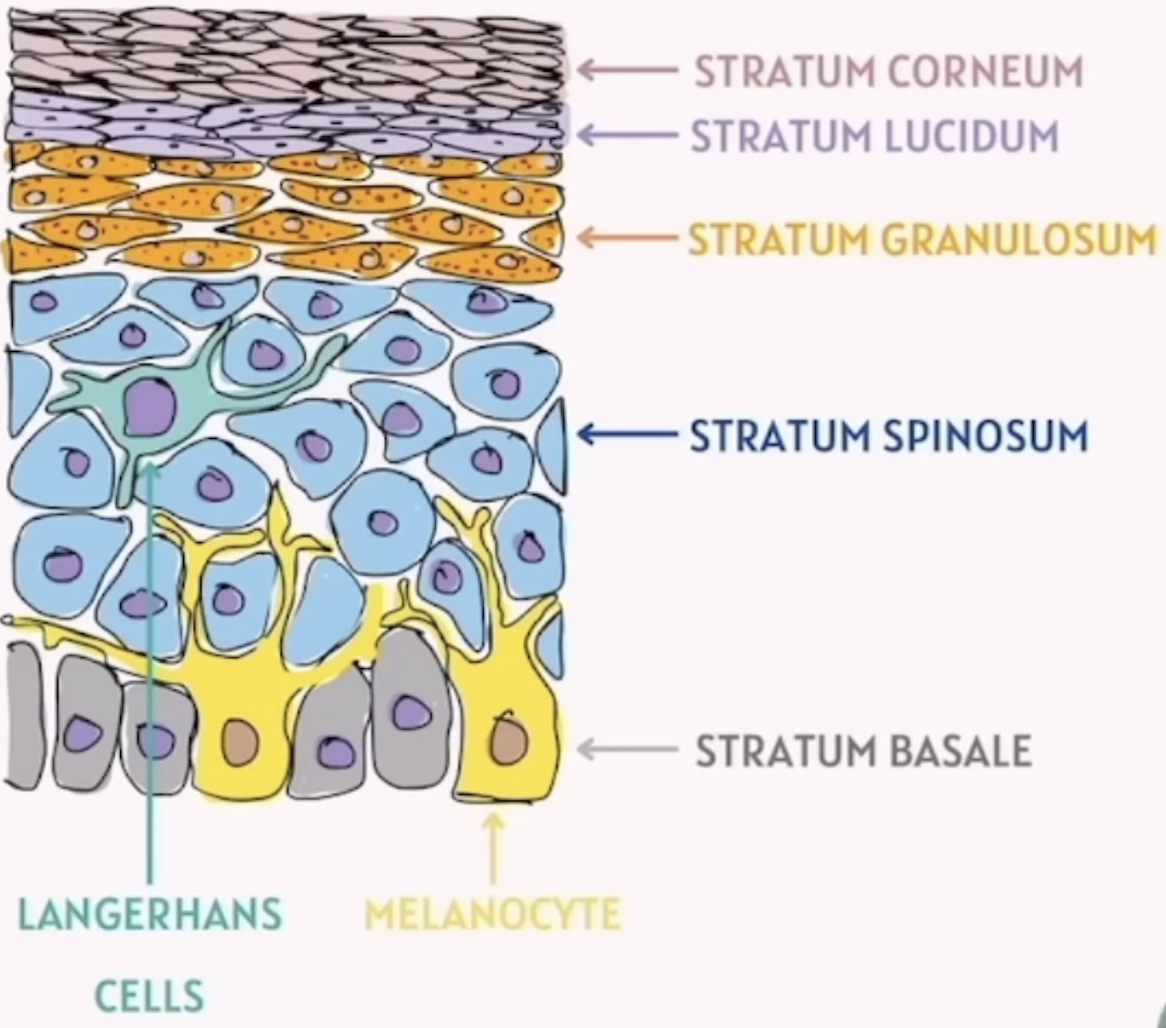
“Come Mate, Let’s Get Sun Burnt Lads”
STRATUM CORNEUM → outermost layer made up of keratin & lipids
MELANOCYTES → cells in skin & yes that produces & contains pigment (melanin)
STRATUM LUCIDUM → thin, clear layer of dead skin cells in thick skin on palms of hands & soles of feet
STRATUM GRANULOSUM → thin layer of cells that has granules of lipids to form waterproof layer
STRATUM SPINOSUM → keratinocytes held tg by desmosomes to make skin flexible & strong
STRATUM BASALE → single columnar/cuboidal row of cells that divide to replace epidermis as it wears away
LANGERHANS CELLS → tissue macrophages of skin
Dermis Layer
PROTEINS → elastin & collagen made by fibroblasts
CONTAINS → blood vessels, sweat glands, nerves, hair follicle
ETC → non-epidermal CT glues everything together
LAYERS → papillary layer & reticular layer
SCARS → fibrous CT makes & leaves mark on skin & creates scar if wound happens in dermis layer
KELOID → irregular fibrous tissue formed at site of scar bc increased collagen production
Hypodermis Layer
IMPORTANCE → connects skin to bone & muscle tissue
HAS → adipose tissue
SWEAT GLANDS → thermoregulation (vasodilation = heat release, vasoconstriction = retain heat)
SEBACEOUS GLANDS → waterproof & lubricate skin & hair
HAIR FOLLICLE → hair bulb undergoes mitosis to drive hair root growth
NAILS → nail root undergoes mitosis to drive nail growth
Skin Cancer
SKIN CANCER → most common cancer in states
BASAL CELL CARCINOMA → abnormal, uncontrolled growth of basal cells
MELANOMA → tumor of melanin-forming cells
SQUAMOUS CELL CARCINOMA → cancer growth make up middle & outer layers of skin
Burn Types
FIRST DEGREE BURNS: outer layer of skin (epidermis) → minor inflammation & redness
SECOND DEGREE BURNS: extends thru epidermis into upper layers of dermis → swelling, blistering, & significant plan
THIRD DEGREE BURNS: penetrates full depth of epidermis & dermis → white/charred skin & numbness bc nerve damage
FOURTH DEGREE BURNS: reaches beyond skin layers into tissue, bonds, & muscles → loss of function
EN = ENTER
EX = EXIT
ENDOCRINE → releases hormones into surrounding no special ducts
EXOCRINE → gland that makes substances & releases them thru duct/opening to body
Hormones Biomolecules
POLYPEPTIDES → derived from amino acids
STEROIDS → derived from lipids
Pituitary Gland Hormones
OXYTOCIN →
ANTIDIURETIC HORMONE (ADH) →
GROWTH HORMONE →
PROLACTIN (PRL) →
THYROID-STIMULATING (TSH) →
FOLLICLE-STIMULATING →
LUTEINIZING HORMONE →
ADRENOCORTICOTROPIC (ACTH) →