FINAL EXAM ANTH 135
 Call Kai
 Learn
 Practice Test
 Spaced Repetition
 Match
 Flashcards
 Knowt Play
1/101

There's no tags or description
Looks like no tags are added yet.
102 Terms
When did Hominins appear?
First appeared around 7 million years ago in the cenezoic era
What is a Hominin?
Any member of the tribe Homini

What is Least Common Ancestor? (LCA)
Most recent individual from which all the organisms of the set are descended

How did Hominins evolve?
Hominins evolve in a branch
What are the big trends in Hominin evolution?
Increase of Brain size and complexity
Decrease in canine size and prognathism
Increase in body size
Increase in bipedal features
What is Bipedalism? And what could be the cause of Bipedalism?
Bipedalism - Walking upright on two legs
Causes: Foraging, Carrying, Body Heat, Tall Grass, Traveling, Tool Use
Where is the Foramen Magnum located?
The hole in the skull where the spinal cord connects to the brain
Quadrupeds is towards the back
Bipeds is centered so it’s balanced

Explain Femur Bicondylar Angle and do Quadrapeds have this?
The Angle created between the proximal and distal end of the femur when standing. Allows for body weight to be centered.
Quadrapeds don’t have this.

What are Grades?
Hominins that seems like they fill the same morphological/ecological niche
Explain the Differences between Adducted Hallux (Hominin) vs Opposable Hallux (Ape)
Adducted Hallux:
Big toe is in line with the rest of the toes and is more robust for pushing off with the toe
Opposable Hallux:
Big toe is divergent from the rest of the foot and is capable of grasping

Explain the use of Arch in foot
It’s a longitudinal arch that assists in foot spring while walking
What is the difference between S shaped spine (hominin) and C shaped spine (Ape)
S shaped spine:
4 curves in cervical, thoracic, lumbar, and sacral
C shaped spine:
One long curve from head to pelvis

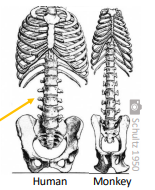
What is the purpose of the Robust lumbar vertebrae?
To support more weight

What is the difference in a Chimp vs a Human’s pelvis orientation proportions?
Shorter and broader
Iliac blades oriented more laterally
Robust sacrum
Helps to support weight of upper leg and glute muscles overall
What is a gait? How do Humans walk vs an Ape?
A manner of style of walking. Apes walk like it’s waddling while Humans are stable, supported , and expend less energy to keep upright.

How can you determine that A. afarensis is bipedal?
You can determine that it’s bipedal due to comparing the angle from a Homo and a Gorilla. The Homo matches the angle with A. afarensis

What was the discovery in Sahelanthropus Tchadensis?
Sahelanthropus was found by Michel Brunet of its “Toumai” Cranium (jaws and teeth too) in Chad.

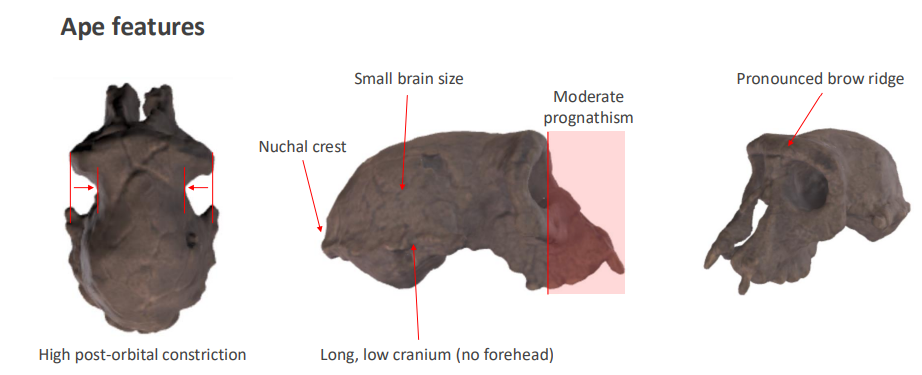
What are the features of the Sahelanthropus Tchadensis Cranium?
Features of Sahlenthropus Cranium:
High post orbital constriction
Moderate proganthism
Pronounced brow ridge
Small brain size, Nuchal Crest, No forehead
What was the Discovery of the Orrorin Tungenesis
Orrorin Tungenesis was discovered in Kenya by Martin Pickford and Brigitte Senut.
Discovered the Femur

What is a Mosaic?
A mosaic is having some features of apes and some features of humans
What was the Discovery of “Ardi” Ardipithecus Ramidus
Discovered in Ethiopia by Gen Suwa, Berhane Asfaw, and Tim White:
Mainly known of having almost all of the anatomical key features of bones like: Ulna, Teeth, Skull, and Humerus but they are all in fragments
Has Bipedal features and Ape Features for climbing, Adapted for arboreal activity
Skull is small, canines are not similar like apes, small brow and has a projecting face
Lead to Ardi being in a Forested Environment

What was the discovery of the Australopithecus Anamensis
Australopithecus Anamensis
Discovered in Kenya by Bryan Patterson and Meave Leakey
Found Jawbone, teeth, fragmented arm, thigh, finger bones, and a skull
What were the features about the Australopithecus Anamensis?
We can Determine Australopithecus Anamensis:
It’s bipedal since its ankle is straight
The arm bone is arboreal and still apey
The Skull has:
Prognathism
Post-Orbital Constriction
Sagittal Crest


Who’s teeth is this? What can we suggest from it?
(Teeth) Australopithecus Anamensis
Robust anterior teeth
Plant based diet cause of microwear
The environment must be forested around lakes
What was the discovery of Australopithecus Afarensis?
The discovery of Australopithecus Afarensis
Discovered by: Mary Leakey and Don Johanson
Many found In Ethiopia, Hadar, Laetoli, Tanzania
A full adult skeleton (Named Lucy), nearly complete baby skeleton (Named Salem)
Knee joint and limb fragments, other bones, several mandibles and partial crania
What are the features of Australopithecus Afarensis?
Features of Australopithecus Afarensis:
Skull: Small Braincase = Small brain, lower face projects forward, receded chin, short and low forehead
Upper Body: Powerful arms, Funnel shaped Ribcage, long forearms, obile wrist that’s similar to modern apes
Lower Body: Heel is modern human like, Upright walking due to the joint angle of knee, Complete knee joint, Thigh length is short, but can balance on its hind legs,
Overall it’s Bipedal

Who’s teeth is this? What can we determine about it?
(Teeth) Australopithecus Afarensis
Tooth shape is generalist diet consists of fruits, nuts, and insects
Species found in almost a million years so it can adapt
What was the discovery of Australopithecus Africanus?
The discovery of Australopithecus Africanus:
Found in Taung, South Africa
Discovered by Raymond Dart
Found partial skulls, jawbones, and skeleton fragments
Dated by 2.3-2.8 mya
What are the Featuers of Australopithecus Africanus?
Features of Australopithecus Africanus:
Skull: Domed braincase same brain size as modern apes
Broad upper jaw
Gracile cheekbones
Lower body: Six lumbar vertebrae can walk bipedally while also flexibile due to their feet and the adaptation from their hips
Upper Body: Relatively long arms, mobile shoulder, large hands, and is good at climbing


What was the discovery of Australopithecus Sediba?
The discovery of Australopithecus Sediba
Found in Malapa, South Africa in a cave deathtrap
1.98 mya by U series dating and Archaeomagnetism
Discovered two partial skeletons and bone fragments
What are the features of Australopithecus Sediba?
Features of Australopithecus Sediba:
Bipedal but gait is different as they’re walking inwards
Skull: Rounded skull, Flatter face and narrower, teeth are similar to homo species
Hands: Arobreally adapted but very differently than other hominins
What are the General trends of Genus Australopithecus?
General Trends of Genus Australopithecus:
Bipedal traits in lower skeleton is clearer
Arboreal features in upper limb and hand
Brain size is small but still developing
Sexual dimorphism is maintained
Body size is slightly larger than chimpanzees
Gracile skeleton and face