Advanced strength + conditioning (part 2)
 Call Kai
 Learn
Learn Practice Test
 Spaced Repetition
 Match
Match Flashcards
 Knowt Play
1/32

There's no tags or description
Looks like no tags are added yet.
Name | Mastery | Learn | Test | Matching | Spaced | Call with Kai | Chat |
|---|
No analytics yet
Send a link to your students to track their progress
33 Terms
How should training load and repetitions be determined?
Based on the athlete's training status, goals, and 1RM (actual or predicted). Adjust exercise load, repetitions, and rest periods according to the training goal.
Send the next slide, and I'll make one concise, high-yield text flashcard per slide.
What is the difference between 1RM and RM, and how should 1RM be assessed?
1RM = maximum weight lifted for one repetition with proper technique. Best for intermediate/advanced athletes using multi-joint exercises. Testing must be consistent (same depth, warm-up, equipment). RM = maximum weight lifted for a specific number of repetitions (e.g., 5RM). Training load is commonly expressed as %1RM.
Why are training loads varied throughout a microcycle?
Volume and intensity alternate between heavy, medium, and light days. Heavy days involve near-maximal effort (~1 rep short of failure), while medium/light days allow recovery while maintaining training frequency and volume.
What is the 2-for-2 rule for progressive overload?
If an athlete performs 2 or more additional reps beyond their assigned goal in the last set of 2 consecutive workouts, increase the weight for that exercise in the next session.
What are six ways to progressively overload without increasing weight?
Volume: Increase sets or reps.
Density: Decrease rest time.
Tempo: Slow eccentric movement (increase time under tension).
Complexity: Progress to more challenging exercises.
Range of motion: Increase movement depth.
Frequency: Train more days per week.
What are mechanical work, volume-load, and repetition-volume?
Mechanical work = Force × Displacement
Volume-load = Weight × Reps × Sets (measures training workload but not actual mechanical work).
Repetition-volume = Total number of repetitions performed during a workout.
What determines rest period length, and how does rest duration affect training?
Rest depends on training goals, load lifted, and training status.
Heavier loads: Longer rest periods.
Shorter rest: Increases metabolic stress and endurance.
Longer rest: Benefits strength and power.
Rest periods should vary by exercise rather than being the same for all exercises.
What are the recommended rest periods for strength, power, hypertrophy, and muscular endurance?
Strength & Power: 2–5 minutes
Hypertrophy: 2–3 minutes (multi-joint); 60–90 seconds (single-joint)
Bodybuilding: 30–90 seconds
Muscular Endurance: ≤30 seconds
Why is monitoring essential in resistance training?
Track progress: Measure improvements in strength, power, and velocity.
Adjust programs: Individualize training plans.
Prevent injury: Identify fatigue and overtraining early.
Ensure recovery: Monitor signs of adequate or inadequate recovery.
What metrics are used to monitor strength and power in the weightroom?
Volume: Sets × Reps
Volume-load: Sets × Reps × Weight
Intensity: %1RM, RPE, or reps in reserve (RIR)
Weight lifted trends: Track estimated 1RM over time.
Bar velocity: Slower speed at a familiar load may indicate fatigue.
What are the formulas for calculating training volume and intensity?
Number of lifts (NL) = Sets × Reps
Load volume = Sets × Reps × Load
Average load lifted = Load volume ÷ NL
Average intensity (%1RM) = (Average load lifted ÷ 1RM) × 100%
An athlete has a 1RM of 115 kg and performs:
5 sets × 5 reps at 100 kg.
5 sets × 5 reps at 95, 105, 110, 110, and 110 kg.
For each scenario, calculate the number of lifts (NL), total load volume, average load lifted, and average intensity (%1RM).
Scenario 1: Constant Load
NL = 25
Load volume = 2,500 kg
Average load = 100 kg
Average intensity = 86.9% 1RM
Scenario 2: Varying Load
NL = 25
Load volume = 2,650 kg
Average load = 106 kg
Average intensity = 92.2% 1RM
What is maximal recoverable volume (MRV), how is it determined, and which exercises cause the most fatigue?
MRV: Maximum training volume an athlete can recover from within a given period.
Determined individually through trial and error.
Exceeding MRV: Decreased performance in subsequent workouts due to insufficient recovery.
Most fatiguing: Deadlift.
Least fatiguing: Bench press.
General weekly set ranges:
Hypertrophy: 8–20 sets
Strength: 4–16 sets
Peaking: 2–8 sets
What are the differences between linear, undulating, and block periodization?
Linear: Gradually increases intensity while decreasing volume over time (hypertrophy → strength → power).
Undulating: Frequently varies volume and intensity within short periods (e.g., weekly), training multiple qualities.
Block: Focuses on one training quality per mesocycle (e.g., strength or hypertrophy).
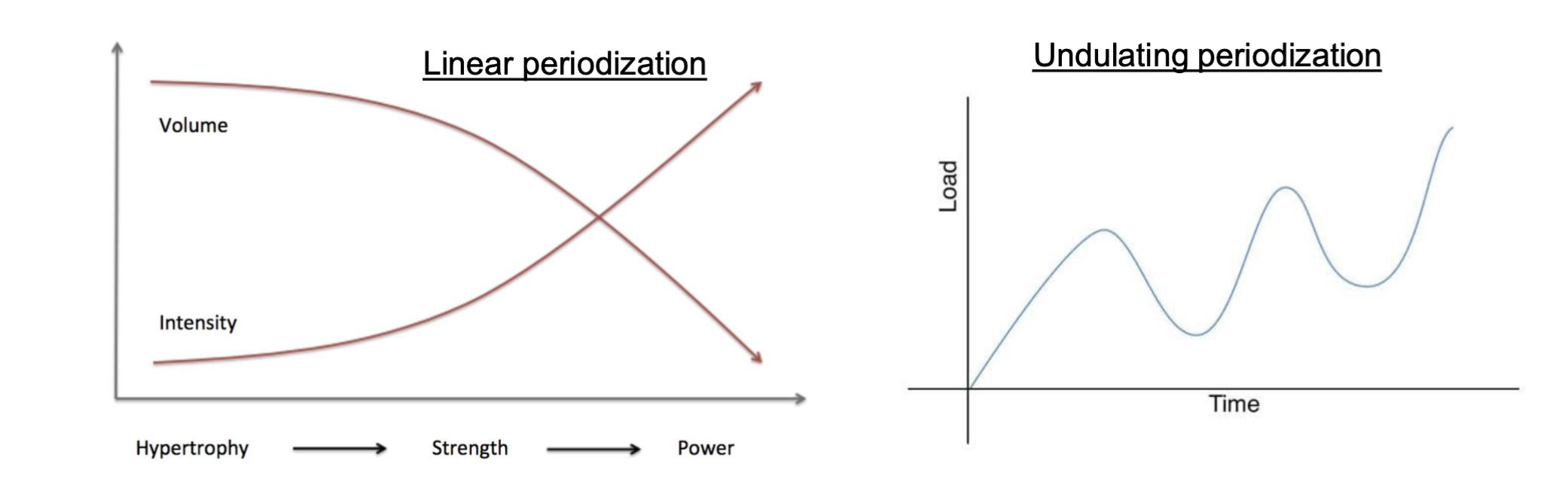
Is linear or undulating periodization better?
It depends on the athlete's goals and needs.
Undulating: May be better for developing multiple adaptations simultaneously.
Linear: Gradually progresses from hypertrophy → strength → power.
Both: Can be combined during different training phases.
How is periodization implemented in a training program?
Backward approach: Start with final goal → mesocycles → microcycles → training sessions.
Volume: Begin near minimal effective volume (MEV) and gradually increase.
Adjustments: Based on athlete feedback, progress, and external factors.
Microcycles: Vary intensity and volume, but keep exercises consistent for adaptation.
Mesocycles: Progress exercises to become more complex or sport-specific.
performance testing…
Why do we test athletic performance, and what are the types of goals and SMART criteria?
Identify talent and areas for improvement.
Set training goals specific to athletic performance.
Motivate athletes through measurable progress.
Goal Timeframes:
Short-term: 1–2 months
Midrange: Current season
Long-term: 1–2+ years
SMART Goals: Specific, Measurable, Attainable, Relevant, Timing.
What are the key testing terms used to evaluate athletic performance?
Testing Battery: Series of tests assessing multiple athletic skills.
Pretest: Before training; establishes baseline ability.
Mid-test: During training; assesses progress and guides adjustments.
Formative Evaluation: Periodic reassessment using mid-tests at regular intervals.
Post-test: After training; evaluates program effectiveness and goal achievement.
What is validity, and what is the difference between construct validity and face validity?
Validity: How well a test measures what it is supposed to measure.
Construct validity: How well a test measures the underlying concept or ability it is designed to assess.
Face validity: Whether a test appears to measure what it should, based on the athlete's or observer's perception.
What is test-retest reliability, what factors affect it, and how does it differ from accuracy?
Test-retest reliability: Consistency or repeatability of test results.
Intra-subject variability: Inconsistent performance by the same athlete.
Inter-rater variability: Differences in scoring between different testers.
Intra-rater variability: Inconsistent scoring by the same tester across trials.
Reliability ≠ Accuracy: A test can produce consistent results but still be inaccurate.
What is accuracy, and how does it relate to validity and reliability?
Accuracy: Ability to measure the true value.
Validity: Measures what it is supposed to measure.
Reliability (Precision): Produces consistent, repeatable results.
Good precision, poor accuracy: Consistent but incorrect results.
Good precision, good accuracy: Consistent results close to the true value.
Poor precision, poor accuracy: Inconsistent and incorrect results.
Key: A test can be reliable without being accurate.
What causes inaccuracy in testing, and what are the types of measurement error?
Observed score = True score + Error
Random error: Unpredictable variation (white noise); reduces precision.
Systematic error: Predictable, consistent bias in one direction; reduces accuracy.
Overall error: Random error + Systematic error.
What preparations are necessary before athletic performance testing?
Staff & Team: Establish date, time, duration, and staff responsibilities.
Testing Organization: Determine athlete order, test sequence, and number of attempts.
Standardization: Use consistent testing methods, rest periods, and RAMP warm-up.
Data Management: Establish procedures for recording and storing results.
What are the eight main parameters assessed during athletic performance testing?
Maximum muscular strength
Maximum muscular power
Agility
Anaerobic capacity
Local muscular endurance
Aerobic capacity
Speed
Nonfatiguing measures (anthropometrics and movement)
What are the seven fatiguing performance testing parameters and examples of each?
Muscular Strength: 1RM, multiple-RM, isokinetic dynamometry.
Muscular Power: Vertical jump, broad jump, 1RM power clean.
Anaerobic Capacity: 400 m sprint, 300 yd shuttle, Yo-Yo Level 2.
Local Muscular Endurance: 1-minute push-ups, YMCA bench press test.
Agility: 5-10-5 test, T-test, zig-zag agility test.
Speed: 40-yard dash, 100 m sprint.
Aerobic Capacity: VO₂max, 1.5-mile run test.
What are the three non-fatiguing performance testing parameters and examples of each?
Flexibility: Measures range of motion. Examples: Sit-and-reach test, overhead squat.
Balance & Stability: Ability to maintain or regain equilibrium. Example: Balance Error Scoring System (BESS).
Body Composition: Proportions of fat and lean tissue. Examples: Skinfolds, DXA, BIA.
What are the key considerations when conducting athletic performance testing?
Sport-specific: Select tests relevant to the sport.
Consistency: Standardize weather, surface, and equipment.
Test Order: Non-fatiguing tests before fatiguing tests.
Preparation: Standardized warm-up, instructions, and familiarization.
Recovery Between Attempts:
Non-maximal: 2–3 minutes
Maximal: 3–5 minutes
What are the key considerations for proper athletic performance test administration?
Testers: Train testers for consistency; use the same tester for each test when possible.
Recording Forms: Prepare scoring sheets beforehand to reduce errors.
Test Format: Test athletes together or in groups; each tester administers one test at a time.
Test Conditions: Maintain consistent temperature, surface, and equipment.
What is the correct order of athletic performance testing to minimize fatigue?
Non-fatiguing tests
Agility
Maximum power & strength
Sprint (speed)
Local muscular endurance
Anaerobic capacity (long, fatiguing tests)
Aerobic capacity
Key: Never test athletes when fatigued. Ideally, separate maximal-effort tests across different days.
What steps should be taken to properly prepare athletes for performance testing?
Communicate: Inform athletes of the date, time, and purpose.
Familiarization: Conduct pretest practice to reduce variability.
Instructions: Provide clear, simple directions to improve reliability and validity.
Demonstration: Show proper testing technique.
Warm-up: Perform a standardized pretest warm-up.
Feedback: Provide consistent feedback between trials.
Cool-down: Supervise a post-test cool-down.
What five instructions should be clearly explained to athletes before performance testing?
Test Purpose: Explain what is being measured (e.g., 1RM squat = lower-body strength).
Test Procedure: Explain proper technique and execution.
Attempts: Specify practice reps, number of trials, and rest periods.
Disqualification Criteria: Explain what makes an attempt invalid (e.g., insufficient squat depth).
Performance Recommendations: Provide technique cues to maximize performance.