3: timestep and CFL condition
 Call Kai
 Learn
 Practice Test
 Spaced Repetition
 Match
 Flashcards
 Knowt Play
1/12

There's no tags or description
Looks like no tags are added yet.
13 Terms
What is the CFL condition? (Q3.A)
condition used in modelling to keep model stable
wave should not travel more than 1 grid cell during 1 time step
C = Courant number

What is the Courant number (C)?
The distance a wave travels in one time step within the grid
What if C = 0.5? (Q3.A)
wave travels half a cell per time step
What if C = 3? (Q3.A)
wave travels three cells per time step

What happens when C exceeds 1? (Q3.A)
Wave travels too fast for the computer to keep up.
Errors can grow, model can become unstable
Where is the CFL condition used? What model? And why? (Q3.A)
ROMS = explicit model
SCHISM = semi-implicit model
What controls time steps in CFL condition? Why? (Q3.B)
Maximum depth controls timesteps (aka 128m)
Deeper water = increased wave speed = smallest allowable time step as they cross grid cell sooner
Shallow water = decreased wave speed = longer time step
Why does the 3D model split its time step up? (Q3.B)
The 3D model splits long time step (120s) into smaller time steps i.e. 6s every 120s while 2D just has short time steps…
You can calculate Fast surface waves in more frequent updates (i.e. 6 seconds)
But to show detailed changes in a 3D flow (with depth), you calculate individual layers and show how currents differ with depth
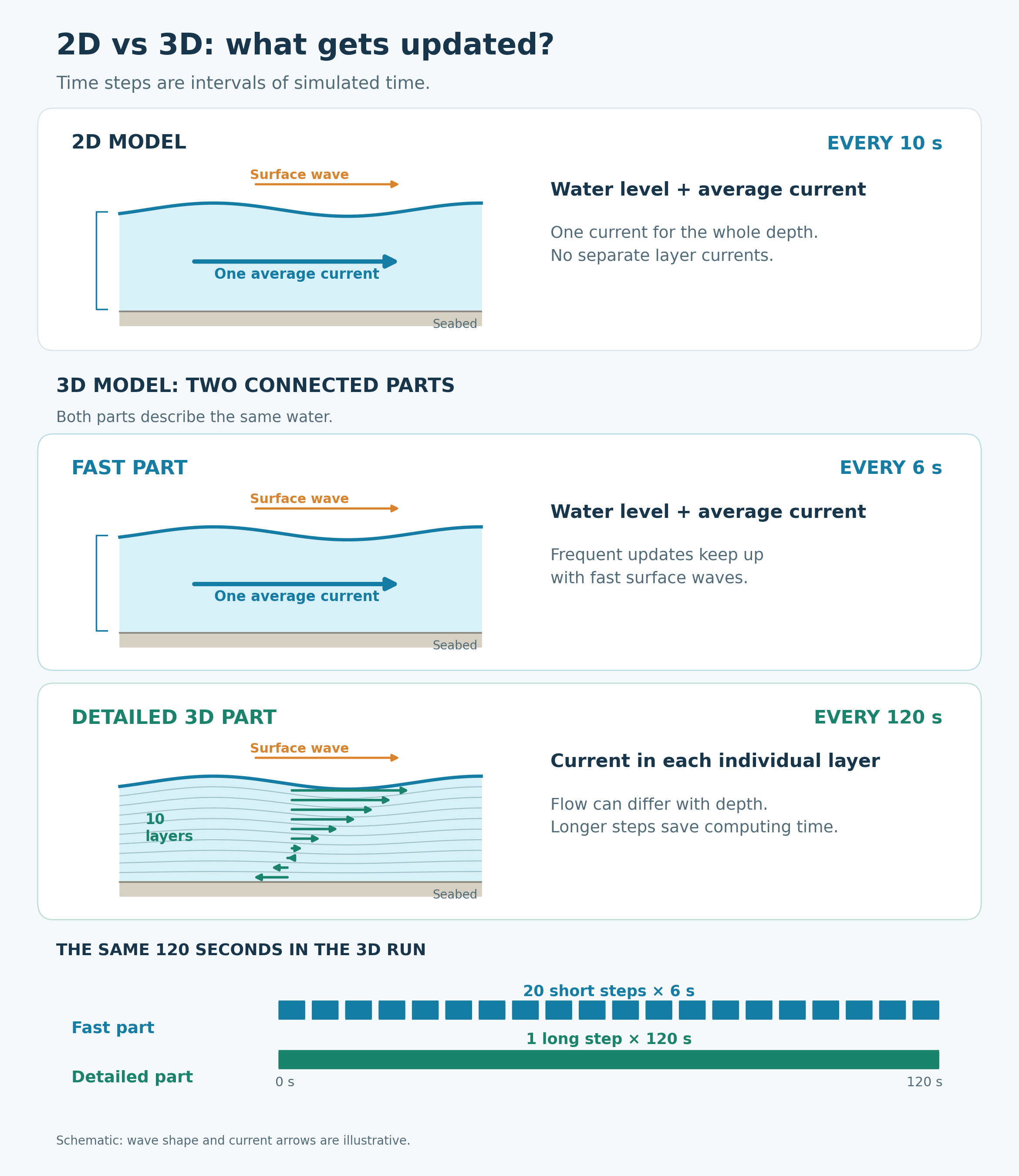
Difference between 3D vs 2D model in CFL? (Q3.B)
2D → updates water level and the depth-averaged current every 10s → x and y only — does not calculate separate layer currents
3D → updates water level and depth-average current (x,y) by 6s AND currents with depth (z) 120s
What does it mean when C = 0.35 vs C = 0.21? (Q3.B)
C = 0.35 → the wave travels 0.35 of a cell in 1 timestep (3D)
C = 0.21 → the wave travels 0.21 of a cell in 1 timestep (3D) - more frequent updating
Is an explicit model be stable for C=2.97? How could we make this stable for ROMS? (Q3.B)
No, it fails the standard explicit method, it would not be stable as the wave travels 3 grid cells during 1 time step.
We could decrease timestep to make it more stable.
What is different about the way SCHISM computes the free surface that allows this? (Q3.C)
ROMS = explicit method - calculates next update directly using already known values (incl values at neighbouring cells)
SCHISM = semi-implicit - calculates next update by
1. explicit for some terms (uses already known values) AND
2. implicit for others — aka unknown values we have to solve for:
pressure-gradient term (caused by sea-level slopes)
continuity equations
*this implicit treatment avoids the CFL restriction <1 - allows longer timesteps