sea turtles
 Call Kai
 Learn
Learn Practice Test
 Spaced Repetition
 Match
Match Flashcards
 Knowt Play
1/65

There's no tags or description
Looks like no tags are added yet.
Name | Mastery | Learn | Test | Matching | Spaced | Call with Kai | Chat |
|---|
No analytics yet
Send a link to your students to track their progress
66 Terms
Purpose of turtle shell
Modified ribcage
Oviparous
Reproductive strategy of laying eggs
K-strategists
Produce few offspring but invest significant parental care in their growth and survival.
Turtle life expectancy
Often over 50, sometimes over 100 for large terrestrial species
Cosmopolitan distribution of turtles
terrestrial, freshwater, and marine habitats
Ectotherms
Activity and distribution are dependant on environmental termperature
TDS
temperature dependent sex determination
Secondary aquatic
Sea turtles breathe air
Sea turtle skin is covered with
Scales and scutes (keratinous layer of epidermis)
Sea turtle adaptations to marine environment
Shell is reduced and has hydrodynamic shape
Front and hind legs are flippers
Can’t contract into shell
Salt glands (turtle tears)
Living families of sea turtles
Dermochelyidae (leatherback)
Cheloniidae (6 species)
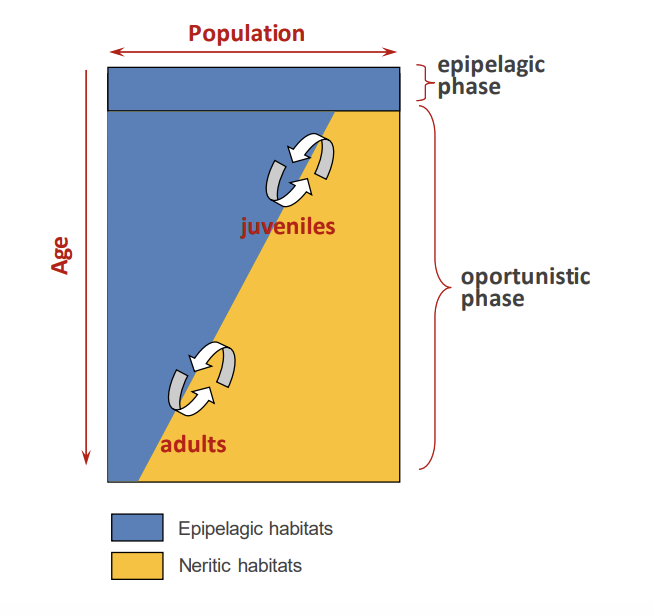
Life history patterns
Neritic developmental pattern (Natator depressus)
Oceanic developmental pattern (Dermochelys coracia & Lepidochelys olivacea)
Oceanic-neritic developmental pattern (All other species)
Relaxed life history model
Status
evaluation of populations relative to some standard/goal
Harvest objectives
Population size/level that would support sustainable yield/catch
Conservation objectives
Ranging from preventing the extinction of species to returning populations to their “natural”/ carrying capacity level
Conservation status metrics
Population trends and probability of extinction
Threatened species classification
Critically engangered (CR), Endangered (EN) and Vulnerable (VU)
Conservation metric/criteria
Population reduction (A), Restricted distribution decline or fluctuation (B), Small population size and decline (C), very small or restricted (D), and quantitative analysis (E)
Shell breakdown
Dorsal shell (carapace), ventral shell (plastron), keratinous plates (scutes)
Evolution of shell on land
Turtles related to pareiasaurus, outside-in evolution of shell, teeth in upper jaw
Aquatic shell evolution
Turtles related to diapsids, inside-out evolution of shell, teeth in upper and lower jaw
First turtle and sea turtle
First turtles ≈ 220 MYA, first sea turtles ≈ 110 MYA
Fam. Dermochelyidae identification
Leatherback turtle (dermochelys coriacea) - leathery shell, no scutes and longitudinal dorsal ridges
Olive ridley identification
Lepidochelys olivacea
2 pairs of prefrontal scales
5 or more costal scutes, first costal scute touches nuchal scute
4 inframarginal scutes with pores
6 or more costal scutes
Kemp’s ridley identification
Lepidochelys Kempii
2 pairs of prefrontal sales
5 or more costal scutes, first costal scute touches nuchal scute
4 inframarginal scutes with pores
5 costal scutes, rounded carapace
Loggerhead identification
Caretta caretta
2 pairs of prefrontal scales
5 costal scutes, first costal scute touches nuchal scute
3 inframarginal scutes without pores
Hawksbill identification
Eretmochelys imbricata
2 pairs of prefrontal scales
4 costal overlapping scutes, first costal scute does not touch nuchal scute
4 inframarginal scutes without pores
Flatback identification
Natator depressus
1 pair of prefrontal scales
4 costal scutes, first costal scute does not touch nuchal scute
4 inframarginal scutes without pores
Flattened carapace with upturned edges
Green turtle identification
Chalonia mydas
1 pair of prefrontal scales
4 costal scutes, first costal scute is not in contact with nuchal scute
4 inframarginal scutes without pores
Rounded head, serrated lower jaw
CCL and CCW
CCL - cuved carapace length
CCW - curved carapace width
Heat exchange
radiation: solar radiation
conduction: heat transfer by direct physical contact
convection: heat transfer by currents of moving fluid
Reptiles control their body temperature by
Thermoregulatory behavior, morphological characters, physiological processes
Physiology and thermoregulation
Cardiovascular control and heat production
Cardiovascular control
changes in heart rate
control of peripheral circulation
Heat production
muscular production
metabolic heat production
counter-current heat exchange
Counter-current heat exchange in sea turtles
Loggerhead and green turtles: radial form
Leatherback turtle: matrix form
How do leatherback turtles maintain higher body temp than surrounding water?
regional endothermy
thermal inertia
control of peripheral circulation
Morphology and thermoregulation
morphological characters like crests (not sea turtles)
Dark colors (melanism)
Thermoregulatory behavior
Because environmental heat loads vary with time and among habitats, reptiles attempt to buffer variation by selecting thermally suitable habitats, restriction of activity time, adopting specific positions and postures
Temperature Dependant Sex Determination
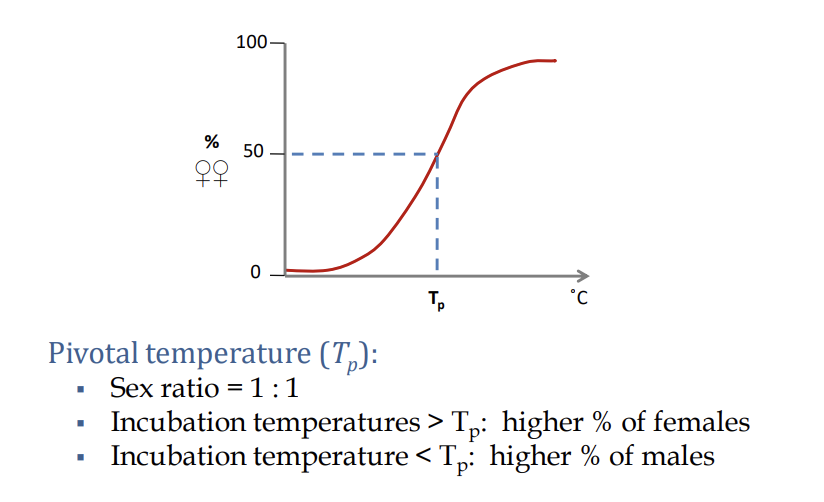
Thermal biology of nest for loggerheads
Nesting pivotal temp: 29.3 C
Incubation: 52.6 days
Nest depth: 50 cm
Reproduction migrations
Adult females move from foraging grounds to reproductive habitats (2-4)
Reproductive habitats constraints
Conditions for adult activity
Conditions for embryonic development
Survival of hatchlings
Nesting process
Beach selection / ascending the beach
Excavating the body pit (5-10 min)
Digging the egg chamber (20 min)
Ovoposition (20-30 min)
Filling the egg chamber (10 min)
Filling the body pit (10 min)
Returning to the sea
Beach Selection
Must be accessible from the sea, high enough to prevent inundation, moist substrate and fine sand must prevent the egg chamber from collapsing, particle size must facilitate gas diffusion
Philopatry
Regional discrimination of reproductive regions
Site fidelity
Fine scale homing to beach
Reproductive biology stats
remigration period: 2-4 years
Nest depth 50-80 cm for constant temp
2-4 nests/reproductive season
10-14 day internesting interval
Embryonic development stats
fertility: >80%
Sex determination: TSD
Pivotal temperature ≈ 29 C
Incubation period: 50-80 days
Hatching success >80%
Hatchling emergence
Break out of shell (pipping)
Quiescent period (around 1 day) for resorption of yolk
Social facilitation (mutual stimulation)
Synchronized upward digging through nest
Inhibition of movements at high temperature
En-masse emergences at night and early morning (1-7 days after pipping)
Orientation and navigating after emergence
sea finding: visual cues (orientation towards brighter, lower oceanic horizon)
nearshore waters (wave refraction zone): wave orientation (24-48 hour swimming frenzy to open ocean)
open ocean: magnetic orientation
“Reproductive population” sea turtles in Mediterranean
Caretta caretta and chelonia mydas
“Rare visitor” sea turtles in the Mediterranean
Eretmochelys imbricata and lepidochelys kempii
“Vagrant” sea turtles in the Mediterranean
Dermochelys coriacea
Green sea turtle reproductive populations
Major green turtle rookeries: Turkey, Cyprus, and Syria
Mean nest number change 2000-2016: +47.1%
Regional IUCN status: Near threatened B2b(ii,iii)
Conservation dependent
Loggerhead sea turtle reproductive populations
most clutches laid in greece, turkey, libya, and cyprus
mean nest number change since 2000-2016: +26.4
regional iucn status: least concern
conservation dependent
Polyandry
clutch fertilized by several males - multiple paternity (microsatellite DNA analysis)
Polyandry fitness benefits
secured fertilization
selection of genetic material
higher genetic variability of offsprings
Polyandry costs to females
increased mortality risk
increased predation risk
increased energetic costs
Natal orign of adult females in mediterranean
90% greece, turkey, and cyprus - ionian/adriatic management unit
Haplotype frequency
CC-A1: endemic for atlantic
CC-A2, CC-A3: shared atlantic and mediterranean (found using mixed stock analysis)
Visitor, visiting taxon
A taxon that does not reproduce within a region but regularly occurs within its boundaries either now or during some period of the last century
Sea turtle thermal vulnerability potential positive effects
Foraging sites may expand with temperature rise
seagrasses may flourish with increased CO2
Sea turtle thermal vulnerability negative effects
High sea surface temp = reduction in ocean productivity
Ocean acidification disrupts coral reefs and seagrasses (lower diversity and abundance)
Increased storm intensity changes foraging conditions
Sea turtle thermal vulnerability species risk assessment
Coastal areas are better protected
equator and subtropics experience thermal novelty
herbivorous and diet specific species worse off