Forensics unit 2
 Call Kai
 Learn
 Practice Test
 Spaced Repetition
 Match
 Flashcards
 Knowt Play
1/22

There's no tags or description
Looks like no tags are added yet.
23 Terms
Prints
What is a latent print
An invisible or barely visible print to the naked eye formed through natural body oils and moisture transferred from friction ridges to surface. typical surfaces are found on glass smooth plastic door handles or paper.
What is a patent print
Visible without any enhancement and is formed when friction ridges coated with foreign substance touch a surface. They are typically found in blood, ink, grease, oil, or paint.
What is a plastic print
A visible 3D impression formed when a finger presses into a soft, malleable material that retains the three-dimensional ridge detail. They are usually found on things like soft candle wax, wet soap, fresh putty, clay, wet paint, or tacky tape
Minutiae
Ridge ending
a single ridge line comes to an abrupt end

Bifurcation
A single ridge line splits into two separate branch ridges

Double Bifurcation
A ridge splits, and one branch splits again

Dot (island)
A tiny ridge point as wide as it is long

Short ridge (island)
A brief ridge segment with a clear start and end

Enclosure (lake)
A ridge bifurcates and quickly combines to form a closed ring

Hook (spur)
A small branch off a main ridge line

Bridge (crossover)
A short connecting ridge between two parallel main ridges

Loop

Whorl

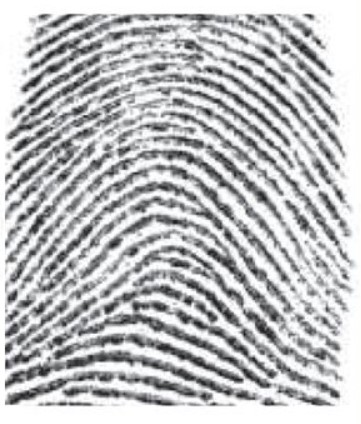
Arch
How to count ridges
Look at the center of the delta (triangles on the sides of the fingerprint), locate the central point of the core, draw an imaginary straight line connecting the delta directly to the core, count every friction ridge line that intersects this imagianary straight line. (DONT count the delta itself or the core, only the ridge lines passing between them)
Technique to dust fingerprints
Choose dusting powder color so that the print will contrast with the surface. Dip the brush made of fiberglass strands and/or animal hair or feather filaments to lightly dip in powder. Tap off excess. Twirl brush across target area with minimal pressure, sweep along direction of friction ridge flow, once lines begin to appear ensuring bristles never scrub or damage oil deposits. Once print is visible a clean brush is used to lightly dust away background powder leaving high contrast sharp Ridge detail. Photograph developed print with scale for court documentation. It's lifted using clear lifting tape, smooth onto a backing card of contrasting color and labeled with evidence details.
Technique to lift dusted fingerprints
Photograph in high resolution with scale alongside fingerprints. For the lifting medium technicians pull a section of lifting tape. Slowly smooth tape over the print to push out air bubbles and prevent wrinkles. In a smooth continuous motion the tape is peeled away from the surface steadily. Powdered adheres to adhesive preserving the friction ridge pattern. Place tape onto the backing card of contrasting color. Tape is rolled onto cards from one edge to another to avoid trapped air. The back of card is labeled with data, date, location, time, investigators name, evidence, item, number, and arrow indicating orientation of print on surface.
Fallacy: cognitive/confirmation bias
Knowing lots of information on case details can skew the examiner's judgment. When they have a target in mind they may actively search for ridge features that confirm their hypothesis while ignoring or downplaying discrepancies between latent prints and known prints.
Fallacy: distortion & partial prints
Due to most crime scene prints being latent there are missing details like minutiae, ridge gaps, Delta's, or any smudged print. This can lead to it looking like another print causing a false match.
Fallacy: subjective interpretation
Many jurisdictions use unreliable methods, one being called ridgeology which constitutes for “sufficient agreement” rather than actual measurements and data. Sometimes when there's a latent print the examiner decides whether distortion is explainable allowing bias to see discrepancies as okay.
One-dissimilarity doctrine
The foundational tenant of friction ridge analysis. The core principle is if a single clear unexplained dissimilarity exists between a latent imprint and a known reference print the examiner must exclude the source. It must explain apparent differences and true dissimilarities. This is important because it doesn't allow for manipulating evidence, it guards against confirmation bias, and prevents false positive identification.