BCS 151 Lecture 17
 Call Kai
 Learn
 Practice Test
 Spaced Repetition
 Match
 Flashcards
 Knowt Play
1/28

There's no tags or description
Looks like no tags are added yet.
29 Terms
How the ear works

Pinna
Pinna is on outer ear
Its job is to bounce sounds are the ear canal
Acts like a funnel to catch airborne sound energy from the environment
It directs and guides those collected sound waves straight into the external ear
Middle Ear
Has two functions
Impedance matching
Purpose: concentrate vibrations from a wide to small areas to properly vibrate cochlear fluid (amplify sounds)
Eardrum gets the vibrations (wide area) and ossicles concentrate them into oval window (small area)
Sound Gating
Purpose: protect the inner ear from loud noises- muscles contract to impede ossicles transmission efficiency (Stop amplification) so doesn't tap too hard on oval window
Preprogrammed: before talking
reflective: after sustained loud noises (is not effective for sudden and short loud noises)
If something explodes- would not be dampened but after it will be
Ears ringing
Basilar Membrane
-
Place Coding
Location of the BM that is most activated by the sound frequency
Apex: low frequencies(100-300)
Base: high frequency (1000 +)
Tonotopic Mapping
Each frequency has a spot it is processed on the basilar membrane
Place coding gives rise to tonotopic mapping!

Organ of Corti
Contains 2 membranes that surround the hair cells, which act as hearing receptors
Basilar Membrane
supports the hair cells and when BM is activated by sound frequency, it wiggles them
Tectorial Membrane
rubs against the moving hair cells, activating neural response
Process
Movement of cochlear fluid moves basilar membrane → move hair cells → rubs against tectorial membrane → generate signals in auditory nerves (neural impulses) →release glutamate (NT)→ APs
Summary - How the organ of corti works
Movement of cochlear fluid moves basilar membrane
Basilar membrane moves the hair cells
Hair cells rub against tectorial membrane
Agitation of hair cells generates signals in auditory nerves
Important information
~15,000 Hair Cells
Hair cells are analogous to cones in the retina
They also release glutamate
KNOW
Be able to explain how the organ of corti and hair cells work
Know the arrow diagram on slides
Cochlear Implants
Microphone records sounds
Converts sounds to digital signals
Bypasses hair cells
Inputs electrical signals directly to spiral ganglion neurons in cochlea
Signals Beyond Cochlea - Characteristic Frequency
Characteristic frequency: Sound frequency that neuron is most responsive to
Monaural neurons are present in the cochlear nucleus (brainstem)
Binaural neurons are present in the superior olive (brainstem)
Pathway of Hearing
Sounds waves vibrate the eardrum (outer)
Move to ossicles (middle) which amplify the sound into the oval window(moves in)
Causes the fluid to vibrate inside the tube (inner)
Causes the round window to bulge out to release the pressure (if no round window, it wont move or allow amplification)
Round window
Round window is concave in (opposite of oval window)
Allow it to go down (releases pressure)
Without the round window…
Without the round window the ossicle would not be able to send vibration into the oval window because fluid would not move
Eardrum
Eardrum causes bones to move → causes ossicles to move → makes oval window to move, and round window does opposite → which amplifies noise
Auditory localization: The problem
Locating sounds is harder.
Auditory localization is vastly inferior compared to vision
Auditory localization: The solutions
Interaural Intensity Difference, best for high frequency sounds
Interaural Time Difference, best for low frequency sounds
“Coloring” of the sound by your pinnas, best for vertical localization
Auditory localization - Interaural intensity difference
High frequency
Head shadow effect: head cast a shadow on sounds (so when reaches the ear farthest away, the intensity is muffled-quieter)
Does not work with low frequencies: generally lower frequencies sound quieter

Its magnitude depends on sound frequency
Less useful for low frequencies

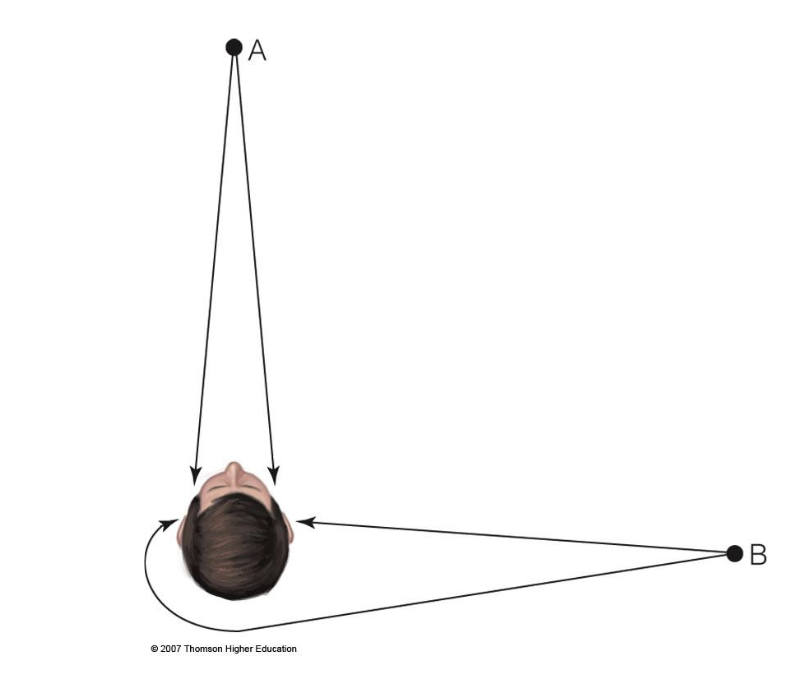
Auditory localization: Interaural Time Difference (ITD)
Low frequency
The tone from A reaches the two ears at the same time.
However, tone from B reaches the right ear first.
Coincidence detection
Meeting point of frequencies used to determine location of sound
Ex: meeting point further to the left, sound came from the right (frequency from right hand had more time to travel, so it was closer)
Vertical localization
Elevation does not provide interaural differences, rather spectral cues
The pinna acts like an acoustic antenna - its resonant cavities amplify some frequencies and attenuate other frequencies
In other words, the pinna filters the sound, and this filtering depends on the sound direction
Precedence effect
A sound coming from the right will hit the right ear before the left ear (same thing as the other one)
Important part: sound bounces off objects, so you have multiple sound waves bouncing at you
Because of this, your ears use the very first sound wave that it hears