Cellular and molecular bio quiz 2
 Call Kai
 Learn
 Practice Test
 Spaced Repetition
 Match
 Flashcards
 Knowt Play
1/55

There's no tags or description
Looks like no tags are added yet.
56 Terms
def for DNA replication
copying a double stranded (ds) DNA double helix.
what direction is DNA synthesized?
5’ to 3’
replication origin, rep fork, DNA POL 3, DNA helicase, Single-Strand DNA binding protein, DNA topoisomerase, sliding clamp, clamp loader, leading strand, lagging strand, primase, Okazaki fragments, DNA POL 1 DNA Ligase, telomerase
rep origin: where DNA replication begins
rep fork: created when DNA helicases unwind the DNA stands
DNA POL3: catalyzes the addition of nucleotides to the 3’ end of a growing strand, Uses a template and makes a complimentary strand proof reads work.
Single-Strand DNA binding protein: Binds to single stranded DNA exposed by DNA helicase
DNA topoisomerase: helps relive tension in one strand of the DNA double helix built up by unwinding the DNA by breaking the DNA then resealing the breaks. in front of the rep fork
Sliding Clamp: Keeps DNA Pol attached to the template so it does not fall off the DNA
Clamp loader: Uses the energy of ATP hydrolysis to lock the sliding clamp onto the DNA
leading strand: elongated continuously toward replication fork
lagging strand: elongated discontinuously, away from replication fork
primase: Synthesizes RNA primers along lagging-strand template
Okazaki fragments: Fragments of DNA on the lagging strand
DNA POL 1: replaces RNA primer with DNA 5’ to 3l
DNA ligase: Uses ATP hydrolysis to seal nick between Okazaki fragments
Telomerase: replicates the end of eukaryotic chromosomes
Endogenous sources, exogenous sources, nucleotide excision repair, mismatch repair
endogenous sources: originating w/in cell – e.g., replication, chemical reactions
exogenous sources: originating in the environment – e.g., ionizing radiation, UV light, chemicals
nucleotide excision repair: fixes damaged nucleotides. Segment of damaged DNA excised, repair DNA pol fills in missing nucleotide using other stand as template, DNA ligase seals nick
\mismatch repair: fixes mismatched nucleotides; proofreading errors
Error rates of DNA replication (no proofreading), DNA replication (with proofreading, no mismatch repair), DNA replication (both)
one mistake per 10^5 nucleotides copied
one mistake per 10^7 nucleotides copied
one mistake per 10^9 nucleotides copied
non-homologous end joining, homolgous recombination
non-homologous end joining: DNA ligase rejoins DNA in double strand break, some nucleotides lost but faster
homologous recombination: DNA pol comes in and codes the missing sequences, Ligase joins it together, slower.
gene, structural gene, transcription, translation
gene: sequence of DNA that codes for a functional product
structural DNA: codes for a protein
transcription: DNA sequence of the coding region of a gene copied into messenger RNA (mRNA)
Translation: sequence of mRNA specifies a sequence of amino acids in a polypeptide (protein)
Summary of Important Differences Between DNA & RNA

messenger RNA, Transfer RNA, Ribosomal RNA, small nuclear RNA, microRNA
mRNA: transcript used to synthesize proteins
tRNA: adapter between mRNA codons and polypeptide amino acids
rRNA: RNA component of ribosomes
snRNA: RNA component of spliceosomes
miRNA: involved with the regulation of gene expression
Transcription, RNA POL
Transcription: copying information in DNA into a temporary RNA molecule
RNA POL: enzyme of transcription, synthesizes complimentary RNA from DNA template strand, elongates 5’ to 3’, no proofreading, no primer, opens <20 bp to access template, no helicase allows for amplification of the DNA information
Prokaryote transcription:
Initiation: – promoter: just upstream of gene coding
region • specific sequences at -10, -30 – sigma ( 浀) factor: RNA pol subunit, binds promoter sequences
• Elongation: – RNA pol adds complementary RNA nucleotides from transcription start site: +1 – sigma factor released
• Termination: – terminator: downstream, specific sequences signal RNA pol release
– included as part of transcription
Transcription in eukaryotes
RNA pol II: for protein coding genes • multiple general transcription factors needed with RNA pol II= transcription initiation complex – assemble at promoter – multiple binding sequences, including TATA box – TFIID (with TATA binding protein, TBP) finds promoter – other TFs & RNA pol II assemble – RNA pol II tail phosphorylated: released from complex to transcribe Elongation factors allow RNA polymerase II to move through DNA packaged in
nucleosomes.
How is precursor mRNA packaged and made ready? defs for RNA capping, Polyadenylation, RNA splicing, exons, introns, spliceosome
RNA capping: adds 7- methylguanosine + 3 phosphates to 5’ end, “5’ m7G cap” • added as mRNA is produced
Polyadenylation: 100s of A’s added to 3’ end, “poly-A tail”
RNA splicing: splicing exons, removing introns
exons: expressed sequences
introns: intervening sequences, recognized by specific sequences at their ends
spliceosome: large protein/RNA machine that assembles to remove introns, splice exons
alternative splicing
Alternative splicing: allows for more than one protein to be produced from the same gene by choosing which exons to keep
RNA processing in euks and proks
Euk RNA processing: provides binding sites for proteins mark mRNAs for export through nuclear pores to cytosol – mark mRNAs to not be degraded – exported for translation in cytosol • in euk., kept for 10-30 min • degraded when done
Bacteria RNA processing: mRNAs translated immediately – mRNAs kept for 3 min
how many ways can an mRNA molecule be translated?
three possible reading frames
mRNA, codons, genetic code, ribosome, tRNA, anticodons, polypeptide
mRNA: messenger RNA
Codons: mRNA nucleotide triplets specify amino acids
Genetic code: correspondence among codons and amino acids
Ribosome: site of translation
tRNA: transfer RNA
Anticodons: complement codons – bound to amino acid
polypeptide: chain of amino acids
ribosome, large subunit, small subunit, ribozymes
ribosome: organelle of protein synthesis – composed of ribosomal proteins and ribosomal RNA (rRNA)
large subunit: 49 proteins and 3 rRNAs (28S, 5.8S, 5S) – 3 tRNA binding sites (E, P, A); catalyzes peptide bond
small subunit: 33 proteins, 18S rRNA – binding site for mRNA; matches codons of mRNA & anticodons of tRNA
ribozymes= RNA enzymes – 2/3 rRNA by mass, gives structure
five steps of elongation of polypeptide during translation
1. charged tRNA with amino acid in the A site, tRNA with growing polypeptide in the P site - anticodons complement codons
2. C-terminus of polypeptide uncoupled from tRNA in P site, transferred to amino acid in the A site - peptide bond catalyzed by large subunit
3. large subunit shifts one codon in the mRNA 3’ direction - spent tRNA in E site - tRNA with polypeptide in the P site
4. small subunit shifts one codon in the mRNA 3’ direction - tRNA in E site ejected
5. next charged tRNA corresponding to next mRNA codon enters A site
Initiation and termination of translation
Initiation: – initiator tRNA = initiator methionine: has anticodon complementary to start codon (AUG) – Translation Initiator factors: proteins match initiator, P site of small ribosomal subunit, and 5’ cap of mRNA – searches mRNA toward 3’ for start codon – large subunit joins assembly – translation proceeds
Termination: stop codons (UAA, UAG, UGA) have no tRNA – release factor: protein hydrolyzes polypeptide from last tRNA – whole thing disassembles
Genetic code, start codon, stop codons, wobble
Genetic Code: the key to translating between mRNA codons and amino acids, has redundancy
Start codon: AUG – also methionine
•Stop codons: UAA, UAG, UGA
wobble: some tRNAs pair with multiple codons
Gene expression can be regulated at multiple steps in the pathway
DNA access: heterochromatin, epigenetic control
transcription: transcription factors
post-transcription: 5’ cap, poly-A tail, exon splicing, transport to cytoplasm
translation: degradation of mRNA, inhibition by miRNA, other translational control
post-translation:, modification e.g., phosphorylation, cleavage, combination with other polypeptides, transport to cellular target
defs for housekeeping genes, transcription regulators, chromatin-remolding complexes
HG: genes expressed in all cells
RT: proteins that affect formation of the transcription initiation complex
Chromatin-remodeling complexes: determine DNA accessibility
Gene expression can be regulated at various steps from DNA to RNA to
Protein

defs for operon, operator, repressor, trp repressor
operon: coordinated cluster of genes, common in bacteria and a single promoter
operator: Regulatory DNA sequence in promoter
repressor: binds to operator to stop synthesis
trp repressor= allosteric transcription regulator – inhibited by tryptophan • Trp high, active repressor binds operator: blocks RNA pol • Trp low, inactive repressor; RNA pol transcribes
lac operon steps include lac repressor and CAP activator

def for enhancers, activators, mediators, transcriptional regulators, looped domains, combinational control, epigenetic inheritance
enhancers: Regulatory DNA sequence in eukaryotes, 100s of bps away from promoter, bound by activators and also repressors
activators: protein that binds to an enhancer transcription regulators, AKA specific transcription factors
mediators: complex of proteins between activators and the transcription initiation complex (general transcription factors and RNA polymerase)
transcriptional regulators: attract proteins that remodel chromatin – tightly-bundled chromatin inhibits transcription – histone modifying enzymes: e.g., attaches acetyl groups to histones • provide binding sites for general transcription factors, etc. – chromatin-remodeling complex: make regulatory DNA sequences more accessible
looped domains: regulate the associations between enhancers and their genes
CC: multiple transcription regulators operate to control expression – common in eukaryotes – multiple transcription regulators per gene – each transcription regulator interacts with multiple genes= coordination
epigenetic inheritance: transmission of traits not caused by changes to the genetic sequence. i.e. “outside of the genome
do somatic cells in a multicellular organism contain the same DNA?
yes
all sources of mutations in an organism
within a gene: change DNA, change RNA, change protein
– in regulatory DNA: change DNA, change where/when gene expressed
– gene duplication: copied gene can evolve new function
– exon shuffling: swapping protein domains, new proteins with new functions
– transposition: mobile genetic elements contribute mutations
– horizontal transfer: DNA passed from one cell to another
– genome duplication: diploid (2n), tetraploid (4n), octoploid (8n), etc.
mutations in asexual vs sexual reproduction
asexual: all mutations passes
sexual: only germ line (gamete cells) mutations pass
point mutation, neutral mutations, silent mutations, missense mutations, deleterious mutations, nonsense mutations
PM: replace one nucleotide with another
NM: no effect on fitness
SM: change codon but not amino acid
MM: change aa but not protein function
deleterious: decreases fitness
NM: changes codon to stop codon
gene duplication can create new genes, crossing over, unequal crossing over
misalignment during homologous recombination leads to gene duplications & deletions
crossing over: swaps segments between homologous chromosomes
unequal crossing over: one homologous chromosome gets part of the other
exon shuffling, mobile genetic elements/transposable elements/transposons, DNA only transposons, nonrepetitive DNA, repetitive DNA
EX: combining exons from different genes
transposons: segments of DNA that can move in the genome
DNA only: mobile elements without an RNA intermediate
NR DNA: 28% of the human genome regulatory DNA, RNAs, pseudogenes
R DNA:50% of the human genome, occurs in multiple copies in the genome
how do we find recognizable similarity between bacteria, archaea and eucarya genes?
small ribosomal rRNA gene
how much of the human genome codes for proteins?
2%
Two major families of transposable sequences in the human genome
1: DNA only transposons like bacteria
2: retrotransposons= mobile elements with an RNA intermediate – only in eukaryotes (most common type in humans) – transcribed into RNA by RNA pol – new DNA made from RNA template by reverse transcriptase – integrated in new location: “copy & paste
viruses and what they are made of (genome, capsid, viral envelope)
virus: transferred from cell to cell, use host cellular machinery to express genes and replica
genome: DNA or RNA ss or ds
capsid: protein coat
viral envelope: derives from host plasma membrane
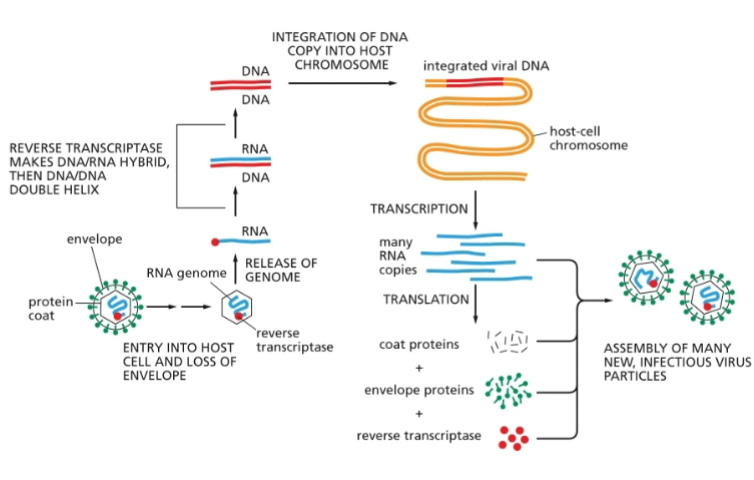
retrovirus
A virus with RNA genome and DNA stage, like HIV
ss RNA genome – reverse transcriptase uses RNA to make ds DNA – ds DNA inserted into host chromosome – can be latent for years: integrated into genome and inactive – completes life cycle when transcribed
DNA sequence, DNA amplification, gel electrophoresis, DNA ladder, PCR
DNA sequence: the list of nucleotides of a segment of DNA
amplification: lost of copies of DNA
gel electrophoresis: uses porous matrix (e.g., agarose) and electricity to separate DNA by size – short molecules move faster than long ones
DNA ladder: standard fragments of known length
PCR: used to amplify specific DNA sequences.
how to isolate DNA molecules
isolate target DNA from unwanted DNA with restriction enzymes and gel electrophoresis
– generate a recombinant DNA molecule
– determine the order of nucleotides in each DNA helix via sequencing
whats needed for PCR

Dideoxy sequencing

shotgun sequencing, RNA-seq, meta-genome, reporter gene, transgenic organism, gene knockout
shotgun sequencing: includes lots of different methods – divide genome into lots of small, random fragments – amplify and sequence those fragments – assemble contiguous fragments based on overlapping sequences
RNA-seq: use cDNA library or direct RNA sequencing (dRNA-seq) to find expressed genes
meta-genome: collective sequences of one gene from an environmental sample
– e.g., identify all the bacteria in a sample by sequencing all the 16S (small ribosomal subunit) DNA
reporter gene: insert gene for easily visualized product after gene’s promoter, Allow Specific Proteins to Be Tracked in Living Cells
transgenic organism: genome altered by stably inserting gene
– e.g., replace gene with mutant version in embryonic stem cells, get cells into germ line • difficult and time consuming
gene knockout: turn off or mutate gene of interest
CRISPR, cas, cas9
CRISPR:: bacteria anti-viral system – clustered regularly interspaced short palindromic repeats – between repeats: copies of viral (phage) genomes – transcribed: palindromic seq. makes stem-loops in guide RNA
Cas (CRISPR associated) endonuclease: cut complementary viral DNA based on guide RNA
cas9: engineered endonuclease that uses guide RNA to cut complementary ds DNA – cut ends ligated with random nt between them: “knockout” gene – OR, if template DNA present, repair enzymes can insert transgene
plasma membrane, internal membrane, three components of cell membrane (lipid bilayer, membrane proteins, carbohydrates), hydrophilic and hydrophobic molecules
PM: outer cell membrane surrounding the entire cell
IM: enclose compartments/organelles within the cell
lipid bilayer: hydrophobic permeability barrier, provides structure
membrane proteins: embedded and adjacent proteins
carbohydrates: attached to membrane lipids and proteins
hydrophilic molecules: charged or polar, able to hydrogen bond with water – dissolve in water – e.g., salts, sugars, nucleic acid
hydrophobic: nonpolar molecules disrupt hydrogen bonds with water – hydrophobic force: minimizes interactions between hydrophobic and hydrophilic molecules – e.g., fats, oils, waxes, steroids
amphipathic, phospholipids, cholesterol, glycolipids
amphipathic: molecules that are hydrophobic and hydrophilic with a hydrophilic polar head and a nonpolar hydrophobic tail
phospholipids: most abundant membrane lipids – charged phosphate “head” – two hydrocarbon “tails”
cholesterol: n animal cells, esp. plasma membrane (20% lipids by mass)
glycolipids: lipids with attached sugars, carbohydrates
what forms spontaneously in an aqueous solution?
lipid bilayer
lipid bilayer, fluid
LB: 2 monolayers of amphipathic lipid molecules – hydrophilic “heads” contact aqueous solution – hydrophobic “tails” contact each other – energetically favorable arrangement - forms a sphere, no exposed edges
fluid: individual phospholipids capable of motion – lateral diffusion, rotation, flexion – but NOT flip-flopping between monolayers
what do phospholipid bilayers do?
spontaneously close in on themselves to form sealed compartments.
fluidity of the bilayer and temperature

membrane assembly steps and defs for lumen, scramblase, flippases
lumen: space inside an organelle
scramblase: enzyme randomly flip-flops phospholipids to even-out
flippases: transporter proteins flip- flop specific phospholipid types to the cytosolic monolayer

True or False? Certain Phospholipids Are Confined to One Side of the
Membrane.
True, Membranes retain their orientation during transfer between cell compartments= the endomembrane system. – Allows for integral membrane proteins and protein secretion.
membrane proteins, {transporters, channels}, anchors, receptors, enzymes, integral membrane proteins, transmembrane proteins, peripheral membrane protiens
membrane proteins: associated with membranes, 50% of mass, 50:1 lipids:proteins
transporters, channels: move small molecules thru membrane
anchors: attach to other macromolecules for stability
receptors: binding external ligand causes change inside cell
enzymes: catalyze reactions
integral membrane proteins: attached to lipid bilayer by hydrophobic forces
transmembrane proteins: have intracellular and extracellular domains
peripheral membrane proteins: noncovalently associate with integral membrane proteins – Extracellular OR cytoplasmic
single-pass transmembrane proteins, multi-pass transmembrane protein
single-pass transmembrane proteins: hydrophobic amino acids on outside of alpha helix; interact with phospholipid tails •
multi-pass transmembrane protein: ≥2 alpha helices – can form a channel – hydrophobic a.a. on outside, hydrophilic a.a. on inside • sometimes beta sheets form into a
beta barrel
cell wall, extracellular matrix, cell cortex
cell wall: rigid carbohydrate structures in bacteria, plants, fungi
extracellular matrix: network of proteins that provides structural support to cells or tissues
cell cortex: internal network of fibers – e.g., spectrin, actin, myosin – peripheral membrane proteins – attach to integral membrane proteins to hold cell shape
glycocalyx, oligosaccharides
Glycocalyx: a layer of carbohydrates surrounding cells
oligosaccharides: (short polymers) attached to glycolipids and glycoproteins – protects plasma membrane – lubricates: hydrophilic, attracts water – involved with cell-cell recognition • e.g., ABO blood type