Biology Exam 1
 Call Kai
 Learn
Learn Practice Test
 Spaced Repetition
 Match
Match Flashcards
 Knowt Play
1/178

There's no tags or description
Looks like no tags are added yet.
Name | Mastery | Learn | Test | Matching | Spaced | Call with Kai | Chat |
|---|
No analytics yet
Send a link to your students to track their progress
179 Terms
Characteristics of a good hypothesis
Testable
Falsifiable
Neither prove hypothesis is correct
Theory
broader than hypothesis
broad enough for new hypothesis
Supported by large body of evidence
Science
approach to understanding natural world
Inquiry
search for info and exploration of natural phenomena
Controlled Experiment
Compares experimental group w/ controlled group
Variable → factor that is manipulated or measured
Independent var
factor being manipulated
Dependent var
factor being measured and affected by independet var.
Structure of an atom
Proton (+1)
Electron (-1)
Neutron (0)
Element
substance that can’t be broken down to other substance by chemical reaction
made of one type of atom
Compound
substance consiting of 2 or more diff elements in fixed ration

Atomic No
shows # of protons elements contain
Uncharged = sampe protons + electrons
Atomic Mass
avrg of all isotopes
PE of electrons
more PE = further from nucleus
Electrons only have avrg distances from nucleus
Bc of only avrg distance → only certain potential energies
Electron Shells
Electrons found in electron Shell
lowest energy on first shell and highest on third
Electron orbital
Each shell has one or more orbital
Space where electron spends 90% of time
Each orbital can have 2 max electrons
Paired electron
orbital has 2 electrons
Unpaired electron
orbital has 1 electron
Valance shells and valance elctrons
Outer shell = valence shells
Electons in valence shell = valence electrons
Completing Valence Shell
complete by forming chemical bonds
type of chem bond is diff for atom off diff elements
Covalent bond
atoms complete valence shell by forming cov bonds
The shairing of pair of valence electrons to form a molecule

Polar Covalent bonds
When electrons are shared between atoms of different electonegativities more time is spent on more electronegative atom.
More electro neg atom = partial neg charge
Less electroneg atom = partial pos charge
Non polar covalent bonds
Cov bones formed between atoms w/ approx equal electronegativities
electros shared equally
Electronegativities of Elements
Oxygen
Nitrogen
Carbon ~ Hydrogen

Ionic bonds
Atom transfers an electron to another atom
gain atom = anion
lose atom = cation
Does not result in molecules as molecules are covalently bonded
Hydrogen can form ionic or covalent bonds?
True. They do this by giving or receiving electron

Hydrogen bonds
form when hydrogen atom covalently bonds to electronegative atom is attracted to another electroneg atom
much weaker than cov bond and ionic bond
Can only form between molecules
Van der waals interactions
electrons not evenly distributed causing regionds of partial neg and pos charges allowing atoms + molecules to come tg
weakest chemical bond
Biology bond rankings
covalent bonds
Ionic bonds
Hydrogen bonds
Van der wall interactions
Chemical reactions
are the making and breaking of chemical bonds
Chemical reactions are reversible
Forwarde and reverse reactions
occur at same rate and concentrations of products + reactants stop chaning
does not mean equal concentrations
Structure of water
Oxygen is electronegative cause electron to spend more time w/ oxygen
As a result
Cov bonds in water are polar
Water is a polar molecule
Oxygen = partial neg | Hydrogen = parial pos
Solvent
substances that are dissolving agents
Solutes
substances that are getting dissolved
Why is water a great ion dissolver
partial neg interactats with Na+ and partial pos interacts with Cl-
Avogadoro’s number
6.02 × 10²³
pH
negative log of hydrogen ion (pH = -log[H+])
Dissociation of water molecules
water molecules break part so the exist in equilibrium with hydronium ions [H3O+] and hydroxide ions (OH)
2 H2O =[H+] + [OH-]
Why does pure wate have a pH of 7
[H+] and [OH-] are both equal at 10^-7
Acids
Acids that increase H3O+ concentration
Do this because H3O+ comine with OH- ions
This forms new water molecules decreasing [OH-]
Bases
substances that decrease H3O+ concentration
Do this by realeasing OH- in water
Or Accept H+ (NH₃ + H₂O ⇌ NH₄⁺ + OH⁻)
Calculating PH
[H+] x [OH-] = 10-14M at 25C
Carbon’s 4 covalent bonds
Carbon has 4 valence electrons but needs 8 to be stable, so it forms 4 bonds.
To make 4 bonds, one of carbon's 2s electrons jumps up to the empty 2p orbital, leaving 4 unpaired electrons.
Those 4 orbitals blend together into 4 identical sp³ orbitals, each ready to form a bond. Making the bonds releases more energy than the jump cost. (tetrahedral shape)
Examples of carbon-based molecules
Methane (CH4)
Ethane (C2H6)
Ethene (C2H4)
Isomers
molecules with have same molecular formula but different 3D structures
3 types of Isomers
Structural Isomers
Cis-Trans Isomers
Enantiomers
Structural isomers
molecules with same molecular formula but a different arrangement of atoms (different connectivity)
Cis-Trans Isomers (non-structural)
molecules that vary in arrangement of atoms around double bond
Ex:
cis-2-butene: both CH₃ groups on the same side
trans-2-butene: CH₃ groups on opposite sides

Enatiomers
molecules that are mirror image of each other

Asymetric carbon
central caron of enantiomer
Hydrocarbons
consist of carbon and hydrogen
are hyrophobic and contain lots of energy
Hydrocarbonds are hydrophobic because:
C-H bonds are nonpolar so they cant form hydrogen bonds
Functional group
chemical groups that affect shape and function of molecule by direct involment in chemical reactions
molecules are categorized by functional groups
Hydroxyl group
consist of oxygen covalently bonded to hydrogen
polar and help form H-bonds to dissolve compounds
can be organic alcholos like ethanol

Carbonyl group
oxygen atom that shares double cov-bond with carbon atom
polar because oxygen is more elctroneg than carbon

Aldehydes
Carbonyl groups that occur at end of chain
Ketones
Carbonyl groups that occur at middle of chain
Carboxyl group
consist of carbon atom that share double cov bond with oxygen and single cov bond with OH bond

Amino Acid
consist of nitrogen atom cov-bonded to hydrogen atoms
Often bind H+ so can act as bases
Amines
molecules containing amine group
Sulfhydrl group
contain sulfur atom cov-bonded to hydrogen atom
2 sulfhydrl groups can form cov binds heping stabilize protein structures

Phosphate group
phosphorus atom cov bonded to four oxygen atoms
Carry negative charge
Carry lots of energy so p-groups raise energy levels of molecules containing them

Thiols
molecules containing sulfhydrl groups
Organic Phosphates
molecules containing phosphate groups
Methyl Group
Carbon cov-bonded to 3 hydrogen atoms
Adding methyl groups affects activity levels of nearby genes
Methylated
molecules containing methyl group
Carbohydrates
include sugars and polymers of sugar
are organic molecules made of carbon, hydrogen, and oxygen
Sugars
are polyhydroxy, aldehydes, or ketones
Sugars have carbonyl group (aldehyde or ketone)
Usually end in “Ose”
Hydroxyl and carbonyl
are polar so sugars dissolve in water
Monosaccharides
simplest sugar
Usualy have formula (CH2O)n n=3 to 7
Aldoses
monosaccharides that have aldehyde group
Ketoses
monosaccharides that have ketose group
Function of monosaccharides
Energy source
used as building blocks to make larger molecules
Dissacharides
2 monosaccharides joined by cov bond
Joined together by dehydration reaction
Dehydration Reaction
type of condesation reaction that releases water molecule

glycosidic linkages
bonds between monosaccharides
Polymers
Large molecule made of repeating monomers
Monomers
repeating units that form polymers
Polysaccharide function
are either storage polysaccharides (carbs) or structural polysaccharides
Storage polysaccahrides
function as surce of energy (ex: starch and glycogen)
Startch
polymer of glucose.
Made by plants store in chloroplasts
Glycogen
polymer of glucose
Stored in liver and muscle cells
Glycogen and starch
broken down by enzymes into glucose
done through hydrolysis reaction
The glucose can befurther metabolized to produce energy or building blocks
Structural polysaccharides
help form cellur and extracellular structures (ex: celluose)
Cellulose
form much of cell wall surrounding plant cel
make plant tissue rigid
major component of wood
alpha glucose monomers
starch and glycogen
beta glucose monomers
Cellulose
Cellulose cant be digested because
because of its chemical structure and the enzymes we lack.
Lipids
molecules that dissolve partly in water
NOT POLYMERS
Fats
synthesized by dehydration reaction that joins fatty acids to glycerol by ester linkage
Triglycerides
3 fatty acids + 1 glycerol molecule
Fatty acids vary in chain length and number of double bonds
split by hydrolisys

Saturated fatty caid
a fatty acid whose hydrocarbon chain has no C=C double bonds
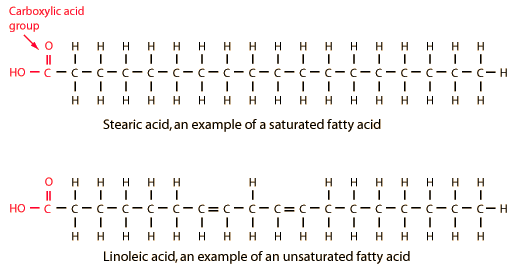
Unsaturated fats
have C=C double bonds
less likely to solidify as double bonds lower melting temperature
Phospholipids
have only 2 fatty acid chains attached to glycerol
3 pos is occupied to phosphate, which is negatively charged
other groups can attach to phosphate
Phosphate region is polar glycerol region is nonpolar
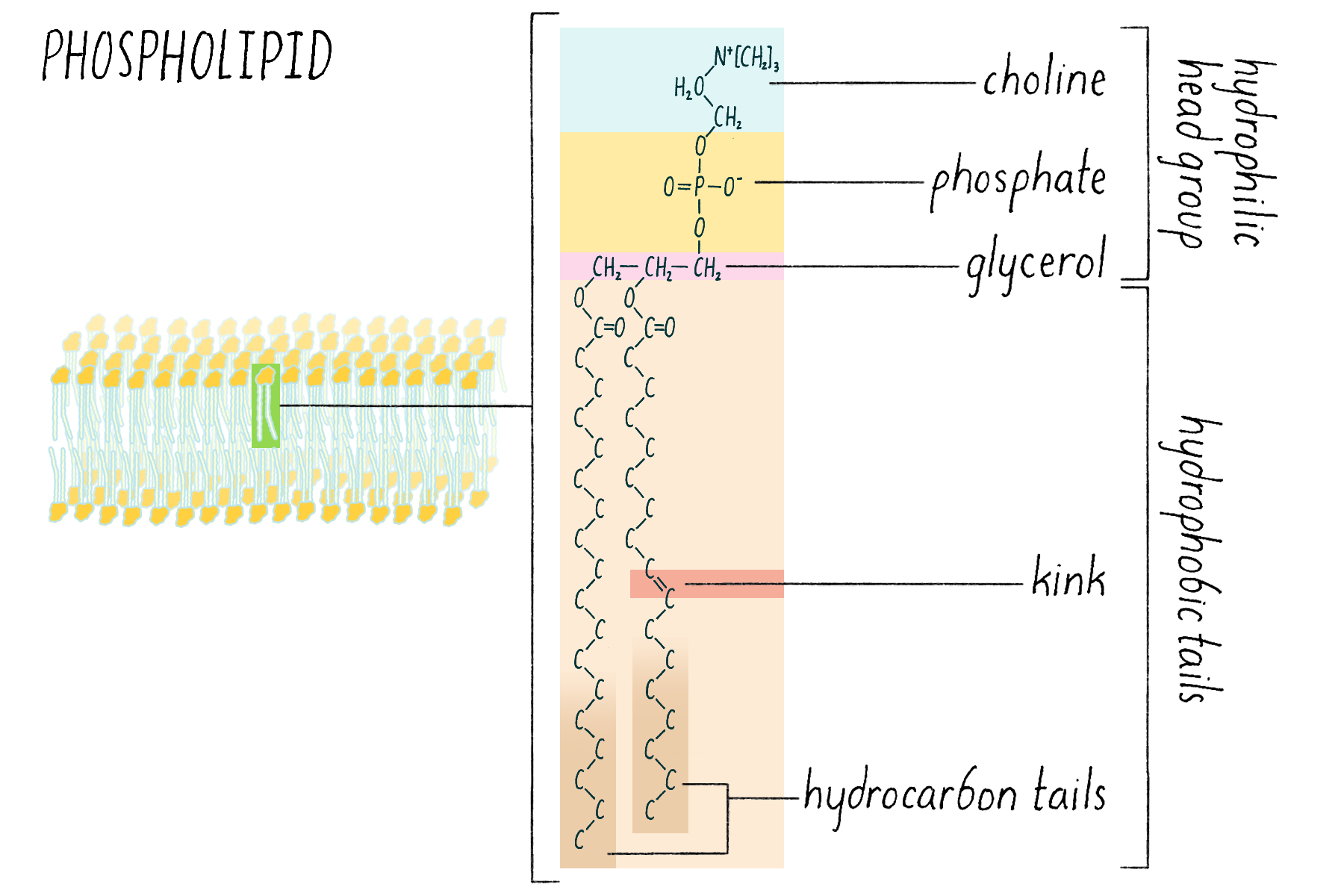
Function of phospholipids
the main structural molecules of cell membranes, and their function comes from being amphipathic: part of the molecule loves water and part avoids it.
Membranes with unsaturated hydrocarbons are more
fluid
tails are kinked not allowing tight packing
Sterols
have carbon skeleton with 4 fused rings
Considered lipds bc theyre hydrophobic
can function as steroid hormones
or example cholestrol → important to cell memberanes

Proteins
are polymers of amino acids, linked in a chain by peptide bonds.
Amino Acids structure
20 different amino acids
R group usually below carbon varies

Polypeptides
chain of many amino acids
joined together by dehydration reaction
results in peptide bond that forms protein
4 levels of protein structure
Primary structure
Secondary structure
Tertiary Structure
Quaternary Structure