American Imperialism
 Call Kai
 Learn
Learn Practice Test
 Spaced Repetition
 Match
Match Flashcards
1/33

There's no tags or description
Looks like no tags are added yet.
Name | Mastery | Learn | Test | Matching | Spaced | Call with Kai | Chat |
|---|
No analytics yet
Send a link to your students to track their progress
34 Terms
Hawaii
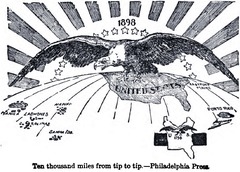
Annexed in 1898. Republic of ______ established in 1887 with the Constitution of the Kingdom of __________. After overthrow of the Republic in 1893, American lawmaker Sanford B. Dole became President of the Republic of _________.

Philippines
Sold to U.S. for the price of $20 million. Islands administered by Insular Government after ___________-American War.

Cuba
Island to the south of the U.S., and of great economic interest (sugar/tobacco) to the U.S. economy. Sight of the _______ Rebellion and many battles during the Spanish-American War.

Guam
A new territory gained by the U.S. after the Treaty of Paris, _________ became a key coaling station in the Pacific Ocean for ships traveling to/from the Philippines.

China
The U.S.'s "natural customer," _________ was seen as a vital market for the U.S. economy. Struggles such as the Boxer Rebellion took place here as several different imperialistic powers struggled to assert dominance in the region.

Puerto Rico
Invaded by the U.S. during the Spanish-American War. One of the insular territories gained by the U.S. as a result of the Treaty of Paris. Inhabitants of _______ _______ are considered U.S. citizens, thanks to the Jones Act of 1917.

Alfred Thayer Mahan
Outspoken advocate of American military expansion. Wrote The Influence of Sea Power Upon History (1890). _______ called for the United States to develop a modern fleet capable of protecting American business and shipping interests around the world.

Queen Liliuo'kalani
Queen of Hawaii. Pushed for a "Hawaii for Hawaiians" agenda. Overthrown in 1893 by wealthy white settlers/landowners.

Sanford B. Dole
___________ was a lawyer and jurist in the Hawaiian Islands as a kingdom, protectorate, republic and territory. Serving as an enemy of the Hawaiian royalty and friend of the elite immigrant community, _________ advocated the westernization of Hawaiian government and culture.

William McKinley
25th president of the U.S., _____________ led the nation to victory in the Spanish-American War. Pushed for expansion and the gold standard. Was assassinated on September 14th, 1901.

William Randolph Hearst
An American newspaper publisher who built the nation's largest newspaper chain and whose methods profoundly influenced American journalism. Proponent of "yellow journalism."

Joseph Pulitzer
A Hungarian-American Jewish newspaper publisher of the St. Louis Post Dispatch and the New York World. ________ introduced the techniques of "new journalism" to the newspapers he acquired in the 1880s. Competition with Hearst linked __________ to the types of journalistic tactics known as "yellow journalism."

George Dewey
Admiral of the Navy, the only person in U.S. history to have attained the rank. Admiral ________ is best known for his victory at the Battle of Manila Bay during the Spanish-American War. Sunk/captured the entire Spanish Pacific fleet in less than six hours.

Theodore Roosevelt
26th president of the U.S. _______________ was famous for his "Big Stick Diplomacy" when it came to foreign affairs. ____________ became the youngest man to assume the U.S. presidency after President William McKinley was assassinated in 1901. He won a second term in 1904. Known for his anti-monopoly policies and ecological conservationism.

John Hay
U.S. Secretary of State_________ issued, in 1899, a series of policy statements called the Open Door notes. The notes were letters addressed to the leaders of imperialist nations proposing that the nations share their trading rights with the United States, thus creating an open door.

Mark Twain
American author and humorist. In describing his transformation and political awakening, _______________ said: "It should, it seems to me, be our pleasure and duty to make those people free, and let them deal with their own domestic questions in their own way. And so I am an anti-imperialist. I am opposed to having the eagle put its talons on any other land."

Expansionism
Policy of territorial or economic expansion.

Imperialism
Policy in which stronger nations extend their economic, political, or military control over weaker territories.
Manifest Destiny
The widely held belief in the United States that American settlers were destined to expand throughout the continent.

Yellow Journalism
Journalism that is based upon sensationalism and often crude exaggeration of events.

Monroe Doctrine
The ____________ was a US foreign policy regarding Latin American countries in 1823. It stated that further efforts by European nations to colonize land or interfere with states in North or South America would be viewed as acts of aggression, requiring U.S. intervention.

Dollar Diplomacy
The effort of the United States—particularly over President William Howard Taft—to further its aims in Latin America and East Asia through use of its economic power by guaranteeing loans made to foreign countries.

Open Door Policy
The ___________ is a term in foreign affairs initially used to refer to the United States policy in the late 19th century and early 20th century outlined in Secretary of State John Hay's __________ Notes, dispatched in 1899 to his European counterparts.

Big Stick Diplomacy
_____________ refers to U.S. President Theodore Roosevelt's foreign policy: "speak softly, and carry a big stick." Roosevelt described his style of foreign policy as "the exercise of intelligent forethought and of decisive action sufficiently far in advance of any likely crisis".

De Lôme Letter
A note written by Señor Don Enrique Dupuy de Lôme, the Spanish Ambassador to the United States, to Don José Canelejas, the Foreign Minister of Spain, reveals de Lôme's opinion about the Spanish involvement in Cuba and US President McKinley's diplomacy.

USS Maine
The _________ is best known for her catastrophic loss in Havana Harbor on the evening of 15 February 1898. Sent to protect U.S. interests during the Cuban revolt against Spain, she exploded suddenly without warning and sank quickly, killing nearly three-quarters of her crew.

The Rough Riders
___________ is the name bestowed on the 1st United States Volunteer Cavalry, one of three such regiments raised in 1898 for the Spanish-American War and the only one of the three to see action. Led by future president Theodore Roosevelt.

Treaty of Paris of 1898
An agreement made in 1898 that resulted in the Spanish Empire's surrendering control of Cuba and ceding Puerto Rico, parts of the Spanish West Indies, the island of Guam, and the Philippines to the United States.

Panama Canal
A 77.1-kilometre (48 mi) ship canal in Panama that connects the Atlantic Ocean (via the Caribbean Sea) to the Pacific Ocean. Project spearheaded by president Theodore Roosevelt.

Roosevelt Corollary
An addition to the Monroe Doctrine articulated by President Theodore Roosevelt in his State of the Union address in 1904 after the Venezuela Crisis of 1902-03. The __________ states that the United States will intervene in conflicts between European countries and Latin American countries to enforce legitimate claims of the European powers, rather than having the Europeans press their claims directly.

Pearl Harbor
A lagoon harbor on the island of Oahu, Hawaii, west of Honolulu. Much of the harbor and surrounding lands is a United States Navy deep-water naval base. It is also the headquarters of the United States Pacific Fleet.

Foraker Act
Enacted April 12, 1900. Officially known as the Organic Act of 1900, is a United States federal law that established civilian (albeit limited popular) government on the island of Puerto Rico, which had recently become a possession of the United States as a result of the Spanish-American War.

Spanish-American War
A conflict in 1898 between Spain and the United States, the result of American intervention in the Cuban War of Independence. American attacks on Spain's Pacific possessions led to involvement in the Philippine Revolution and ultimately to the Philippine-American War.

Boxer Rebellion
An anti-imperialist uprising which took place in China towards the end of the Qing dynasty between 1898 and 1900. It was initiated by the Militia United in Righteousness (Yihetuan), known in English as the "Boxers," and was motivated by proto-nationalist sentiments and opposition to foreign imperialism and associated Christian missionary activity. The Great Powers intervened and defeated Chinese forces.
