Kinesiology: Joints and Levers
 Call Kai
 Learn
 Practice Test
 Spaced Repetition
 Match
 Flashcards
 Knowt Play
1/19

There's no tags or description
Looks like no tags are added yet.
20 Terms
Uniaxial Joint
Joint with one degree of freedom, moving in one plane (e.g., hinge, pivot).

Biaxial Joint
Joint with two degrees of freedom, moving in two planes (e.g., condyloid, saddle).
Multiaxial Joint
Joint with three degrees of freedom, moving in three planes (e.g., ball and socket).
Open Kinematic Chain
Movement where the distal extremity is unattached and freely moveable in space.

Closed Kinematic Chain
Movement where the distal extremity is fixed to an object or the ground.
Unloaded joint function
relaxed, open, unstressed
Loaded joint function
forces or stress being applied, compressed, under tension/distraction, bending, torsion, shearing
Arthrokinematics
Passive range of motion based strictly on anatomical joint structure.
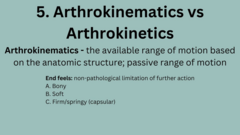
Arthrokinetics
Active range of motion considering the forces, momentum, and resistance causing movement.

Non-Pathological End Feels
Normal anatomical limitations to joint movement: bony, soft, or firm/springy.
Pathologic Range of Motion
Abnormal joint movement categorized as hypomobile or hypermobile.
First-Class Lever
Lever system best for balance, with the fulcrum between weight and force.

First-Class Lever Example
The vertebral column acting against gravity.
Second-Class Lever
Lever system best for power, with weight between fulcrum and force.

Second-Class Lever Example
The act of plantarflexion at the ankle.
Third-Class Lever
Lever system best for ROM and speed; the most common lever in the body.

Mechanical Advantage
The efficiency of a lever measured by effort required to overcome resistance.

Newton's Law of Inertia
An object remains at rest or in motion unless acted upon by an external force.
Newton's Law of Acceleration
Acceleration is proportional to force magnitude and inversely related to object mass.
Newton's Law of Action/Reaction
For every action force, there is an equal and opposite reaction force.