Wk 6: Infancy Part I
 Call Kai
 Learn
Learn Practice Test
 Spaced Repetition
 Match
Match Flashcards
 Knowt Play
1/52

There's no tags or description
Looks like no tags are added yet.
Name | Mastery | Learn | Test | Matching | Spaced | Call with Kai | Chat |
|---|
No analytics yet
Send a link to your students to track their progress
53 Terms
An infant’s birth height increases by ___% by age 1, and ___% by age 2.
50%
75%
An infant’s birth weight ___ by 5 months and ___ by 1 year.
doubles
triples
An infant’s birth weight ____ by age 2.
quadruples
Growth during infancy occurs in ____.
spurts
What principles explain infant changes in body proportions?
Cephalocaudal principle
Proximodistal principle
Principle of hierarchical integration
Principle of independent systems
Cephalocaudal principle
Cephalocaudal = head to tail
indicates that the head develops more rapidly than the rest of the body during infancy
Proximodistal principle
Proximodistal = near to far
indicates that development occurs from the center of the body outward, with control of the trunk before limbs.

Principle of hierarchical integration
indicates that skills develop separately and independently during infancy
simple skills develop first, eventually integrating into more complex skills over time
Principle of independent systems
indicates that different body systems grow at different rates
The ___ system and ___ are the foundation of development.
nervous system
brain
Neurons
cells in the nervous system that communicate by releasing neurotransmitters into synapses
Cerebral cortex
the outer layer of the brain responsible for complex functions like perception, cognition, and motor control
How many hours a day do newborns sleep?
16-17 hours a day, waking every few hours to feed
What are the ABCs of Safe Sleep?
they state that a baby should sleep:
Alone
on their Back
in a safe Crib right from the start (to reduce the risk of Sudden Infant Death Syndrome (SIDS)).
What are the 8 basic reflexes an infant is born with?
rooting
stepping
swimming
moro (startle)
blinking
babinski
sucking
grasping
What is the rooting reflex?
an automatic response in newborns where they turn their head and open their mouth in search of food when their cheek is stroked
disappears around 3 weeks of age

What is the stepping reflex?
an automatic movement in infants where they make stepping motions when their feet are placed on a flat surface
disappears around 2 months of age

What is the swimming reflex?
an automatic response in infants where they exhibit swimming motions when placed in water
disappears around 6 months of age

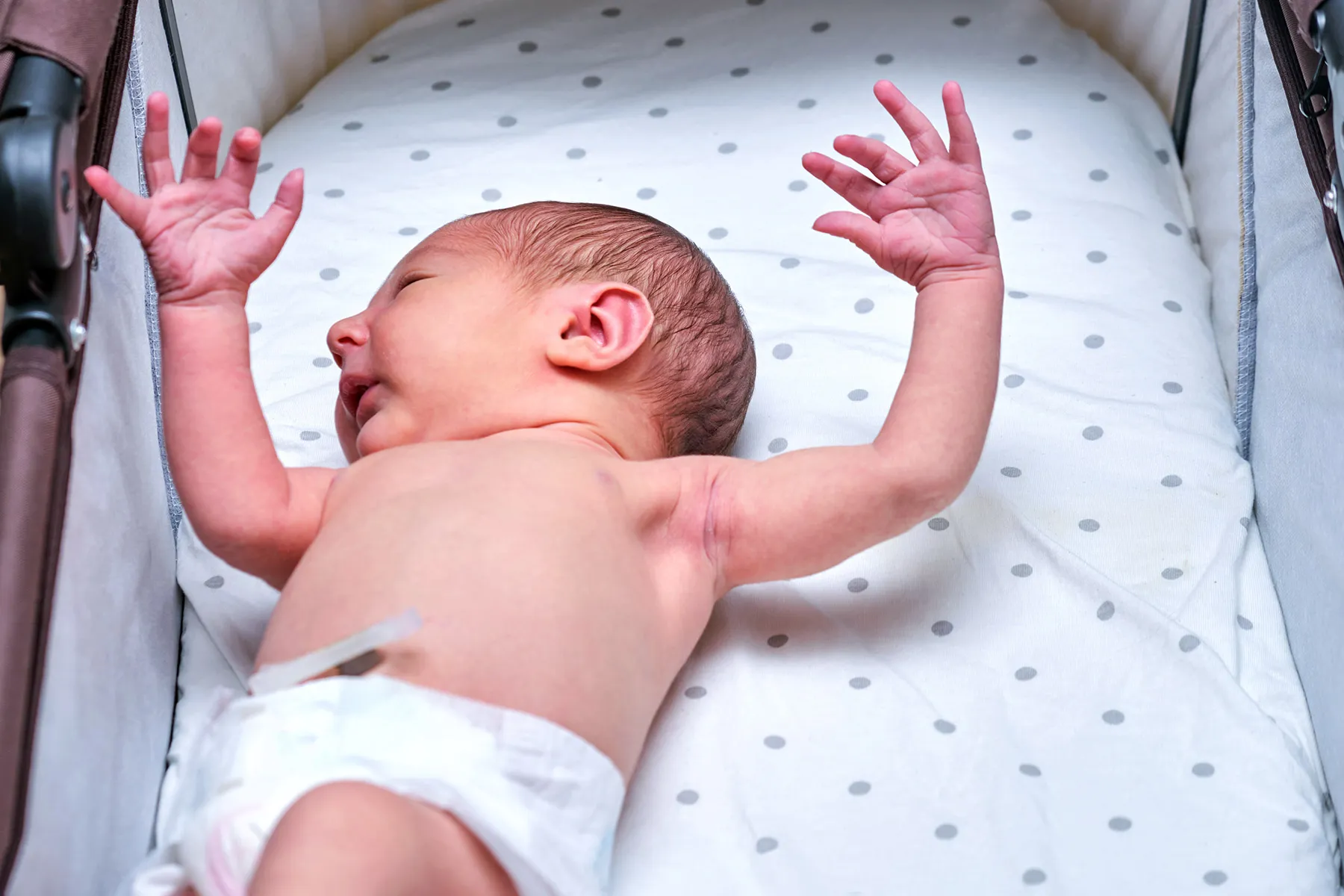
Moro (startle) reflex
an automatic response in infants where they fling their arms and legs outward in response to a sudden stimulus, such as a loud noise or loss of support
typically disappears around 6 months of age
Blinking reflex
an automatic response in infants where they close their eyes in response to bright light
remains throughout life
Babinski reflex
an automatic response in infants where they fan out their toes when the sole of their foot is stroked
disappears around 8-12 months of age
Sucking reflex
an automatic response in infants where they instinctively suck on objects placed in their mouth
remains throughout life
Grasping reflex
an automatic response in infants where they grasp objects placed in their hands
disappears around 6 months of age
Gross Motor Development
the progression of a child's ability to use large muscle movements
ex: crawling, standing, walking
Fine Motor Development
the progression of a child's ability to use small muscle movements
ex: grasping, reaching
Children develop fine and gross motor skills at ___ rates.
different
What gross and fine motor movements does a 3 month old have?
Expected gross motor: rolls from side to side
Expected fine motor: grasps rattle
What gross and fine motor movements does a 6 month old have?
Expected gross motor: sits without support
Expected fine motor: transfers object from one hand to the other
What gross and fine motor movements does a 7-9 month old have?
Expected gross motor: stands with support
Expected fine motor: grasps with thumb and finger
What gross and fine motor movements does an 11 month old have?
Expected gross motor: stands alone
Expected fine motor: develops pincer grasp
What gross and fine motor movements does an 11-14 month old have?
Expected gross motor: walks independently
Expected fine motor: builds a tower with 2 squares
What gross and fine motor movements does a 16 month old have?
Expected gross motor: walks upstairs
Expected fine motor: removes socks and shoes
What gross and fine motor movements does a 24 month old have?
Expected gross motor: jumps, runs, kicks a ball
Expected fine motor: drinks from a cup without spilling
Types of malnutrition
Marasmus
Kwashiorkor
Marasmus
a form of malnutrition characterized by a diet low in all essential nutrients
causes lasting physical damage, learning and behavioral effects, and puts child at risk for death
Kwashiorkor
a form of malnutrition characterized by a diet low in protein
causes lasting physical damage, learning and behavioral effects
What is food insecurity?
the lack of access to healthy, nutritious foods
What can food insecurity cause?
physical growth issues
learning problems
What senses does a newborn have?
vision
hearing
smell
taste
sensitivity to pain
responds to touch
Piaget’s Theory for Cognitive Development suggests that infants have schemas. What are schemas?
mental structures that organize and interpret information
What two principles underlie growth in children’s schemas?
assimilation and accommodation
Assimilation
the process by which people understand an experience in terms of their current stage of cognitive development
they apply an existing schema to new experiences
ex: children who encounter a flying squirrel at a zoo and call it a “bird” are assimilating the squirrel to their existing schema of bird
Accommodation
the process of adjusting an existing schema or creating new ones in response to new information and experiences
ex: when children see a flying squirrel and call it “a bird with a tail,” they are beginning to accommodate new knowledge, modifying their schema of a bird
Piaget suggests that the sensorimotor stage, the initial major stage of cognitive development, can be broken down into six substages. What are these six stages?
reflexive schemas
primary circular reactions
secondary circular reactions
coordination of secondary circular reactions
tertiary circular reactions
mental representations
Reflexive schemas (birth to 1 month)
infants use innate reflexes to learn and grow cognitively
Primary circular reactions (1-4 months)
an infant engages in simple motor habits centered around their own body (ex: sucking their thumb)
Secondary circular reactions (4-8 months)
an infant can perform intentional, goal-directed behavior and understands object permanence (ex: child picking up rattle and shaking it repeatedly)
Coordination of secondary circular reflexes (8-12 months)
an infant will imitate familiar behaviors and repeat actions that produce interesting effects (ex: mimic face expressions or drop toys to see them fall)
Tertiary circular reactions (12-18 months)
infants carry out miniature experiments to learn about objects (ex: dropping a spoon repeatedly to see how it falls in different ways)
Mental representation (18 months to 2 years)
the ability to form internal images or concepts of objects and events
advanced object permanence (ex: knowing an object exists even if it is invisible to us, like under a blanket)
Object permanence
understanding that an object exists, even when out of sight
How do we test if an infant understands object permanence?
By hiding an object and observing if the infant searches for it, indicating they believe it still exists
Displaced reference
the ability to use words or symbols to refer to an object that is not present
this is a huge achievement in cognitive development