1 radio physics - basic concepts atoms and radiation
 Call Kai
 Learn
Learn Practice Test
 Spaced Repetition
 Match
Match Flashcards
 Knowt Play
1/148

There's no tags or description
Looks like no tags are added yet.
Name | Mastery | Learn | Test | Matching | Spaced | Call with Kai | Chat |
|---|
No analytics yet
Send a link to your students to track their progress
149 Terms
what is matter made up of
discrete units called atoms
what do atoms of the same element share
the same chemical properties
what happens when atoms combine in defined proportions
they form composite substances or chemical compounds
what is a molecule
the smallest entity that retains the composition of a substance
give me an example of a molecule
H20/water
what are the two main parts of an atom
positively charged nucleus
electron shell
what is the charged of the nucleus
positive
what is an electron shell formed by
negatively charged electrons
what particles make up the nucleus
protons (+)
neutrons
what is the charge of a proton
positive
what is the charge of a neutron
no electrical charge
what are protons and neutrons called collectively
nucleons
what is the symbol for protons
Z
what is the symbol for neutrons
N
what is the equation for the mass number
A = Z + N
where is practically all of an atoms mass located
in the nucleus
what is the typical radius of a nucleus
10-15 m (very small)
The nucleus contains practically all the mass of the atom and its typical radius is on the
order of 10-15 m (1 fm); on the atomic scale this implies that the atom is, for the most part …… ?
empty space
what is the density of nuclear matter
1014 g.cm-3

LOOK
done
what surrounds the nucleus of an atom
the electron shell
what is the electron shell made up of and what is their charge
negative electrons (-e)
how significant is the mass of electrons
their mass is negligible
what type of energy states do electrons occupy
discrete energy states
what does discrete energy states mean
electrons can only have specific energy values
Can electrons have any possible energy?
No. They occupy specific energy states.
What are the electron shells traditionally called?
K, L, M, N, O, P and Q.
What is the principal quantum number?
the number n identifying an electron shell
What values can the principal quantum number have?
n = 1, 2, 3, 4…
Which shell corresponds to n = 1?
K shell
What happens to binding energy as n becomes smaller?
Binding energy becomes greater.
Which electrons have greater binding energy?
Electrons in more internal shells.
the smaller n (most internal) =
the greater binding energy of the electron
What is electron binding energy?
The minimum energy required to remove an electron from the atom.
What happens to binding energy as the shell becomes more external?
It becomes lower.
What does binding energy depend on?
The element (Z) and the shell.
Does binding energy depend only on the shell?
No. It depends on Z and the shell.
What does Z represent here?
The element's atomic number.
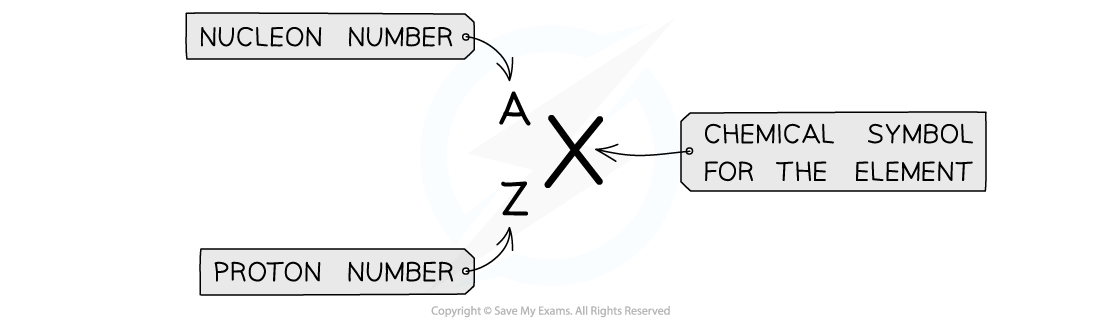
How are different nuclei represented?
A/Z X

What does X represent
The element.
What does Z represent
the atomic number
What does the atomic number Z tell you?
The number of protons.
What does A represent
The mass number.
What does the mass number A represent?
The total number of nucleons ( A= Z + N )
What does N represent?
The number of neutrons.
What determines which element an atom is?
Its number of protons (Z).
Can two different elements have the same Z?
no
What are isotopes?
Atoms with the same Z but different A.
What do isotopes have in common?
The same number of protons.
What differs between isotopes?
Their number of neutrons.
Are isotopes the same chemical element and why?
yes because they have the same Z

all are the same chemical element, carbon, identified by the number of protons, which determines its ….
chemical behaviour
What are isobars?
Nuclides with the same A but different Z.

: Why are isobars different elements?
They have different numbers of protons.

What are isotones?
Nuclides with the same N but different Z.
What does “same N” mean for isotones?
They have the same number of neutrons.
Are isotones the same element and why
no they have different number of protons
What happens when an atom absorbs energy?
One or more electrons may be promoted to higher energy levels.
What is the promotion of an electron to a higher level called?
Excitation.
What is excitation?
Moving an electron to a higher energy level.
( when an atom absorbs energy, 1 or more electrons may be promoted to higher energy levels)
what is the definition of the process of ionisation
when the energy supplied is sufficient to remove the electron from the atom
What is the key difference between excitation and ionization?
Excitation raises an electron; ionization removes it.
What happens to the atom after an electron is removed?
It becomes an ion.
What is the minimum energy required to ionize an atom called?
Ionization energy/protentional
Is ionization energy the same for every element?
No. It is characteristic of each element.
What is an ion?
An atom with a number of electrons different from its number of protons.
When does an atom become an ion?
When its number of electrons differs from its number of protons.
What happens when an atom loses an electron?
It becomes positively charged.
What is a positive ion called?
A cation.
What is a cation?
An atom with fewer electrons than protons.
What happens when an atom has more electrons than protons?
It becomes negatively charged.
What is a negative ion called?
An anion.
Are excited atomic states stable?
No. They are unstable.
What do excited atoms tend to do?
De-excite.
how does an excited (unstable) atom de-excite
emitting excess energy
an excited (unstable) atom de-excites by emitting excess energy in the form of
Electromagnetic radiation.
(Ey = Ef - Ei)
What determines the frequency of the emitted radiation?
The energy difference between the levels.
What happens to the electron during de-excitation?
It moves from a higher energy level to a lower one.
What unit is used to measure atomic masses?
The unified atomic mass unit (u).
How is the unified atomic mass unit (u) defined?
1/12 of the rest mass of a carbon-12 atom.
How do the masses of protons and neutrons compare?
They are practically equal.
Does the electron's mass significantly affect the total mass of an atom?
no ( negligible)
What unit are atomic energies usually expressed in?
The electronvolt (eV).
What is an electronvolt (eV)?
The energy acquired by an electron when it crosses a potential difference of 1 volt in vacuum.
what is eV in joules
1,6. 10 -19 J
what is KeV
103 eV
what is MeV
106 eV
How can electromagnetic radiation be described?
As a wave made of oscillating electric and magnetic fields.
What happens to the electric and magnetic fields in electromagnetic radiation?
They oscillate
How are the electric and magnetic fields oriented relative to each other?
They are mutually perpendicular and in phase
electromagnetic radiation can be described as a wave composed of oscillation electric (E) and magnetic (B) fields, mutually perpendicular and in phase, which what…….
which propagates in vacuum at speed ( c )
how fast does electromagnetic radiation travel in a vacuum
c = 3.108 m/s
What is frequency (ν)?
The number of oscillations per unit of time.
What is wavelength (λ)?
The length of one complete oscillation.
What equation relates speed, frequency and wavelength?
c = ν × λ
What happens to wavelength when frequency increases?
Wavelength decreases
What happens to wavelength when frequency decreases?
Wavelength increases
What is the relationship between frequency and wavelength when the speed is constant?
They are inversely related
What happens to frequency when wavelength becomes shorter?
Frequency increases
What happens to frequency when wavelength becomes longer?
Frequency decreases