Audiology Exam 1 Study Guide
 Call Kai
 Learn
 Practice Test
 Spaced Repetition
 Match
 Flashcards
 Knowt Play
1/140

There's no tags or description
Looks like no tags are added yet.
141 Terms
Definition of Audiology
Field in healthcare involved in the study, diagnosis, treatment, and prevention of hearing and vestibular disorders
Current professional requirements to be an Audiologist
4 year bachelor’s degree in communication disorders or another health/science-related area
Graduate degree (Au.D. or other doctoral degree (PhD) or both
Pass a national examination in audiology (PRAXIS)
Minimum 1820 hours of supervised clinical hours - separate from specialization hours
State license to practice audiology (LARA in Michigan)
Label parts of Ear

Structures that belong to Outer Ear
Pinna (Auricle)
External Auditory Meatus (ear canal)
Tympanic Membrane
Structures that belong to Middle Ear
Three Ossicles (Middle Ear Bones)
Two Major Muscles (tensor tympani and stapedius)
Eustachian tube
Structures that belong to Inner Ear
Cochlea
Vestibular System
What is the Pinna made of?
Cartilage and Skin
What is another name for the External Auditory Meatus?
Ear Canal
How many bends are in the Ear Canal (EAM)?
Two in an S-shaped course
What is another name for the Tympanic Membrane?
Eardrum
What are the layers of the Tympanic Membrane
Outer Layer - Cutaneous Layer
Middle Layer - Fibrous Layer
Inner Layer - Mucosal Layer
Where in the tympanic membrane are the layers located?
Pars tensa
What are the three ossicles?
Malleus
Incus
Stapes
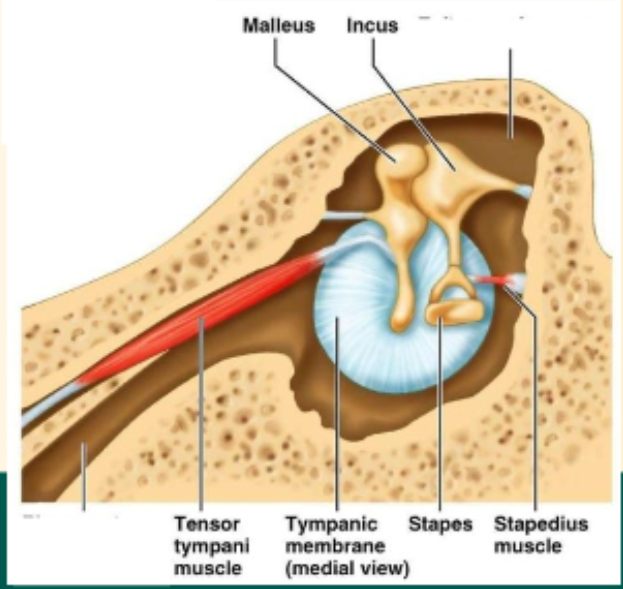
What ossicle is the smallest bone in the human body?
Stapes
What are the middle ear muscles?
Tensor Tympani
Stapedius
Which muscle attaches to which ossicle?
Tensor tympani attached to malleus → CN V
Stapedius attached to stapes → CN VII
What is the purpose of the Eustachian Tube?
To equalize middle-ear pressure
What does the eustachian tube connect to?
Connects the middle ear to the nasopharynx
What is the cycle of the Eustachian tube?
Closed at rest
Opens during swallowing/ yawning
Provides drainage from middle ear
Where is the cochlea located within the inner ear?
Temporal Bone
How many turns does the Cochlea have?
Approximately 2 ¾ turns
What are the chambers of the Cochlea?
Scala Vestibuli
Scala Media
Scala Tympani

Which chambers contain perilymph?
Scala Vestibuli
Scala Tympani
Which chambers contain Endolymph?
Scala Media
The sensory organ for hearing is called?
Organ of Corti
What does the Organ of Corti contain?
Inner Hair Cells
Outer Hair Cells
Supporting Cells
What is the purpose of Inner Hair Cells?
Primary sensory receptors → Sends most auditory information to the brain
What is the purpose of Outer Hair cells?
Amplify and tune cochlear responses
Which hair cell contains more cells/rows?
Outer hair cell rows 3 vs 1
Outer hair cells 12k vs 3.5k
How is the cochlea organized?
By frequency → Base High Frequency, Apex Low Frequency
Tonotopic Organization of Pitches
16 kHz
8 kHz
4 kHz
2 kHz
1 kHz
500 Hz

Brainstem Pathway (E COLI)
Eight Nerve
Cochlear Nucleus
Olivary Complex
Lateral Lemniscus
Inferior Colliculus
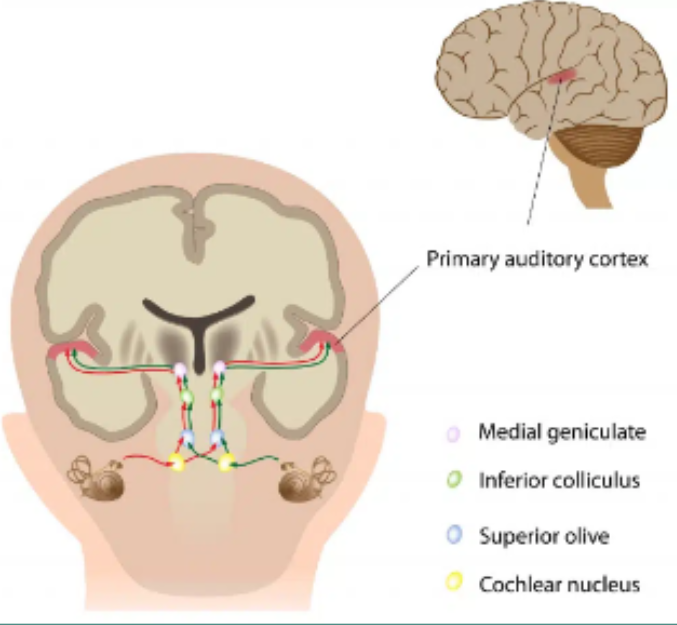
What is the eight nerve?
The cochlear/vestibular nerve
What is does the Eighth Nerve consist of?
75% cochlear nerve bundles
25% vestibular nerve bundles
Auditory Nerve
Pathway from sound wave to hearing in the brain (America Must Hate Electric N)
Acoustic Energy - vibrating air molecules create a sound pressure wave
Mechanical Energy - the tympanic membrane and ossicles vibrate
Hydraulic Energy - the stapes moves the cochlear fluids
Electrochemical Energy - hair cells convert mechanical movement into neural signals
Neural Transmission - the auditory pathway carries information to the auditory cortex
What is the range of human hearing?
20 Hz to 20,000 Hz
What is compression?
The portion of a sound wave cycle where particles of medium are compacted. This is when molecules are temporarily packed closer together
What is rarefaction?
The portion of a sound wave where particles of a medium are less dense (decreased below static value). This is when molecules are temporarily spread farther apart
What is a sine wave?
A mathematical representation of periodic oscillation (cycle of vibration)

One complete cycle of vibration is how many degrees?
360
What is frequency?
The number of cycles per second measured in Hz
1 Hz = 1 cycle per time
Psychological Correlation: Pitch

What is the relationship between frequency and wavelength?
Inverse

How do you count Cycles/Hz on a graph?
Measure point that goes down to the point that goes up (Refer to slide 16-17 on Week 2.2)
(*Sreenath tip - think of it as a circle to complete 1 thingy)

What is amplitude?
The physical size/length of a sound wave (pressure variation) from the center line.
Measured in Pascals (Pa)

What is loudness?
Our perception of how strong/loud a sound is
What is the relationship between amplitude and loudness?
Direct

What are the four types of hearing loss?
Conductive Hearing Loss (CHL)
Sensorineural Hearing Loss (SNHL)
Mixed Hearing Loss
Neural Hearing Loss

Where does the breakdown occur for Conductive Hearing Loss (CHL)?
Blockage, Damage, or Disease to Outer and/or Middle ear
Which part of the auditory system remains normal for CHL?
Cochlea and Auditory Nerve
Where does the breakdown occur for Sensorineural Hearing Loss (SNHL)?
Inner Ear - Missing/Damaged hair cells of the cochlea or other cochlear structurers
Which part of the auditory system remains normal for SNHL?
Outer Ear, Middle Ear, and Auditory Nerves
Where does the breakdown occur for Mixed Hearing Loss (MHL)?
Problems from both Inner and Outer or Middle Ear
Which part of the auditory system remains normal for MHL?
Auditory Nerve

Where does the breakdown occur for Neural Hearing Loss (NHL)?
Synapse, Auditory Nerve, Neural Auditory Pathway or combinations of these
Which part of the auditory system remains normal for NHL?
Cochlear function have be preserved
Which two types of hearing loss are the most common?
CHL and SNHL
Which types of hearing loss are more common temporarily?
CHL
MHL
Which types of hearing loss are more common permanently?
SNHL
NHL
What is ANSD?
Auditory Neuropathy Spectrum Disorder : Auditory information is not transmitted in a normal, synchronized manner
What is Auditory Processing Disorder (APD)?
Difficulty processing and interpreting auditory information despite adequate access to sound
Can APD be diagnosed because someone reports difficulty hearing?
No
What might a person with APD experience?
Difficulty understanding speech in background noise
Difficulty following rapid or complex verbal information
Problems distinguishing similar sounds or patterns
What is the main difference between APD and NHL?
NHL there is a problem with the neural transmission of auditory information
APD there is a difficulty with the central processing of that information
What is Functional/Nonorganic Hearing Difficulty?
A discrepancy between reported/behavioral hearing ability (subjective responses) and objective evidence of auditory function (objective responses)
Poor agreement between behavioral thresholds and objective measures
What are some reasons for functional hearing loss?
Patients might exaggerate existing hearing loss
Patients might be seeking monetary gain or emotional reward
Patients may have mental or emotional conditions
What are the causes of CHL?
Cerumen Impaction
Congenital Ear Abnormalities
Otitis Media / middle-ear effusion
Otitis Externa
Exostoses/ “Surfer’s ear”
Eustachian tube dysfunction
Tympanic membrane perforation
Otoscleosis
Cholesteatoma
Which conditions are permanent in CHL?
Congenital Ear Abnormalities
Tympanic Membrane Perforation (Could be permanent based on size)
Otosclerosis
Cholesteatoma
What are the common abnormalities in Congenital Ear Abnormalities (CEA)?
Microtia → underdeveloped or absent pinna
Aura Atresia → Absent or completely closed EAC (External Auditory Canal)
Aural Stenosis → EAC is present but narrowed
What is OME?
Otitis Media with effusion
Fluid (Goo) behind the eardrum without an acute infection
Reduces mobility of the tympanic membrane and ossicular chain
What is AOM?
Acute Otitis Media
Fluid behind the eardrum with an acute infection
Often follows an upper respiratory infection
Can be called “Glue Ear”
What can OME evolve from?
Common Cold
Allergies
Smoke Exposure
Anything that can cause obstruction/swelling of Eustachian tube
What does surfer’s ear develop from?
Repeated exposure of the ear canal to cold water and cold air
What is exostoses?
Abnormal bone growth along the walls of the ear canal from repeated cold-water exposure

What is the role of tympanoplasty?
To close the opening and restore the integrity of the tympanic membrane after a perforation which does not heal
In Otosclerosis, which ossicle is affected?
Stapes
What are the causes of Otosclerosis?
Hereditary
Women can see this during pregnancy or postpartum - changes in estrogen accelerates bone growth
Men experience accelerated progression with age
What is a treatment option for otosclerosis?
Stapedectomy: replace stapes with prosthesis or hearing aids if patient does not want to undergo surgery

What are the causes of SNHL?
Age-Related hearing loss/presbycusis
Inner-ear malformation
Noise induced hearing loss
Ototoxic medications
Genetic conditions
Congenital infections/cCMV
Meningitis
Sudden SNHL
Meniere’s disease
What are the two inner ear malformations? How are inner ear malformations identified?
Mondini Malformation / Incomplete partition type II → cochlea has fewer or abnormal turns than the typical 2.5- 2.75 turns
Cochlear Hypoplasia → The cochlea is smaller or less developed than normal due to incomplete development of the inner ear, and the severity of hearing loss does not always correspond directly to the degree of anatomical abnormality
What is syndromic hearing loss?
Hearing loss occurs with other medical or developmental features
What is nonsyndromic hearing loss?
Hearing loss occurs without other major associated clinical features
What are 2 common genes for nonsyndromic hearing loss?
GJB2
OTOF
Is GJB2 a common or rare gene associated with hereditary nonsyndromic hearing loss?
Common
Is GJB2 one of the most common genes associated with nonhereditary or hereditary nonsyndromic hearing loss?
Heriditary
GJB2 provides instructions for making which protein?
Connexin 26
What is the pathway for SNHL from GJB2?
GJB2 variant
Abnormal connexin 26
Disrupted cochlear function
SNHL
What is cCMV?
A congenital infection with cytomegalovirus that can cause delayed-onset or progressive SNHL in pediatrics
How can a pregnant woman reduce the risk of infection/transmission of cCMV?
Wash hands with soap and water after changing diapers or helping a child use the toilet
Do not share food, utensils, or cups with young children
Do not share pacifiers
Avoid contact between a child’s saliva and your mouth
Clean toys and surfaces that may have saliva or urine on them
Which state was the first to implement universal screening?
Minnesota
When is hearing targeted screening used?
When infants fail the newborn hearing test
What are the common causes of MHL?
Chronic middle-ear disease + presbycusis
Otosclerosis with cochlear involvement
Noise-induced SNHL + conductive pathology
Temporal bone trauma
Long-Standing ear disease
What type of hearing disorder can OTOF cause?
Auditory dysynchrony in which inner hair cells may function but cannot effectively transmit signals to the auditory nerve
What is the first FDA-Approved Gene Therapy for inherited hearing loss?
OTOF Gene therapy
How does OTOF gene therapy work?
Vectors deliver functional OTOF genetic material to cochlear hair cells → restores otoferlin production → restores synaptic transmission
Who is OTOF gene therapy for?
Pediatric and adult patients with molecularly confirmed biallelic OTOF variants
Severe-to-profound/profound hearing loss
No prior cochlear implant in the treated ear
What is absolute sensitivity?
Ability to detect faint sound
What is differential sensitivity?
Ability to detect differences or changes in intensity, frequency, duration, or other dimensions of sound
What does absolute sensitivity and differential sensitivity refer to?
Absolute: Hearing Sensitivity → Can I detect the sound
Differential: Hearing Acuity → Can I tell that the sound changed
What is an Audiogram?
Plots the softest sounds detected at different frequencies
Your hearing threshold = lowest level detected about 50% of the time
Measured separately for each ear and usually includes air and bone conduction thresholds, but not always
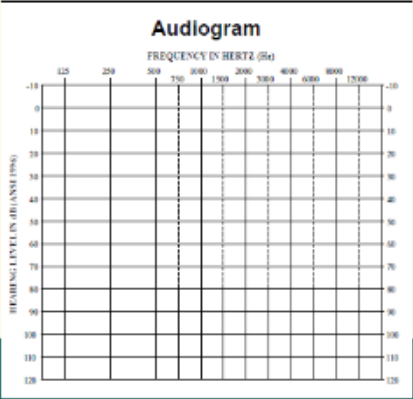
What is an Audiogram used to do?
Describe hearing sensitivity
Identify and characterize hearing loss
Monitor changes in hearing
Guide medical, surgical, and rehabilitative decisions