2 - Ca2+ signalling
 Call Kai
 Learn
 Practice Test
 Spaced Repetition
 Match
 Flashcards
 Knowt Play
1/55

There's no tags or description
Looks like no tags are added yet.
56 Terms
why is Ca2+ important?
used in many cells to trasmit signals.
describe the concentration gradient of calsium?
it is very extreme:
Inside cells: ~100 nM (very low).
Outside cells: 1.5–2 mM (much higher).
Calcium affects many affector proteins, give the 2 types + examples?
Enzymes: kinases, phosphatases and phospholipases.
Ion channels: potassium, chloride and TRP channels.
Give some examples of processes that calcium regulates?
muscle contraction, hormone release and neurotransmitter release.
what is the Ca²⁺ signalling toolkit?
the systems cells use to control calcium levels, including Ca²⁺ entry/release, buffering, removal and activation of target proteins.
describe calcium entry/release?
ca2+ enters from either outside the cell OR released from intracellular stores.
give some examples of how calcium enters?
voltage-gated calcium channels (VGCCs): open when the cell membrane depolarises.
transient receptor potential (TRP channels): allow Ca²⁺ to enter from outside the cell.
IP3 receptors (IP3R): release Ca²⁺ from the ER when IP₃ binds.
Ryanoid receptors (RyR): release Ca²⁺ from the ER in response to Ca²⁺.
what do calcium buffers do?
Bind excess Ca²⁺ in the cytoplasm to prevent sudden changes in its concentration.
why are calcium buffers important?
They help control the strength and duration of Ca²⁺ signals and protect cells from Ca²⁺ toxicity.
give examples of calcium buffers?
Parvalbumin: slow Ca²⁺ buffer.
Calbindin-28k: rapid Ca²⁺ buffer.
why is removing calcium from the cytoplasm important?
To restore resting levels and prevent toxicity.
give some examples of some mechanism that remove calcium?
Mitochondria: take up Ca²⁺ and help regulate its concentration.
PMCA: uses ATP to pump Ca²⁺ out of the cell.
SERCA: uses ATP to pump Ca²⁺ into the ER for storage.
how can scientists measure changes in Ca²⁺ levels inside cells?
they use fluorescent indicators which bind Ca²⁺ and change their fluorescence, which makes them visible.
There are many pathways for calcium to enter/be released, for each describe the mechanism. 1. ligand-gated ion channels?
Open when a specific ligand binds to them, allowing Ca²⁺ to enter the cell.
TRP and store-operated channels?
allow Ca²⁺ to enter cells.
Voltage-gated calcium channels (VGCCs)?
open when the membrane depolarises.
Conformational couplin?
L-type VGCCs activate ryanoid receptors (RyRs) through physical interaction, triggering Ca²⁺ release from the ER.
Calcium-induced calcium release?
Incoming Ca²⁺ triggers further Ca²⁺ release from intracellular stores.
IP₃ receptor-mediated release?
IP₃ binds to IP₃Rs on the ER, causing Ca²⁺ release.
what are Rapid Ca²⁺ signals?
quick rises in intracellular Ca2+ that trigger fast cellular responses.
what channels are involved in rapid calcium signals?
VGCCs allow Ca²⁺ entry; RyRs release Ca²⁺ from the ER.
What is calmodulin (CaM)?
A protein that binds Ca²⁺ and activates other proteins.
What happens when Ca²⁺ binds to calmodulin?
It activates proteins that regulate ion channels and enzymes.
What are CaMKII and PKC?
Enzymes activated by Ca²⁺ signalling that regulate cellular activities.
How can Ca²⁺ signalling affect gene transcription?
It activates signalling proteins that influence which genes are expressed. (so can switch genes on and off).
What are slow Ca²⁺ signals?
Repeated rises and falls in intracellular Ca²⁺ called oscillations.
what are oscillations?
Repeated increases and decreases in intracellular Ca²⁺ concentration.
What can slow Ca²⁺ signals regulate?
Longer-lasting cellular responses, including changes in gene expression.
What is the key difference between rapid and slow Ca²⁺ signals?
Rapid signals act quickly; slow oscillations can regulate longer-lasting responses.
what do Calcium-binding proteins (buffers) do?
bind ca2+ to reduce fluctuations in intracellular conc. + help protect cells from calcium toxicity.
what is Ca2+ sequestration and extrusion?
Sequestration: Moving Ca²⁺ into storage compartments, such as the ER or mitochondria.
Extrusion: Pumping Ca²⁺ out of the cell.
Purpose: Both reduce cytoplasmic Ca²⁺ levels and restore resting concentrations.
what is a Mitochondrial Ca²⁺ uniporter?
transports Ca²⁺ into mitochondria, driven by the mitochondrial membrane potential.
what is a Na⁺/Ca²⁺ exchanger?
exchanges Na⁺ and Ca²⁺ across the plasma membrane.
what is SERCA (sarco-endoplasmic reticulum Ca2+-ATPase)?
Pumps Ca²⁺ into the sarcoplasmic/endoplasmic reticulum using ATP.
WHAT IS PMCA (Plasma Membrane Ca²⁺-ATPase)?
pumps Ca²⁺ out of the cell using ATP.
what does Phospholipase C do?
breaks down PIP₂ → DAG + IP₃.
what does IP3 do?
binds to IP₃ receptors on the endoplasmic reticulum (ER) → Ca²⁺ is released into the cytoplasm.
what are oscillations affected by?
the concentration of the signalling molecule, so a stronger stimulus → more frequent Ca²⁺ oscillations.
how do Ca²⁺ signals spread between neighbouring cells?
through gap junctions, allowing cells to communicate.
what is Calmodulin?
a calcium-binding protein that acts as an intracellular Ca²⁺ sensor.
because calmodulin is such an important protein, how is it’s presence insured in the body?
Encoded by 3 different genes, which produce identical calmodulin proteins.
how does calmodulin work?
It binds Ca²⁺, changes shape + interacts with target proteins to control their activity.
what are some examples of things that Ca2+/calmodulin complex interacts with + controls their activity?
CaMKII: a Ca²⁺/calmodulin-dependent protein kinase that phosphorylates target proteins.
Calcineurin: a Ca²⁺/calmodulin-dependent phosphatase that removes phosphate groups from proteins.
Myosin Light Chain Kinase (MLCK): phosphorylates myosin light chains → promotes smooth muscle contraction.
Ion channels: calmodulin regulates their activity → affects ion movement across cell membranes.
explain the process of Ca²⁺/Calmodulin-dependent protein kinase II (CaMKII)?
Ca²⁺ binds to calmodulin, which then binds to CaMKII. CaMKII phosphorylates itself + becomes active.
Even when Ca2+ levels in the cell decrease because it has autophosphorylated. - some sort of molecular memory as it remm=embers the presence of calcium and it’s still active.
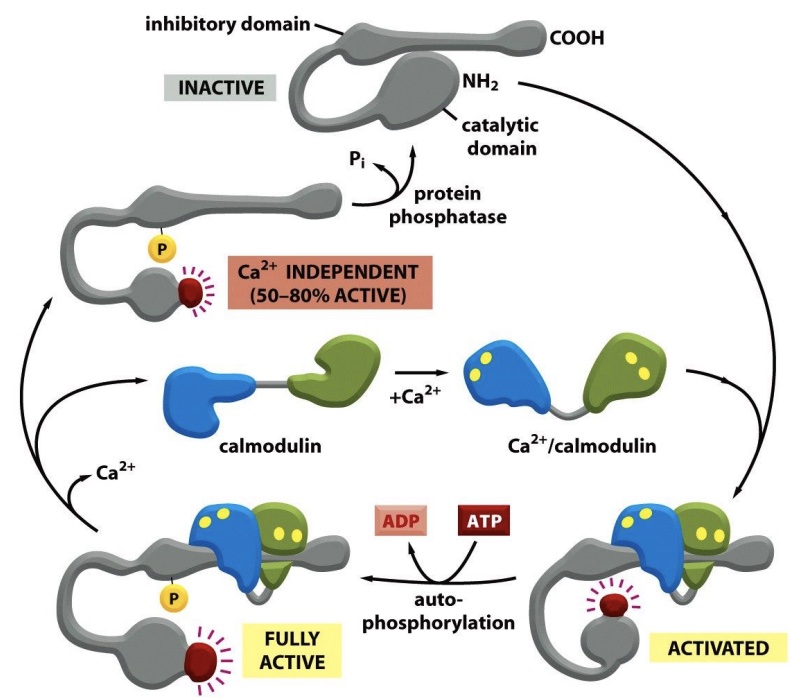
how does CaMKII become inactive?
Protein phosphatases remove the phosphate groups from CaMKII.
what is CamKII dependent on?
frequency of Ca²⁺ oscillations, not just the intracellular Ca²⁺ concentration.
so why is CaMKII usefull?
because it can can produce longer-lasting changes in cell activity through autophosphorylation.
what is a cell process that CamKII can help regulate?
Cell division.