Lecture 15 - Gene Expression
 Call Kai
 Learn
 Practice Test
 Spaced Repetition
 Match
 Flashcards
 Knowt Play
1/18

There's no tags or description
Looks like no tags are added yet.
19 Terms
flow of genetic information
proposed by Francis Crick
DNA → RNA → protein - unidirectional
RNA/ribonucleic acid
sugar - ribose (additional -OH)
bases - A, U, C, G
one strand
3 main kinds:
mRNA
rRNA
tRNA
codons/genetic code
sequence of 3 bases produces 1 amino acid
only 20 different amino acids
umnambiguous & redundant
wobble hypothesis
proposed by Francis Crick
explains why multiple codons can code for a single amino acid
one tRNA molecule can recognize and bind to more than one codon, due to less precise base pairing that can arise between the 3rd base of the codon and the base at the 1st position on the anticodon

transcription
occurs in the nucleus
first part of gene expression
synthesis of RNA complementary to DNA
there stages:
initiation
elongation
termination
transcription initiation
one DNA strand serves as template for RNA synthesis (other strand not transcribed)
DNA read in 3’-5’ direction & mRNA synthesized in 5’-3’ direction (just like DNA replication)
components:
promotor - specific DNA sequence that indicates transcription start site (promote not transcribed)
RNA polymerase - enzyme that makes RNA strand; binds promotor, unwinds helix, begins transcription

transcription elongation
RNA synthesis
antiparallel to template strand (5’-3’)
just like DNA replication but uses RNA triphosphate
transcription termination
specific DNA sequence (NOT stop codon) causes RNA polymerase to release DNA
mRNA transcript release
mRNA modification
occurs in nucleus and only in eukaryotes
mRNA after transcription is not ready for protein synthesis
5’ cap and 3’ poły-A tail is added to the mRNA
tail - protect mRNA from being broken down
cap - allows to move out of nucleus
strand is exported out of the nucleus, ribosome recruitment and protection
RNA splicing
occurs in the nucleus
introns are removed & exons are connected
results in mature mRNA

introns
regions that do not code amino acids
exons
regions that code for amino acids
translation
mRNA → polypeptide
occurs in ribosomes (cytoplasm or surface of ER)
three stages:
initation
elongation
termination
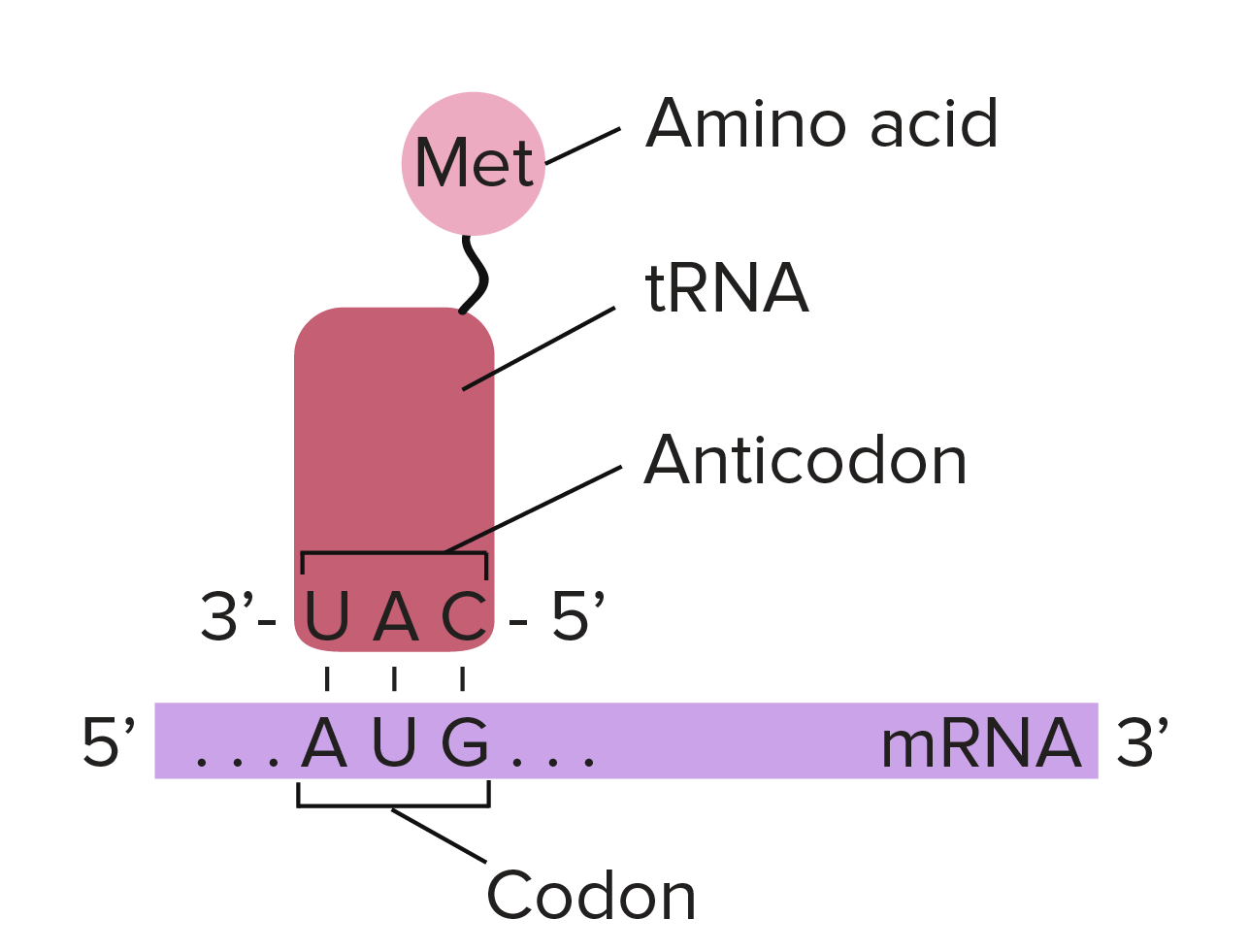
transfer DNA (tRNA)
single-stranded
~80 nucleotides
in translation
many variants and carries specific amino acids into ribosome

anticodon
3 bases on loops of tRNA
complementary to codon in mRNA
how each codon codes for one specific amino acid
ribosomal RNA (rRNA)
catalyzes peptide bond formation
acts as a ribozyme
makes up the ribosome with protein
translation initiation
mRNA binds to small ribosomal unit
first tRNA binds (complementary to start codon)
large subunit associates

translation elongation
cyclical process
codon recognition
peptide bond formation - endergonic, requires E
translocation - work, requires E
each cycle adds 1 amino acid to polypeptide
translation termination
stop codon recognized by release factors (proteins)
cannot form new peptide bond → components dissociate