12. Drug discovery and development
 Call Kai
 Learn
 Practice Test
 Spaced Repetition
 Match
 Flashcards
 Knowt Play
1/15

There's no tags or description
Looks like no tags are added yet.
16 Terms
Basics of the current R&D process
Pipeline model
Continous selection and attrition process
Validated drug targets are essential
So are the compound “libraries”
Alternative pathways are increasing
Discovery of drug targets
discovery and lead optimization → assay development screening lead optimization → find molecules that interact and show promising properties
Compounds may come from plants, in silico prediction, natural sources and chemistry
Receptor modeling
Models can be made to predict a ligand and receptor site to see if the drug can work

Toxins as inspiration for drug discovery
Venom peptides can be researched to see how they reach the target site and research they pharmacokinetics/dynamics
Principles of early drug discovery
Target validation: genetics, cellular and in vivor experimental models to identify and validate target
Compound screening: HTS & selective library screens; structure-based design. REiterative directed compound synthesis to improve compound properties
Secondary assays: In vitro & ex vivo secondary assays (mechanistic), selectivity & liability assays
In vivo analysis: compound pharmacology, disease efficacy models, early safety & toxicity studies
What are animals used for in drug development?
Disease progression
Pathway elucidation
Animal model validation
Target validation
Safety/Efficacy
Mechanism of action
Diagnostics/biomarkers
Clinical development
Where humans are used to test efficacy of drug. Consists of three phases
Phase I: healthy volunteers
Very small dose: used to study pharmacokinetics
Phase II: Small number of patients
Look for effect, are pharmacokinetics the same?
Phase II: large multi-centre trials
How long does drug development take and how much does it cost?
10-12 year process
More than 1000 million USD
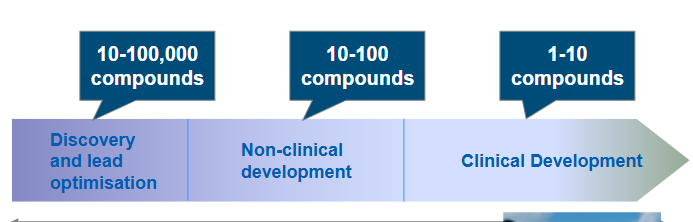
You start with 10-100000 compounds and end up with 1-10 compounds
Then you need regulatory approval
Post-market surveillance
‘Pharmacovigilance’, ‘geneesmiddelbewaking’
To detect side/adverse effects after introduction on the market
To ensure medicines are safe
EMA, national authorities, ‘marketing authorisation holder’
Organization in the Netherlands for inspection of drugs on the market
College ter Beoordeling van Genesmiddelen (CBG): responsible for safety checks
Inspectie Gezondheidszorge & Jeugd (IGJ): will inspect compliance to pharmacovigilance requirements
Bijwerkingencentrum Lareb
Report adverse effects
Knowledge center for adverse effects
Initiate investigations
CBG, RIVM, NVWA
Challenges in drug development
Treatment for a disease may have very high failure rate, leading to companies giving up on research
During clinical trials people may die or become very ill.
Companies need to be creative (low hanging fruit = picked)
Increase of R&D costs
Cuts and lmits by governments and health insurers
Patent expires, more competition
However…
World-wide demand for (new) drugs still rising
Many unmet medical needs (cancer, neurology, diabetes, etc)
More aged persons with buying power and demand for adequate medical care.
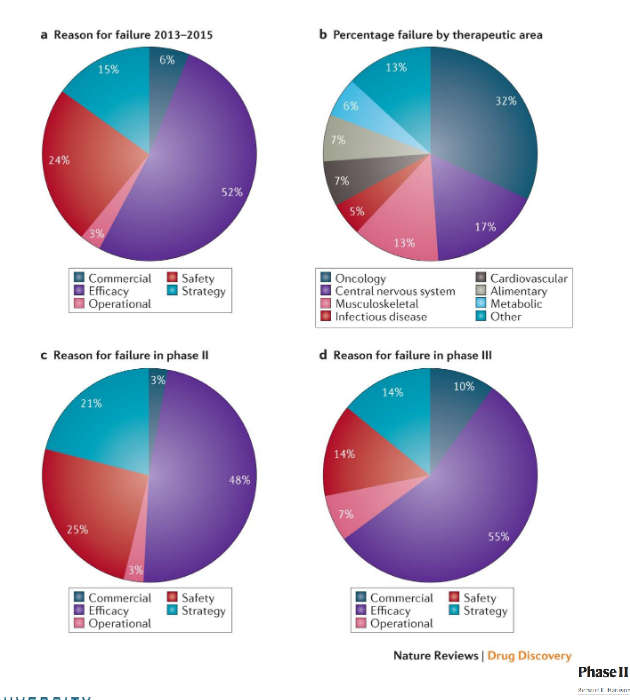
Reasons for failure
Often because of lack of efficacy = drug does not work.
Or because toxicity is unacceptable.
Personalized medicine approach
Many drugs do not respond and have no effect.
This is because all our bodies are very different and hence most drugs only work on 30-50% of patients.
Placebo
Placebo response accounts for at least 75% of positive effects of antidepressant medication
Which drugs are currently being developed?
Ghrelin: made in the stomach, highly expressed when you are hungry
Once you eat, Ghrelin goes down.
A drug is being developed to prevent ghrelin from going to the brain
AI revolution & drug discovery
Companies are applying AI to find new targets, or to understand diseases better.
AI can find links between different compounds and give ideas for new drugs.
