Plant Physiology Exam 2
 Call Kai
 Learn
 Practice Test
 Spaced Repetition
 Match
 Flashcards
 Knowt Play
1/44

There's no tags or description
Looks like no tags are added yet.
45 Terms
Highlight: Describe a membrane “Pump”
Primary active transport against electrochemical potential gradient using ATP and conformational changes. Pumps H+ to maintain membrane potential.
Highlight: Describe “Ion Channels”
Passive high to low concentration, no conformational changes,
Highlight: Describe the three types of “Carrier Protein”
1) Uniport
2) Symport
3) Antiport
Highlight: Describe “Uniport carrier protein”
Passive with gradient, transports only one solute.
Highlight: Describe “Symport carrier protein”
Secondary active transport against gradient using protonmotive force. Moves two solutes in the SAME direction: H+ moves down the gradient in order to move solute A against A’s gradient. Does NOT use ATP.
Highlight: Describe “Antiport carrier protein”
Secondary active transport against gradient using protonmotive force. Moves two solutes in OPPOSITE directions: H+ moves down the gradient in order to move solute A against A’s gradient. Does NOT use ATP.
Describe the effect of CN- (cyanide) on ATP synthesis and impact on membrane transport
Inhibits ATP synthesis in mitochondria by blocking ETC. Adding CN- inhibits membrane Pump because Pump uses ATP.
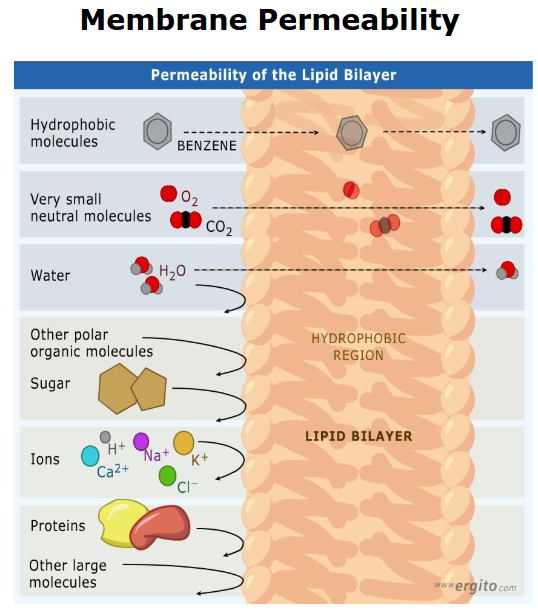
How does each of the following move through the membrane?
Benzene:
H20:
Ions:
Polar molecules:
Large molecules:
O2:
Benzene: passive because its hydrophobic
H20: aquaporin
Ions: active transport
Polar molecules: active transport
Large molecules: active transport
O2: passive
What are the two products of the light reactions in photosynthesis? Where are these products used?
ATP and NADPH
Used in the Calvin Cycle to make sugars
Where does the light reaction happen in photosynthesis?
In the thylakoid membrane in the chloroplast.
What parts of the electromagnetic spectrum are important for photosynthesis?
Visible spectrum, mainly blue (430-450 nm) and red (680 nm).
Absorption:
Light energy exciting a pigment molecule in photosystems 1 and 2 of the ETC.
Absorption spectrum VS Action spectrum
Absorption spectrum: every wavelength absorbed by the plant.
Action spectrum: wavelengths actually used in photosynthesis.
Engelmann’s Experiment
Determined which wavelengths were best for photosynthesis. Used a prism to split light into different colors and exposed algae to each one. Used O2 seeking bacteria to determine under which colors the algae produced O2. The O2 seeking bacteria grew most under blue and red light. This is evidence for the absorption and action spectrums.
Describe the transfer of energy from pigment molecules to the reaction center.
1) Photon absorption: A photon hits an antenna pigment molecule in the light harvesting complex.
2) Electron excitation: The photon excites an electron to a higher energy state
3) Resonance: As the electron drops back down to its ground state, it releases energy. This energy jumps directly to an adjacent pigment molecule. No electrons actually move.
4) Reaction Center: The resonance hop repeats from pigment to pigment across the antenna complex until it reaches a pair of chlorophyll a molecules at the reaction center.
5) Charge separation: Once the energy arrives at the reaction center it excites an electron high enough that the chlorophyll molecule loses the electron, transferring it to the primary electron acceptor and starting the light dependent reactions.
What complex makes NADPH and what side of the thylakoid membrane is it produced?
Ferrodoxin; Stroma
What complex makes ATP, what is the process called, and how does the H+ gradient contribute?
H+ flow down the gradient from the lumen to the stroma through ATP synthase. This proton motive force spins ATP synthase, which drives photophosphorylation of ATP.
What is the primary electron donor in photosynthesis?
Water, H2O
What complex transfers electrons from Cytochrome B to Photosystem 1?
Plastocyanin
What complex transfers electrons from Photosystem 2 to Cytochrome B and moves H+ against the gradient from stroma to lumen?
Plastoquinone
What direction does the Electron Transport Chain move H+?
Against the gradient from the thylakoid stroma to the lumen, creating an H+ gradient that drives ATP synthase.
Name the complexes of the ETC in the order of electron flow.
Photosystem 2, plastoquinone, cytochrome b, plastocyanin, photosystem 1, ferrodoxin.
Describe the Z-scheme.
PS2 is a strong oxidant and can split H2O. PS1 is a strong reductant and can deliver e- to NADP+. They have different jobs and need to collaborate. It is called a Z scheme because of the visual diagram.

How do some herbicides work?
They block the transition of PQa to PQb or they stop NADP+ from becoming NADPH.
What are the three steps of the Calvin Cycle?
1) Oxidation
2) Reduction
3) Regeneration
Which steps of the Calvin cycle require NADPH and which require ATP? How much of each?
Reduction requires 12 ATP and 12 NADPH. Regeneration requires 6 NADPH.
What is the main enzyme in carboxylation?
Rubisco
What is the reaction equation for the carboxylation step?
6CO2 + 6RuBP(5C2P) —> 6(6C) —> 12(3C1P)
What is the reaction equation for the reduction step?
12(3C1P) + 12ATP —> 12(Bisphosphoglycerate 3C2P)
12(Bisphosphoglycerate 3C2P) + 12 NADPH —> 12(G3P 3C1P)
2(G3P 3C1P) —> sugar
10(G3P 3C1P)—> Regeneration.
What is the reaction equation for the regeneration step?
10(G3P 3C1P) —> 6(RuMP 5C1P) + 6ATP —> 6(RuBP 5C2P)
What is the overall equation for the Calvin Cycle?
6CO2 + 6RuBP + 18ATP + 12NADPH —> 1 glucose(C6H12O6) + 6RuBP
Where does the Calvin Cycle occur?
Thylakoid Stroma
What is photorespiration?
Photorespiration happens when Rubisco utilizes O2 in carboxylation instead of CO2. This makes an intermediate that is not helpful and must be transformed through a complex cycle involving the chloroplast, peroxisome, and mitochondrion. This extra cycle uses ATP and loses a CO2, making photorespiration wasteful and not beneficial to the plant.
Can plants use sucrose during both the day and night?
Yes! Excess sugar is stored as starch which can be mobilized at night.
Describe the key points of the C4 cycle?
Spatial separation of calvin cycle and transpiration.
CO2 is converted to a 4C storage compound using PEP in Mesophyll cell.
Calvin cycle converts 4C storage compound back to CO2 for use in CC in the Bundle Sheath cell.
PEP (3C) is regenerated using ATP
Describe the key points of CAM metabolism?
Temporal separation of transpiration and Calvin cycle.
Night: stomata opened, CO2 converted to 4C storage molecule using PEP.
4C storage molecule is stored in the Vacuole
Day: stomata closed, 4C molecule is moved to the mitochondrion then to the chloroplast for use in the Calvin cycle.

Which image is a leaf grown in the sun and which is a leaf in the shade?
A= sun
B= shade


Describe the light intensity correlating to each frame (left) (middle) or (right). Describe why.
left: darkness
middle: weak light
right: strong light
Chloroplasts move to the edges of their cells under strong light to reduce photosynthetic surface area and reduce excessive light damage.
Describe the light dependence of photosynthesis.
In low light levels the rate of photosynthesis is limited by light. At higher light levels photosynthesis is no longer limited by light and becomes carboxylation-limited.

Is light dependence different through the levels of a forest?
Yes, the forest canopy has the greatest light dependence, the shoots have medium light dependence, and individual needles have the lowest.
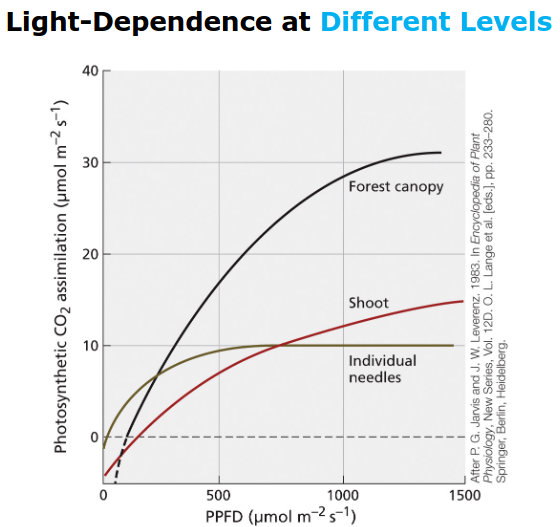
How is light dependence different between leaves grown in shade vs sun?
Leaves grown in the sun have higher light dependence and those grown in the shade have lower light dependence.

What does the xanthophyll cycle do, where does it occur, and what are the three molecules involved?
The xanthophyll cycle dissipates excess light energy which reduces photo damage.
It occurs in the antenna pigments in the photo-receptors next to each reaction center PS2 and PS1.
Violaxanthin, antheraxanthin, zeaxanthin.
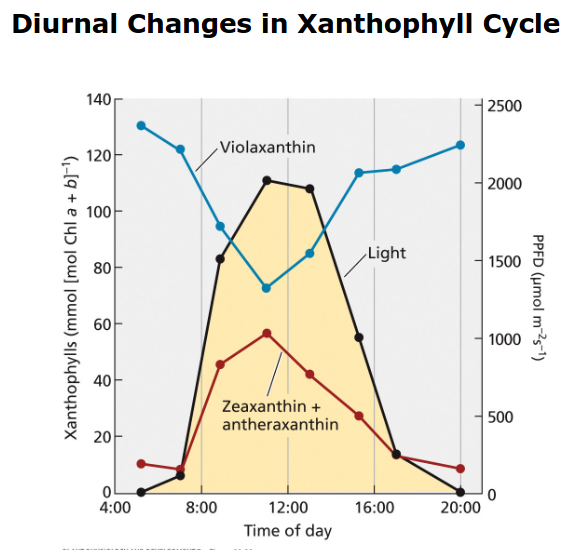
Describe how the xanthophyll cycle works.
Violaxanthin is a normal antenna pigment that transfers light energy to the reaction centers. At lower light intensities the concentration of violaxanthin is high.
Violaxanthin is converted into antheraxanthin and zeaxanthin at high light intensities. Antheraxanthin and zeaxanthin dissipate excess light energy to protect PS2 from light damage. The concentrations of both the compounds are high during periods of greater light intensity.
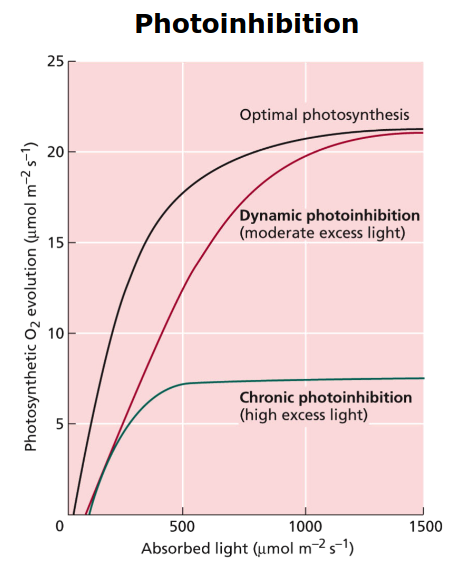
Which reaction center is at risk of photo damage and what is the term used to describe when the reaction center incurs damage?
Photosystem 2.
Photoinhibition
How do leaves dissipate excessive light energy?
Radiative heat loss, convection, and evaporative cooling.
