1.3
 Call Kai
 Learn
Learn Practice Test
 Spaced Repetition
 Match
Match Flashcards
 Knowt Play
1/38

There's no tags or description
Looks like no tags are added yet.
Name | Mastery | Learn | Test | Matching | Spaced | Call with Kai | Chat |
|---|
No analytics yet
Send a link to your students to track their progress
39 Terms
What are proteins?
Large macromolecules constructed from 20 different types of building blocks called amino acids
Polymers of amino acids
Have a variety of function in cells
*The number and types of proteins vary between individuals and in one person on a daily basis.
How do proteins differ?
As they are made up of varying combinations of the 20 different amino acids, proteins vary in the number, type, and sequence of amino acids
Each protein is therefore unique and suits its special role/function in the cell/organism
What functions do proteins have?
Catalysing reactions; e.g. Enzymes
Being involved in cellular communication; e.g. Hormones
Inactivating or neutralising invading molecules, substances, or organisms (antigens); e.g. Antibodies
Providing structures; e.g. hair and nails
Transport of substances; e.g. oxygen via haemoglobin
Contraction and movement e.g. muslces
Regulation of genes; e.g. activator and repressor proteins
What determines the function of a protein?
The unique shape of each protein
This shape is obtained by the way the polypeptide chain is folded
How do functional proteins work?
By recognising and binding to complementary molecules on the cell membrane
What is an r group?
A side chain/R group is the unique chemical group attached to the '-carbon' of every amino acid, distinguishing them from each other.
R groups determine the amino acid's specific properties (Size, charge, hydrophobicity, reactivity)
These groups dictate how proteins fold and function
What are the four protein structures?
primary, secondary, tertiary, quaternary
What is the primary structure of a protein?
The specific amino acid sequence of a protein (formation determined by the codons on mRNA)
Held together by peptide bonds

What is the amino acid sequence of a protein determined by?
the nucleotide sequence of the gene that encodes the protein (primary structure)
- affects all subsequent levels of structure
What is the secondary structure of a protein?
Two patterns of hydrogen bonding occur, which is caused by hydrogen bonding between amino acids
In one (coiling), hydrogen bonds form along a SINGLE chain, linking amino acids to others further down the chain, causing it to coil into a shape called an 'alpha-helix'
In the other (folding), hydrogen bonds occur across TWO chains, linking the amino acids in one chain to the other. Often many parallel chains are linked, which forms a beta-pleated sheet

What is the tertiary structure of a protein?
The 3-D structure/shape of the polypeptide caused by folding
Forms spontaneously because of forces of attractions between amino acids
A protein is usually forced into its tertiary shape by hydrophobic exclusion from water (polar side chains)
Proteins with a folded shape (e.g. hormones) are called globular proteins
Exists as the protein folds to achieve maximum stability
How/why are proteins usually forced into a tertiary shape by hydrophobic exclusion from water?
Hydrophobic exclusion is the DRIVING force for protein folding, though there are other factors which influence folding
Hydrophobic interactions, where the R group of amino acids are hydrophobic and nonpolar cluster together on the inside of the protein, leaving hydrophilic amino acids on the outside to interact with surrounding water molecules
(E.g. Egg white goes from clear to opaque because the heat denatures the proteins bonds and exposes the hydrophobic amino acids to the water, causing them to cluster which gives the egg white appearance)
What do the grooves and clefts of the 3-D shape of a protein (tertirary structure) do?
The grooves and clefts act as active sites in enzymes and receptor binding sites in hormones
Determines the function of proteins; therefore the 3-D structure of a protein is critical to its function
What interactions determine how a protein will fold?
1. Hydrogen bonding between different amino acids
2. Covalent disulphide bridges between two cysteine side chains
3. Ionic bonds can form
4. Van der Waals attractions
5. Polar portions gathering on the outside to gather with water while non-polar remain inside
What interactions between r groups result in the tertiary structure?
Dispersion forces - occurs between non-polar R groups
Hydrogen bonding - occurs between polar R groups containing N or O
Covalent bonding - occurs between R groups containing Sulphur atoms (disulphide linkage)
Ionic bonding - occurs between R groups with an electric charge
What is the quaternary structure of a protein?
Many proteins consist of multiple polypeptide chains which requires multiple genes to code for them
When two or more polypeptide chains chemically bond to form a functional protein, the individual chains are referred to as the subunits of the protein (subunits don't need to be the same)

What is an example of what can happen when the identity of ONE amino acid in the sequence changes?
Sickle cell anaemia occurs when there is a mutation that alters the identity of a single amino acid at the corner of the beta units of the haemoglobin molecule.
This causes a 'sticky' patch which causes on haemoglobin molecule to stick to another
What are the four classes of biomolecules?
Lipids
Carbohydrates
Nucleic acids
Proteins
What does each amino acid contain?
A central carbon, a hydrogen, a carboxyl group, an amino group, and a variable R group
What do R groups do?
Specifies the class of the amino acid
-Electrically charged
- Hydrophilic side chains
- Polar but uncharged side chains,
- Nonpolar but uncharged side chains, and
- Special cases
What is polarity?
Polarity is determined by the molecular geometry and the uneven distribution of electrons
Polarity controls a molecule's physical and chemical behaviour by creating partial positive and negative charges (dipoles) due to unequal electron sharing
This determines solubility (like dissolves like)
What does polarity do?
Knowing the polarity of molecules allows the prediction of whether or not they will mix to form chemical solutions
The rule is "like dissolves like" meaning polar molecules will dissolve into other polar liquids and vice-versa with non-polar
(This is why oil and water don't mix; oil is nonpolar, water is polar)
How does structure determine function?
Protein shape is dependent on amino acid sequences
Haemoglobin is a globular protein, meaning it folds into a globe-like structure
Collagen (in skin), is a fibrous protein, meaning it folds into a long fiber-like chain
Any slight change to a protein's shape may cause the protein to be dysfunctional
What are some functions of proteins?
Acting as enzymes, receptors, transport molecules, regulatory proteins for gene expression, etc.
Enzymes - Catalysing reactions
Hormones - Cellular communication
Antigens/Antibodies - Invading, neutralizing invading molecules, substances or organisms
Structure - E.g. hair, nails
Transport - Oxygen via Haemoglobin
Contraction and Movement - Muscles
Regulation of Gene - Activator and repressor proteins
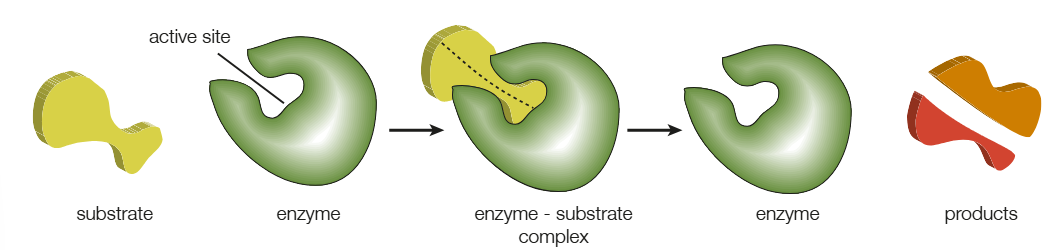
What are enzymes?
Mostly globular proteins that catalyse/increase the rate of chemical reactions
Have an active site - formed by folding and binding polypeptide chains
Substrate binds to active site
Possesses SPECIFICITY - each enzyme only has one substrate
Metabolic pathway: a sequence of enzyme-catalysed chemical reactions
What are receptors?
Receptor proteins have a specific shape that will bind to one specific molecule with a complementary shape (e.g. a hormone)
Cells have proteins called receptors that bind to signalling molecules and initiate a physiological response
Different receptors are specific for different molecules
- Dopamine binds to dopamine receptors, insulin to insulin receptors, etc.
What are hormones?
Important chemical messenger molecules used by plants and animals
Regulate processes such as growth, development, and response to chemicals/stimuli
Many are proteins, and differences in structure allow them to bind to cell membrane receptors and bring about an action
-Not all are proteins, some are lipid based (oestrogen is a steroid hormone made from cholesterol)
What is cellular communication?
Cells (multicellular) use a variety of molecules as signals (peptides, large proteins, amino acids, nucleotides, steroids, and lipids)
Each cell responds to different signals and ignores the rest
How does a cell choose which signals to respond to?
Located on or within the cell are receptor proteins, each with a 3-D shape that fits the shape of a specific signal molecule
When a signal molecule approaches a receptor protein of the right shape, the two bind
This binding induces a change in the receptor shape, producing a response in the cell

What is the process of hormone signalling/cell communication?
1. Synthesis of a hormone
2. Storage of the hormone in a gland, then secretion into the bloodstream
3. Transport via bloodstream to target cells
4. Binding to a complimentary receptor protein the target cells membrane
5. Relaying a message to the nucleus inside the cell which leads to a cellular response/triggers a change in the shape of the channel into the cell

What are antigens?
Foreign molecules (non-self) usually found embedded in the surface of viruses or cells e.g. bacteria\\
Provoke an immune response
What are antibodies?
Specialised Y-shaped proteins that bind to non-self molecules (bacteria, viruses)
Lymphocytes (white blood cell/B cells) respond to antigens by producing antibodies

How do antibodies act?
By binding to a specific antigen in a complementary manner, leading to deactivation or neutralisation
It is the 3-D quaternary structure of the antibody that enables it to bind with and inactivate the antigen
What are regulatory proteins?
Cells have many mechanisms for regulating or controlling either the switching on or off of genes
"On" genes = promote transcription
"Off" genes - prevent transcription
What are repressor regulatory proteins?
In bacteria proteins called repressors bind to promoter sites (sections of DNA near genes) to prevent RNA polymerase from binding - prevents transcription
What are activator regulatory proteins?
The binding activator proteins (promoters) to DNA near genes assists the binding of RNA polymerase (+ transcription)
Regulatory proteins identify specific sequences on the double helix without unwinding it

What is a proteome?
All the proteins found in a cell or organism at a specific time
Each cell expresses a specific section of the genome to make the protein it requires:
E.g. stomach gastric glands produce different proteins to a scalp cell that makes hair protein
What is proteomics?
The study of proteins including the abundance, variations, and modifications
What are biomarkers?
Molecules/proteins in blood that give indications of abnormal processes or disease