Bio Unit 3 Quiz 1 Multiple Choice
 Call Kai
 Learn
 Practice Test
 Spaced Repetition
 Match
 Flashcards
 Knowt Play
1/58

There's no tags or description
Looks like no tags are added yet.
59 Terms
exergonic
(Exergonic reactions can occur spontaneously, and free energy is released from the reaction.)
Which chemical reaction is more likely to occur?
Endergonic reactions do require energy to overcome an activation barrier and exergonic reactions do not require energy to overcome an activation barrier.
(Both endergonic and exergonic reactions require a small amount of energy to overcome an activation barrier.)
(Endergonic reactions are not spontaneous and exergonic reactions are spontaneous. Endergonic reactions have a positive Delta G and exergonic reactions have a negative Delta G. Endergonic reactions consume energy and exergonic reactions release energy.)
Which of the following comparisons or contrasts between endergonic and exergonic reactions is false?
This is an anabolic process.
(An anabolic process is one in which simpler molecules combine to form complex molecules with input of energy. Synthesis of new DNA strands from nucleic acid building blocks is an anabolic process.)
DNA replication involves unwinding two strands of parent DNA, copying each strand to synthesize complementary strands and releasing the resulting two semi-conserved strands of DNA. Which of the following accurately describes this process?
The first law involves conserving energy while the second law involves the inability to recapture energy.
(The first law of thermodynamics states that energy can neither be created nor destroyed. It is just transformed from one state to other. The second law of thermodynamics states that every energy transfer involves some loss of energy in an unusable form, such as heat energy, resulting in a more disordered system.)
What is the difference between the first and second laws of thermodynamics?
digestion of sucrose
(Digestion of sucrose is a catabolic process because sucrose, being a disaccharide, is a complex molecule. Its digestion produces the simpler compounds glucose and fructose with the release of energy.)
Which of the following is a catabolic process?
a power plant burning coal and producing electricity
(Energy is transformed from one form to another. Neither created nor destroyed)
Which of the following is the best example of the first law of thermodynamics?
the sun
What is the ultimate source of energy on this planet?
the ability to do work
Which of the following best describes energy?
compare their reaction rates
(The activation energy of a particular reaction determines the rate at which it will proceed. The higher the activation energy, the slower the chemical reaction will be. Thus, relative activation energies between two chemical reactions can be judged by comparing their reaction rates.)
Which of the following is the best way to judge the relative activation energies between two given chemical reactions?
Delta H
Which of the terms in the Gibbs free energy equation denotes enthalpy?
It decreases entropy within the system.
Which best describes the effect of inputting energy into a living system?
sucrose
(Sucrose is a disaccharide molecule made of glucose and fructose. The stored potential energy in it would be the greatest.)
Which of the following molecules is likely to have the most potential energy?
glucose
(glucose is synthesized by plants when light energy is converted to chemical energy through the process of photosynthesis. Glucose is then passed on to the food chain and is then used as a part of the animal cell’s cellular respiration reactions, in which it is first broken down in the process of glycolysis to make ATP, the chemical energy the cell uses to perform work. The image below shows how plants absorb solar energy and use it to drive the process of photosynthesis, thereby producing glucose and oxygen as by-products which are then used for the animal cell’s cellular respiration needs.)
What food molecule used by animals for energy and obtained from plants is most directly related to the use of sun energy?
Catabolic reactions produce energy and simpler compounds, whereas anabolic reactions involve the use of energy to make more complex compounds.
Describe the connection between anabolic and catabolic chemical reactions in a metabolic pathway.
A spontaneous reaction is one which releases free energy and moves to a more stable state. Instantaneous reactions occur rapidly with sudden release of energy.
(A spontaneous reaction occurs without the input of energy and decreases the free energy of a system, making the system more stable and releasing that energy to do work. An instantaneous reaction occurs very rapidly with a sudden release of energy. A spontaneous reaction does not require energy to carry out the reaction. It releases free energy that is used by the system to move to a stable state. The difference lies in the duration of reactions: spontaneous reactions can take seconds to years, while instantaneous reactions occur right away.)
Explain the difference between a spontaneous reaction and one that occurs instantaneously.
The transition state of the reaction exists at a higher energy level than the reactants. Activation energy is always positive regardless of whether the reaction is exergonic or endergonic.
Describe the position of the transition state on a vertical energy scale, from low to high, relative to the position of the reactants and products, for both endergonic and exergonic reactions.
Higher level of entropy refers to higher state of disorder in the system and it can be reduced by input of energy to lower the entropy.
(The system has lost energy and is in a higher state of disorder. Energy or work must be invested into the system to restore order and lower entropy. When a system is in a state of disorder, then it possesses high entropy. The entropy can be reduced by input of energy, which reduces the randomness and lowers the entropy of the system.)
What does it mean for a system to be in a higher level of entropy? How can it be reduced?
hydrolysis and exergonic
(A hydrolysis reaction involves addition of water to break bonds, thus liberating energy.)
Which pair of descriptors of chemical reactions go together?
All organisms must harvest energy from their environment and convert it to ATP to carry out cellular functions.
What is the underlying principle that supports the idea that all living organisms share the same core processes and features?
Photosynthesis is inhibited, less glucose is produced, and water used by the cells is not replaced.
(Photosynthesis is inhibited, less glucose is produced, and water that leaves the cells is not replaced, causing wilting of the plant. When adequate water is not present, photosynthesis will decrease or stop altogether. This is because water is an important reactant in the photosynthesis reaction. As a result, the product of the photosynthesis reaction, glucose, will decrease. Wilting of plants will occur as a result of diminished water in the cells.)
Water deficiency is arguably the easiest deficiency to detect in plants. This is because plants that are lacking water will wilt, as water within the plant’s cells helps to supports the plant’s weight. Plant cells become water deficient because their cells use the water for metabolic processes. What happens to the metabolism of a plant that does not have adequate water?
adenosine triphosphate
Energy can be taken in as glucose, and then has to be converted to a form that can be easily used to perform work in cells. What is the name of the latter molecule?
ATP to ADP
What reaction will release the largest amount of energy to help power another reaction?
a key fitting into a lock
Which of the following analogies best describe the induced-fit model of enzyme-substrate binding? (Hint: this is also the name of a now outdated model of enzyme activity.)
it provides energy to coupled reactions
What is true about the energy released by the hydrolysis of ATP?
They increase the Delta G of reactions.
(They do not increase the Delta G of reactions. Enzymes have no effect on the Delta G of a reaction, that is, they do not change it even if a reaction is exergonic or endergonic.)
Which of the following is NOT true about enzymes?
The reaction proceeds, but much more slowly.
What happens if an enzyme is not functioning in a chemical reaction in a living organism that needs it?
to lower the activation energy of a reaction
What is the function of enzymes?
ATP
When cellular respiration occurs, what is the primary molecule used to store the energy that is released?
ADP + phosphate
What is ATP made from?
the bond between the second phosphate and third phosphate
What part of ATP is broken to release energy for use in chemical reactions?
binds to an enzyme away from the active site and changes the conformation of the active site, decreasing its affinity for the substrate
(An allosteric inhibitor binds to an enzyme away from the active site and changes the conformation of the active site, decreasing its affinity for the substrate. An allosteric inhibitor is a molecule that binds to an enzyme, thus inhibiting the enzyme’s activity. An allosteric inhibitor may be a competitive or noncompetitive inhibitor.)
An allosteric inhibitor does which of the following?
Energy from the breakdown of glucose and other molecules in animals is released as ATP, which transfer energy to other reactions.
How do chemical reactions play a role in energy transfer?
Enzymes are important because they only catalyze the desired substrates into the reactions’ desired products.
(Chemical reactions can occur without an enzyme catalyzing them, but not at a rate consistent with life. Enzymes speed up reactions that allow chemicals to be available for an organism’s growth and maintenance. However, enzymes are also very specific to their host molecules. This ensures that only reactions whose products are needed will be catalyzed.)
If a chemical reaction could occur without an enzyme, why is it important to have one?
ATP dissociates and the energy released by breaking of a phosphate bond within ATP is used for phosphorylation of another molecule. ATP hydrolysis also provides energy to power coupling reactions.
How does ATP supply energy to chemical reactions?
Phosphorylation refers to the attachment of a phosphate to another molecule to facilitate a chemical reaction.
What is phosphorylation as it occurs in chemical reactions?
Feedback inhibition benefits the cell by blocking the production of the products by changing the configuration of enzymes. This will prevent the cells from becoming toxic.
How does enzyme feedback inhibition benefit a cell?
competitive
Enzyme inhibitors play an important part in the control of enzyme functions, allowing them to continue, or inhibiting them for a period of time. Which inhibitor affects the initial rate but do not affect the maximal rate?
Production of energy by glycolysis will not occur, skeletal muscles will not function properly
Phosphofructokinase deficiency occurs when a person lacks an enzyme needed to perform glycolysis in skeletal muscles. Glycolysis is the beginning of the cellular respiration used to release chemical energy from glucose What effect could phosphofructokinase deficiency have on the body?
Both enzyme and substrate undergo dynamic changes, inducing the transitions state of the substrate.
Enzymes facilitate chemical reactions that result in changes to a substrate. How does the induced fit model of enzymes and substrates explain their function?
3
(Moving 3 Na+ ions requires 6.3 kcal/mol of energy. Moving a hypothetical fourth Na+ ion would require 8.4 kcal/mol. The hydrolysis of ATP releases 7.3 kcal/mol and does not release enough energy to do this.)
The hydrolysis of one ATP molecule releases 7.3 kcal/mol of energy (ΔG = −7.3 kcal/mol of energy). If it takes 2.1 kcal/mol of energy to move one Na+ across the membrane (ΔG = +2.1 kcal/mol of energy), what is the maximum number of sodium ions that could be moved by the hydrolysis of one ATP molecule?
Carbohydrates can feed into oxidative phosphorylation.
(As carbohydrates eventually transform into glucose, they can be fed into glycolysis. Oxidative phosphorylation is only performed by the electron transport chain by oxidizing NADH and FADH₂.)
Which of the following statements about catabolic pathways is false?
pyruvate and NADH
(Each glucose molecule produces 2 pyruvate and 2 NADH molecules. These are further used in the fermentation process to form either lactate or ethanol.)
Which molecules are produced in glycolysis and used in fermentation?
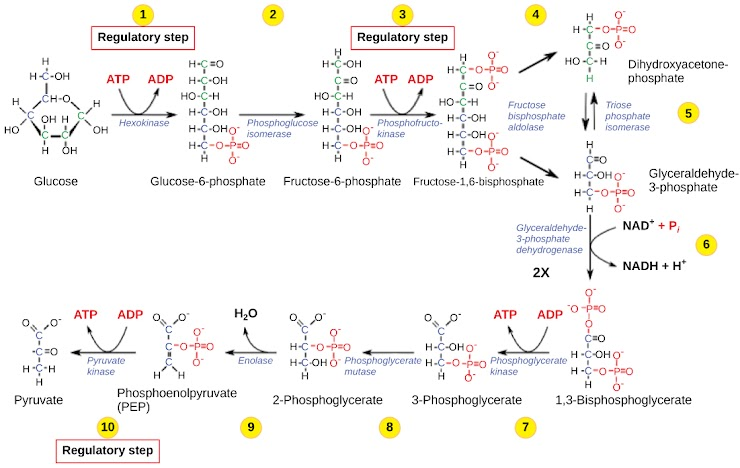
hexokinase
(Hexokinase is responsible for phosphorylating glucose into glucose-6-phosphate which traps and prevents its passage through the plasma membrane. Therefore, hexokinase is needed for glycolysis to start.)
Review Figure 7.20 that shows the steps of glycolysis. The control of which enzyme exerts the greatest control of glycolysis?
the main process used to break down fatty acids
(Beta-oxidation involves breaking down fatty acids using two carbon fragments from the carboxyl end of fatty acids. It occurs in the mitochondria, and the beta- carbon of fatty acids is oxidized.)
what is beta-oxidation?
They increase the activity of enzymes involved with glycolysis.
(ADP is an activator and a positive regulator of certain enzymes like phosphofructokinase-1.)
What impact, if any, do high levels of ADP have on glycolysis?
lactic acid fermentation
Which of the following fermentation methods can occur in animal skeletal muscles?
increased activity of pyruvate kinase
Which of the following does not occur as ATP concentration increases relative to ADP?