Chapter 9 - Cell membrane and transport processes
 Call Kai
 Learn
 Practice Test
 Spaced Repetition
 Match
 Flashcards
 Knowt Play
1/27

There's no tags or description
Looks like no tags are added yet.
28 Terms
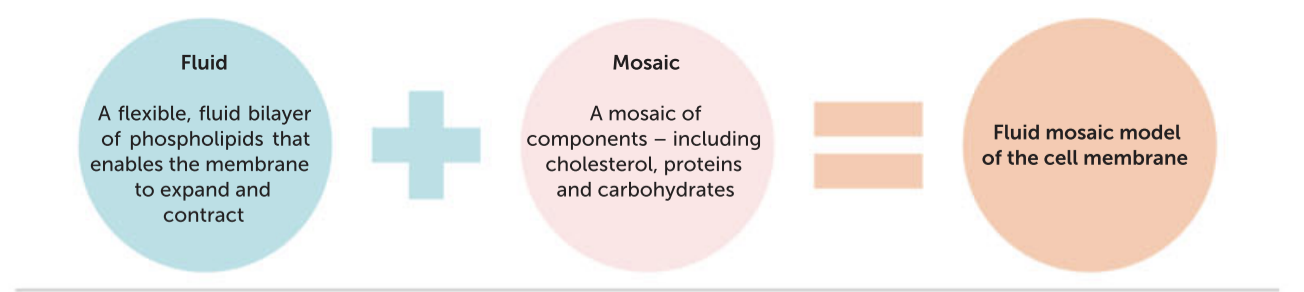
Fluid mosaic model of the cell membrane
The fluid mosaic model describes membranes as a double layer of lipids (a lipid bilayer), which can flow and change shape, with specialised protein molecules embedded in various patterns
Movement of materials across membranes
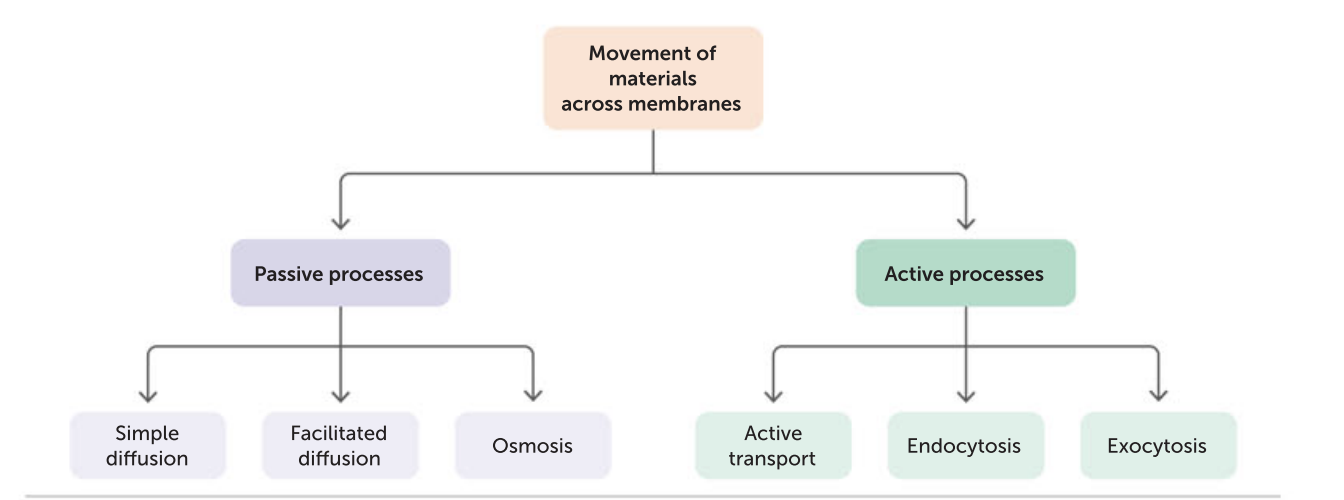
factors that affect exchange of materials across membranes include
▪ the surface area to volume ratio of the cell
▪ concentration gradients
▪ the physical and chemical nature of the materials being exchanged
Cell membrane functions
•the recognition of other cells,
•the transportation of materials into and out of the cell – it is selectively permeable
•the provision of attachment sites for enzymes and hormones
where do unicellular organisms live?
often live in dynamic environments, such as freshwater ponds, where conditions may change quickly therefore must control the movement of substances across their cell membrane to cope with rapid changes like these.
Osmosis – Passive Transport
Osmosis is the diffusion of water through a semipermeable membrane and down its concentration gradient.
Hypotonic
Water molecules will diffuse through the membrane into the cells because the cells have a lower concentration of solvent (less water).

Factors that increase the rate of diffusion
The diffusion rate is increased when the concentration gradient is great, when heat is applied,
when molecules are smaller and when movement occurs through a gaseous medium.
Give one reason why plant cells do not burst when placed in hypotonic solution
Plant cells do not burst when placed in a hypotonic solution; they become turgid. This is because the tough cell wall stretches, but does not break, when there is a net movement of water into the cell
plant cell in hyper tonic solution

physical and chemical factors that affect the movement of substances across cell membrane
Physical factors are size and shape. Chemical factors are charge and whether a substance is hydrophilic or hydrophobic. (lipid solubility)
How does increasing the size of a cell affect the cells ability to gain and lose substances by diffusion
As a cell grows larger, both its surface area and volume increase, but its volume grows faster than its surface area. Diffusion of substances into and out of cells occurs across the surface so a large surface-area-to-volume ratio in smaller cells allows for a high rate of diffusion, whereas a small surface-area-to-volume ratio in large cells reduces the rate of diffusion.
Define plasmolysis
Plasmolysis is the shrinkage of the cytoplasm of a plant cell and pulling away from its cell wall
and towards the centre (1 mark) because of water loss (1 mark).
state two functions of the proteins in the cell membrane
• active transport
• passive transport
• receptors
• recognition
• attachment sites
• enzymes.
metabolism
The sum of all the biochemical reactions in an organism
Anabolic reactions
Anabolic reactions involve the synthesis of complex molecules from simpler ones and usually require energy to form new chemical bonds.
Catabolic reactions
Catabolic reactions involve the breakdown of complex molecules into simpler ones and usually release energy from breaking chemical bonds.
The folded membranes of mitochondria
The folded membranes of mitochondria (cristae) are studded with enzymes needed for cellular respiration. Mitochondria increase their internal surface area by having internal membranes that are folded and stacked.
The internal membranes of chloroplasts are also studded with enzymes necessary to keep photosynthetic reactions continuing.
enzyme
An enzyme is a biological catalyst that speeds up biological reactions without undergoing any change itself. Most enzymes are proteins; all enzymes are macromolecules. Enzymes lower the activation energy required for a reaction to proceed.
Without enzymes, chemical reactions would take much longer to occur. Without enzymes, the reactions that occur in living organisms would be so slow as to hardly proceed at all; this would be incompatible with the maintenance of life.
Intracellular enzymes
Intracellular enzymes speed up and control metabolic reactions inside cells.
Extracellular enzymes
Extracellular enzymes are produced by cells but achieve their effects outside the cell. They include digestive enzymes, which break down food in the small intestine.
Exergonic reactions
Exergonic reactions (‘exo’ means out) are those that release energy. They are sometimes referred to as ‘downhill’ reactions. When molecular bonds are broken, energy is released. It makes sense that when a large molecule is broken down to smaller molecules, a large amount of energy is released. For example, when starch breaks down to sugar, energy is released. The opposite type of reaction, when molecular bonds are formed, is called an endergonic reaction (‘endo’ means in). They absorb energy. These are sometimes referred to as an ‘uphill’ reaction.

Activation energy
The activation energy is the minimum amount of initial energy required to start a chemical reaction. Activation energy is usually supplied in the form of heat energy (thermal energy) that the reactant molecules absorb from their surroundings.
Enzymes catalyse reactions
Enzymes catalyse reactions in cells by lowering the activation energy required. They do not provide energy; instead, they weaken bonds within reactants to speed up the reaction. Enzymes are able to destabilise existing chemical bonds in reactants.
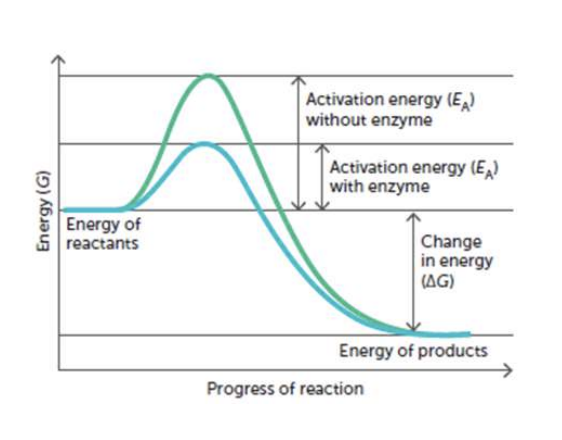
the breakdown of hydrogen peroxide (H2O2 ) into oxygen and water, according to the reaction:

reactant and enzyme
A reactant is a substance that is an input in a reaction. It changes chemically into a product and
is not reusable at the conclusion of the reaction. This is in contrast with an enzyme, which is
present at the start of a reaction (like a reactant is) but remains unchanged and is reusable at the
conclusion of the reaction