Lecture 10 - 12 Populations, Metabolism, ETC
 Call Kai
 Learn
Learn Practice Test
 Spaced Repetition
 Match
Match Flashcards
 Knowt Play
1/121

Earn XP
Description and Tags
Lectures 10 -
Name | Mastery | Learn | Test | Matching | Spaced | Call with Kai | Chat |
|---|
No analytics yet
Send a link to your students to track their progress
122 Terms
How can we measure “size” in terms of microbial populations? (2 ways)
We can use both # of cells
We can use mass of population
How do we directly count cells? (3 techniques)
Cell Counts can be conducted on
Counting Chambers
Electronic Counters (like flow cytometry and coultier)
Membrane filters
Counting Chambers
Advantages
Disadvantages.
Easy, inexpensive, and quick
Useful for counting both eukaryote and prokaryotes.
Cannot distinguish living from dead cells.

Membrane Filters
Advantages
Cells filtered through special membrane that provides dark background for observing cells
Cells are stained with fluorescent dyes
Useful for counting bacteria
With certain dyes, may distinguish living from dead cells
Electronic counters —> Flow Cytometry
Microbial suspension forced through small orifice with a laser light beam
Movement of microbe through orifice impacts electric current that flows through orifice
Instances of disruption of current are counted
Specific antibodies can be used to determine size and internal complexity.

Coulter Counter
Microbial suspension is forced through a small hole.
Electrical current flows through the hole, and electrodes placed on both sides of the hole measure electrical resistance. Every time a microbial cell passes through the hole, electrical resistance increases (For example, the conductivity drops), and the cell is counted
How can we do viable counting? (methods)
Why does it matter?
• Whether or not a cell is alive or dead isn’t always clear cut in microbiology
cells can exist in a variety of states between ‘fully viable’ and ‘actually dead
Spread/Pour plates/Membrane filter methods

Viable Counting methods —> Spread/pour plates
– diluted sample of bacteria is spread over solid agar surface or mixed with agar and poured into Petri plate
– after incubation, the numbers of organisms are determined by counting the number of colonies multiplied by the dilution factor
– results expressed as colony forming units (CFU)
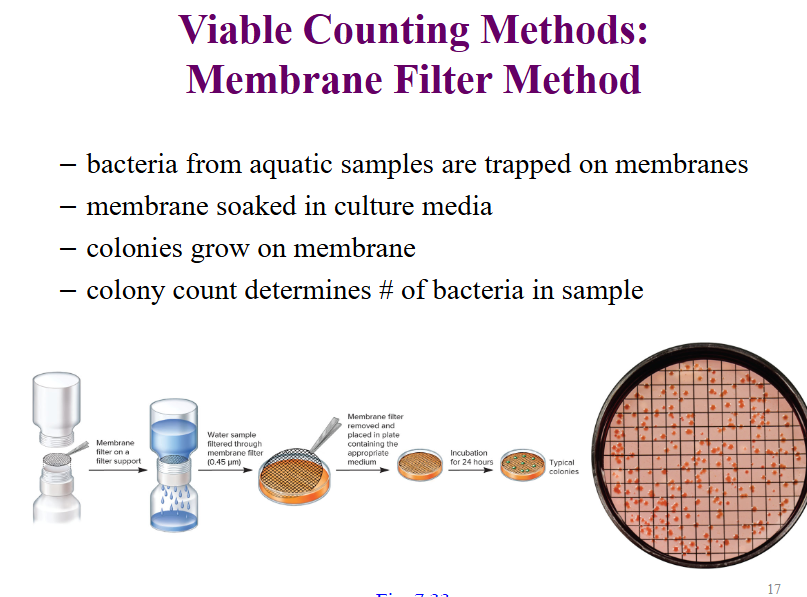
Viable Counting Methods:
Membrane Filter Method
– bacteria from aquatic samples are trapped on membranes
– membrane soaked in culture media
– colonies grow on membrane
– colony count determines # of bacteria in sample
Measurment of Cell Mass
3 different methods
• Dry weight
• Quantity of a particular cell constituent
• Turbidometric measures (light scattering)
Advantages or disadvantages of Dry Weight Cell Mass measurement
• Dry weight
– time consuming and not very sensitive
Advantages or disadvantages of Quantifying a particular cell constituent to find cell mass
• Quantity of a particular cell constituent
– e.g., protein, DNA, ATP, or chlorophyll
– useful if amount of substance in each cell is constant
Advantages or disadvantages of Turbidometric measures to find cell mass
• Turbidometric measures (light scattering)
– quick, easy, and sensitive

CAUTION for absorbance readings
• At very high cell densities (~10 9 cells/ml for E. coli),
Absorbance is no longer proportional to cell density.
• This is because of multiple scattering of photons by the cells.
• Multiple scattering makes it appear that the cell density is lower than the actual value.
• In this case, the culture has to be diluted, absorbance measured, and then multiplied by the dilution factor
How do we Continuously Culture Microorganisms
We use an OPEN SYSTEM to grow them
– continual provision of nutrients
– continual removal of products/wastes
• Maintains cells in exponential phase at a constant biomass concentration for extended periods
• Achieved using a continuous culture system
What is a Chemostat?
What is it used for?
How does it work?
• An essential nutrient is in limiting quantities
• Rate of incoming medium equals the rate of removal of medium from vessel

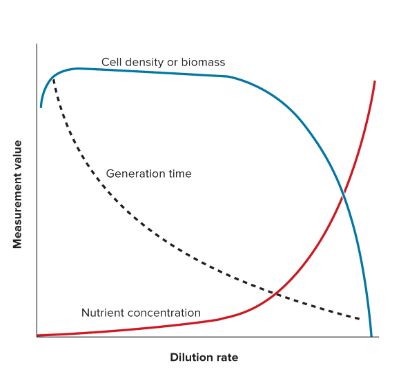
Dilution Rate in regard to microbial growth in a chemostat.
What is it
What is the optimal ratio to keep.
• Dilution rate – rate at which medium flows through vessel
• Note: cell density maintained at wide range of dilution rates
• Chemostat operates best at low dilution rates
What is a Turbidostat?
What does it modify
What stays consistent
What does it operate best in?
• regulates the flow rate of media through vessel to maintain a predetermined turbidity or cell density
• dilution rate varies
• no limiting nutrient
• turbidostat operates best at high dilution rates
Metabolism
What is it?
What does it consist of?
Metabolism is the total of all chemical reactions in the cell and is divided into two modules:
Anabolism
Catabolism
Catabolism
What does it do?
Energetically what does it do?
What does it provide.
From Greek “descent”, as in take apart
It involves usable energy-producing or “fueling” reactions
• provides reducing power (NADPH)
• generates precursors for biosynthesis
Anabolism
What does it do?
Energetically what does it do?
What does it provide.
From Greek “ascent”, as in put together
• synthesis of complex organic molecules from simpler ones
• requires energy provided by fueling reactions
• requires reductants: NADPH, generated by catabolism
Types of Work (for the sake of this class)
Chemical Work
Transport Work
Mechnanical Work
How does a cell do:
Chemical Work:
Chemical work
– synthesis of complex molecules
How does a cell do:
Transport Work
– uptake of nutrients, elimination of wastes, and maintenance of ion balances
How does a cell do:
Mechanical Work
– cell motility and movement of structures within cells
Thermodynamics
– a science that analyzes energy changes in a collection of matter called a closed system (e.g., a cell)
– all other matter in the universe is called the surroundings
First Law of Thermodynamics
• Energy can be neither created nor destroyed
• Total energy in universe remains constant
- However, energy may be redistributed either within a system or between the system and its surroundings
Second Law of Thermodynamics
Entropy
The measure of disorder, randomness, or uncertainty in a system
Physical and chemical processes proceed in such a way that the disorder of the universe increases
Second Law of Thermodynamics
What is it
What is the symbol and units
What does it being positive or negative mean
What is the total change in entropy (how does this relate to the second law)
Entropy
Entropy is a measure of the randomness or disorder of a system.
Its symbol is the capital letter S. Typical units are joules per kelvin (J/K).
Change in entropy can have a positive (more disordered) or negative (less disordered) value.
In the natural world, entropy tends to increase.
According to the second law of thermodynamics, the entropy of a system only decreases if the entropy of another system increases.
Energy
Def
Units (2)
Joules (J)
Calorie
Joules
What is it a measure of, what are the units
– units of work (kg * m2 / sec 2 )
Calorie
What is it a measure of, what are the units
Conversion to J
Calorie (cal)
– amount of heat energy needed to raise the temperature of 1 gram of water from 14.5 to 15.5°C
1 cal of heat is equivalent to 4.1840 J of work
Free Energy
Symbol
• ΔG (“Gibbs Free Energy”)
– amount of energy available in a chemical
reaction or process to do work
Enthalpy
Symbol
ΔH
Change in enthalpy → heat content
T
Temperature in degrees Kelvin
Entropy
ΔS
Change in entropy
Free Energy Reaction (how to calcualte Gibbs)
What does the result mean
What does this indicate about our reactions (based on the result of the equation)
Limitations of Gibbs
ΔG - ΔH - T ΔS
Expresses the change in energy that can occur in chemical reactions and other processes
Indicates whether a reaction will proceed spontaneously
if ΔG is negative, reaction can proceed spontaneously in the direction written
if ΔG is positive, reaction cannot proceed spontaneously in the direction written
if ΔG = 0, reaction is at equilibrium
IT CANNOT TELL US HOW RAPID A REACTION WILL PROCEED, just the direction
Chemical Equilibrium
consider the chemical reaction
A + B ⇌ C + D
Reaction is at equilibrium when rate of forward reaction = rate of reverse reaction
Equilibrium constant (Keq )
expresses the equilibrium concentrations of products and reactants
Standard Free Energy Change
Free energy change defined at standard conditions of concentration(1 M, each reactant and product), pressure (1 atm), temperature (25 oC), and pH (7.0)
ΔG0
standard free energy change at pH 7
directly related to Keq
ΔG o ́ = -2.303RT•logKeq
What do exergonic Reactions mean?
The ΔGo is negative
We have a sponanteous reaction

What does an enedergonic reaction mean?
ΔGo is positive
(reaction will not proceed spontaneously)

What do enzymes affect?
What are the limitations
Speed up rates of reaction, but cannot change the ΔG or the direction of the reaction.
ΔG is an inherent property of the reaction.
What is the energy currency of the cell?
ATP
What is phosphate transger potential?
What has a high phosphate transfer potential.
ATP is said to have a HIGH phosphate transfer potential
– It readily sends a phosphate group to other molecules
– Other molecules have higher phosphate transfer potential than ATP

Cell’s Energy Cycle:
Catabolism
What are some examples of processes that primarily use catabolism?
What do they transfer the energy into?
Is used in:
Aerobic respiration
Anaerobic Respiration
Fermentation
Phototrophy
Chemolithotrophy
Then is transferred into
Chemical Work
transport work
Mechanical work

What are other energy sources akin to ATP that can be used?
GTP
CTP
TTP
UTP
I like ya CUTG (first letter of every energy source)
ATP in metabolism
What is it’s main role?
Exergonic breakdown of high energy ATP is coupled with endergonic reactions to make them more favorable

REDOX REACTIONS
What are they? What do they involve?
What does this cause?
Redox Reactions
• Many metabolic processes involve oxidation-
reduction reactions (electron transfers)
• Electron carriers are often used to transfer electrons from an electron donor to an electron acceptor
• Transfer of electrons from a donor to an acceptor
– can result in energy release, which can be used to form ATP
What does a redox reaction consist of?
What is their relationship?
Redox: Two Half Reactions
• One is electron donating reaction
• One is electron accepting reaction
• Acceptor and donor are conjugate redox pairs
What does a standard redox potential measure?
What is the positive version and negative version mean
Conversion to gibbs
Measure of the tendency of the reducing agent to lose electrons
more negative E0 —> better electron donor (being oxidized)
the better the electron donator the better the reducing agent it is)
more positive E0 —> better electron acceptor (being reduced)
The better it is at accepting electrons or the better oxidizing agent.
Can be converted to ΔG:
ΔG = − n (23.062 kcal* mol-1* volt-1) ΔE’0 , where n is the number of electrons transferred

Electron Movement and Reduction potentials:
What does the difference between Eo of the acceptor and the Eo of the donor mean? What can it tell us?
The greater the difference between the E 0 of the acceptor and the E0 of the donor
(E0 acceptor – E0 donor ) Δthe more negative the ΔG

Electron transport Chain (ETC)
What is it?
What is organized in it?
How does it work?
Electron carriers are organized into ETC.
First electron carrier will have the most negative Eo. (redox potential) (the more tendency to lose an electron)
The potential energy stored in the first redox couple is released and used to form ATP
First carrier is reduced and electrons are moved to the next carrier and so on.

Electron carriers
Where are they at in bacteria, archaeal, and eukaryotic cells
Examples include NAD, NADP and others.
• Located in plasma membranes of chemoorganotrophs in bacteria and archaeal cells
• Located in internal mitochondrial membranes in eukaryotic cells
• Examples of electron carriers include NAD, NADP, and others
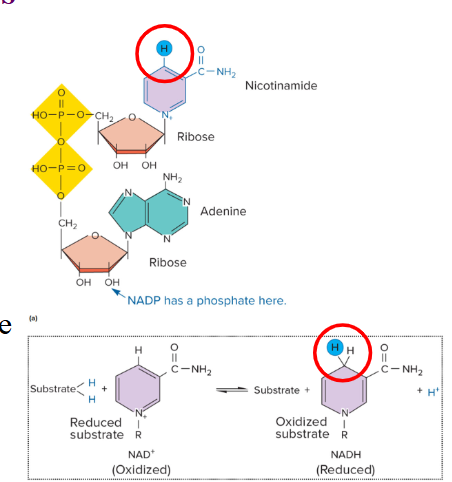
What are some examples of electron carriers (2)
MAIN ONES
NAD
– nicotinamide adenine dinucleotide
NADP
– nicotinamide adenine dinucleotide phosphate
What are some examples of electron carriers (2)
Special ones
FAD
Flavin Adenine Dinucleotide
CoQ
A quinone
Also called a ubiquinone
What are the three things a cell needs for growth?
Chemical Components
Reducing Power
Energy
Chemical Components needed for growth
Carbon and also the rest of CHONPS and other nutrients
Reducing Power (electrons)
Mostly in the form of hydrides (H-)
Energy:
Reducing Power needed for growth
Reducing Power (electrons)
Mostly in the form of hydrides (H-)
Energy needed for growth
ATP, proton motive force
Autotrophs
Def
Where do they get it
Self FEEDER.
Get carbon from inorganic molecules, mainly CO2, but some can get it from CO or CH4 (methane)
Heterotrophs
Def
Where do they get it
Use organic molecules as carbon sources
Can use a variety of carbon sources, mono- and polysaccharides, organic acids, amino acids, nucleotides, etc.
Lithotrophs
– Get electrons from inorganic electron donors: H2O, H2 , H2S
Heterotrophs (Organotrophs)
from organic molecules as carbon sources
Gets their electrons from carbon sources.
Phototrophs
Energy source is light
Chemotrophs
get energy from oxidation of inorganic molecules
Heterotrophs
gets energy from catabolism of organic compounds.
Bowtie Model of Metabolism
There are 100s of Carbon Sources, which are transferred to 12 universal precursor molecules. (this is the Catabolism process, oxidative processes that generates energy)
Then those are turned into the Amino Acids, nucleotides, sugars, fatty acids, vitamins, cofactors, and more the body needs. (this is the anabolistic process that requires energy)

What are the implications of the bowtie model?
What are the two main implications
The function of catabolic pathways is not only to generate energy (mostly ATP), but also to generate the 12 precursor molecules and reductants (mostly NADPH)
All organisms have to have pathways to produce the 12 universal precursor molecules, regardless of the carbon and energy sources they can use, and regardless of their composition.
Meaning that at least that is common in metabolism.
Chemoorganotrophic Energy supplying processes
#whatdatmean
There are two
Chemoorganotrophic means breaking down organic molecules to create energy chemically
2 distinct modes:
– Respiration
– Fermentation
Respiration
What modes is it split into again?
What are the terminal acceptors?
– Respiration: uses terminal electron acceptor(s):
aerobic: terminal electron acceptor is O2
anaerobic: some other terminal electron acceptor, e.g.
NO 3- , Fe3+, SO 42- , fumarate, and others
What are examples of electron acceptors in anaerobic respiration.
NO 3- , Fe3+, SO 42- , fumarate, and others
Respiration
How does it generate energy
In its two variations as well
ATP is made mainly by the proton motive force
This proton motive force is generated by
aerobic respiration as the final electron acceptor is O2
or
anaerobic respiration in which the final electron acceptor is exogenous acceptor such as: NO3-, SO4 2-, CO2, Fe 3+, SeO4 2-
organic acceptors may also be used.

Fermentation
How does it gain energy
What is the electron acceptor look like
What does it use in the process.
• No exogenous electron acceptor (inside of the body)
• Does not involve the use of an electron transport chain
• ATP synthesized only by “substrate-level” phosphorylation (SLP)
What do all pathways of chemoorganotrophs share in common?
The different carbon sources and energy are funneled into common degradative pathways.
Catabolism of Glucose
General Steps (3)
Glucose to Pyruvate
Pyruvate to CO2 in the TCA cycle to produce more ATP
Oxidation of NADH, FADH, in the electron transport chain to generate more ATP
Glucose to pyruvate
The first steps
Glycolysis is the first step.
Glycolysis is a series of reactions for the breakdown of Glucose (a 6-carbon molecule) into two molecules of pyruvate (a 3-carbon molecule) under aerobic conditions;
or
Lactate under anaerobic conditions along
with the production of a small amount of energy
What are the three common routes of Glycolysis
– Embden-Meyerhof pathway
– Entner-Duodoroff pathway
– Pentose phosphate pathway
Emden-Meyerhoff Pathway
What are the phases of it?
In what organisms does it occur?
Occurs in the cytoplasmic matrix of most microorganisms, plants, and animals
The most common pathway for glucose degradation to pyruvate.
Functions in the presence or absence of O2
Has two phases
Six Carbon phase
Three carbon phase
Steps in Embden Meyerhoff
Step 1:
Energy investment step, we see The addition of phosphates (from ATP)
Step 2:
Oxidation steps generate NADH (producing NADH from NAD+)
Step 3:
High-energy molecules used to synthesize ATP by substrate-level phosphorylation. (A way that cells make ATP by transferring a phosphate group from a high energy molecule to ADP).
This leads 2 ATP net, 2 NADH, and 2 pyruvate per glucose
*Sidenotes
2 Important reactions in Embden-Meyerhof
What are two key elements of it?
Entry point of phosphate (Pi) into the metabolic network
Requires energy, which is provided by oxidation of glyceraldehyde 3–phosphate by NAD + (into NADH)
Transfer of high energy phosphate bond from 1,3 bisphosphoglycerate to ATP

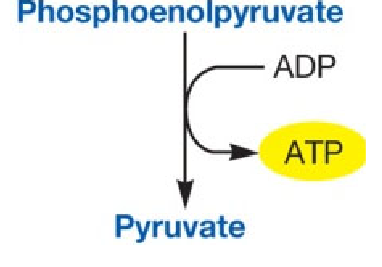
One more important reaction in Embden-meyerhof
A second enzyme synthesizing ATP
Phosphoenolpyruvate (ADP —>ATP)
Summary of Embden-meyerhof glycotic pathway
In terms of chemical (it is dumb, but just do it the way this class wants it
glucose + 2 ADP + 2 Pi + 2 NAD+
—>
2 pyruvate + 2 ATP + 2 NADH + 2H+
Entner-Duodoroff Pathway
Chemically what it looks like
What uses it?
What is the difference between Embden-Meyerhof
• Used by Gram-negative, aerobic bacteria lots of which are soil-borne, and a few Gram-positive bacteria and archaea
• Replaces the first phase of the Embden-Meyerhof pathway
2 pyruvate + 1 ATP + 1 NADPH + 1mNADH + 2H+
Instead of 6-glucose 6 phospate, it turns into fructose 1,6 - bisphosphate.
We instead form step KDPG
this nets up a pyruvate straight up and glyceraldehyde 3-phosphate by the enzymes of Embden Meyerhof pathway.
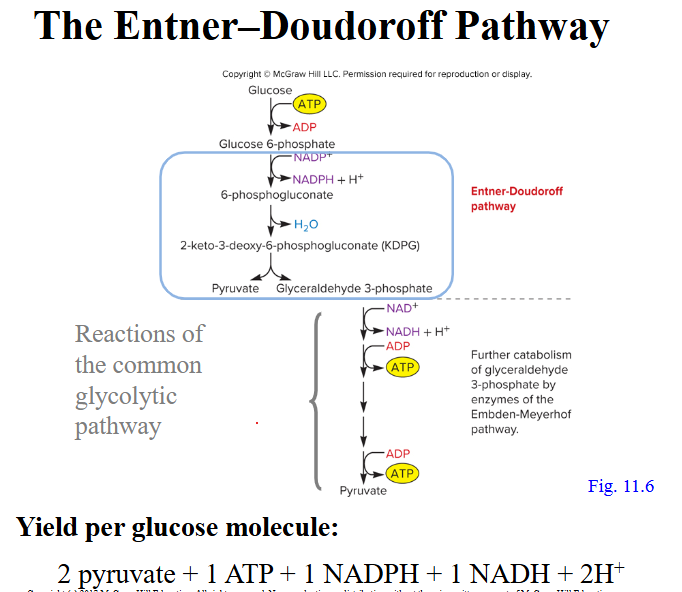
The pentose phosphate pathway
What is it also known as?
When does it occur?
Does it work aerobically? Anaerobically?
• Also called hexose monophosphate pathway
• Operates at same time as glycolytic pathway or Entner-Doudoroff pathway
• Can operate aerobically or anaerobically
Pentose Phosphate Pathway
What are the main things produced or occuring (3)
• Also called hexose monophosphate pathway
• Operates at same time as glycolytic pathway or
Entner-Doudoroff pathway
• Can operate aerobically or anaerobically
Alternative for metabolizing glucose 6 phosphate.
Is in charge of the Oxidation steps, produce NADPH
Sugar trans-formation reactions (sugars into other sugars)
Produce sugars needed for biosynthesis (creates sugars for creation of other molecules)
Sugars can also be further degraded (some other sugars can be put toward glycolysis)
Specific Results of the Pentose phosphate pathway
Name the 3 things generated
What are they used for.
RESULTS
Generation of reducing equivalents, in the form of NADPH, used in reductive biosynthesis reactions within cells (EX: Fatty acid synthesis)
Production of ribose 5-phosphate (R5P), used in the synthesis of nucleotides and nucleic acids. (DNA and RNA)
Production of erythrose 4 phosphate (E4P) which is used in the synthesis of aromatic amino acids.
TCA cycle
What is the main function
What are other names for it
What commonly practice it
What does it produce
It turns Pyruvate into CO2
Also known as the Krebs or Citric Acid cycle
Common in Aerobic Bacteria, Free-living protozoa, most algae, and fungi
A source of biosynthetic precursors like GTP, NADH, and FADH
TCA Cycle Summary
What are the NET THINGS GENERATED
For each acetyl-CoA molecule oxidized, TCA cycle generates:
2 molecules of CO2
3 molecules of NADH
one FADH2
one GTP

BEUATIFUL GORGEOUS SUMMARY VERSIONS:
Embden-Meyerhoff Pathway of Glycolysis
1) Starts with glucose-6-phosphate (6-carbon compound)
2) that is cleaved into two 3-carbon compounds (pyruvate)
3) generates a net of 2 ATP’s
4) generates 2 NADH’s
5) produces 2 pyruvates
BEUATIFUL GORGEOUS SUMMARY VERSIONS:
Entner-Douderoff
1) Starts with glucose-6-phosphate (6-carbon compound)
2) that is cleaved into two 3-carbon compounds
3) generates a net of 1 ATP
4) generates 1 NADH and 1 NADPH
5) produces 2 pyruvates
BEUATIFUL GORGEOUS SUMMARY VERSIONS:
Pentose Phosphate Pathway
1) Starts with glucose-6-phosphate
2) produces 2 NADPH’s
3) produces three of the 12 universal precursor molecules needed for biosynthesis (ribose-5-phosphate, erythrose-4-phosphate, and sedohepulose-7-phosphate) (R5P, E4P)
4) Not a direct source of ATP
BEUATIFUL GORGEOUS SUMMARY VERSIONS:
TCA Cycle
1) Starts with acetyl–CoA (2-carbon compound) and oxaloacetate
2) produces 2 CO2 ’s and an oxaloacetate
3) produces 3 NADH’s, 1 FADH
4) produces 1 GTP (which is needed as an energy source for peptide bond formation in translation
TOTAL RECAP FOR LECTURE
CATABOLISM OF GLUCOSE
Embden Meyerhoff
Pyruvate Dehydrogenase
TCA cycle
NET FOR EVERYTHING
NET TOTAL
1 Glucose —> 6 CO2 + 10 NADH + 2 FADH + 2 ATP + 2 GTP

Electron transport and Oxidative Phosphorylation
What is the main purpose of it?
Where is it done?
What are the materials it used to undergo this process?
What does this also help create?
In order to have these pathways operate continuously, it is
necessary to reconvert (oxidize) the NADH and FADH2 to
NAD+ and FAD+.
This can be done by the electron transport chain (ETC), which
uses some terminal electron acceptor to oxidize NADH, FADH2 , and other electron donors.
Many more ATPs are synthesized by the oxidation of NADH and FADH2

Electron Transport Chain
The mitochondrial electron transport chain is a series of electron carriers that transfer electrons from FADH and NADH to a terminal electron acceptor (O2)
The electron flow from carriers with lower reduction potentials. to one with greater E0

Electron Transport Chain - Redox Pairs
• Each carrier is reduced and then re-oxidized
• Carriers are constantly recycled
• The difference in reduction potentials electron carriers, NADH and O2 is large, resulting in release of great deal of energy
How does ETC generate proton motive force?
In eukaryotes
Location
Items involved
In eukaryotes the e- transport chain carriers are in the inner mitochondrial membrane, connected by coenzyme Q and cytochrome c
e- transport is accompanied by proton movement across inner
mitochondrial membrane

Bacterial and Archaeal ETC’s
How do they differ from euk
Location
Conformational differences
Located in the plasma membrane
Some resemble mitochondrial ETC, but many are different
Different electron carriers
May be branched
may be shorter
may have lower phosphorus / oxygen ratio
Paracoccus dentrificans
Gram-?
What kind of interaction with air?
What are differences in energy sources?
• Facultative, Gram-negative soil bacterium
• Very versatile metabolically
• In presence of O2 , uses aerobic respiration
– similar electron carriers and transport mechanism as mitochondria
– protons transported across the cytoplasmic membrane to periplasmic space
– can use methanol as carbon/energy source instead of glucose

Electron Transport Chain of E.coli
Differences vs euk
Different ways of undergoing ETC
Different array of cytochromes used than in mitochondria
Branched Pathway(s)
Upper branch (bd)
– stationary phase or low aeration (higher affinity for O2 , lower efficiency)
Lower Branch
exponential phase and high aeration
Like two engines, different terminal oxidases to transfer electrons to oxygen. The upper branch is used when O2 is very low. With high affinity and low efficiency
Lower branch is used when there is high oxygen. Lower affinity of oxygen, but it is much more efficient.