5.1 reliability
 Call Kai
 Learn
 Practice Test
 Spaced Repetition
 Match
 Flashcards
 Knowt Play
1/26

Earn XP
Description and Tags
5.1 reliability
27 Terms
Cohen’s kappa (or κ)
is a measure of inter-rater reliability used on nominal or ordinal data.
Example of cohen´s kappa
when different raters agree on whether some has a disorder or not, or when raters assess the severity of a disorder: mild, moderate, severe.
κ formula


refers to
the proportion of agreements

refers to
the proportion of agreements that could be due to chance
Example 2: Inter-rater reliability

Guidelines to interpret Cohen’s kappa
κ = 0− 0.20 : none
κ = 0.21 − 0.39 : minimal
κ = 0.40− 0.59 : weak
κ = 0.60− 0.79 : moderate
κ = 0.80− 0.90 : strong
κ above 0.90: almost perfect
Cohen´s kappa guidelines apply to the interpretation
of inter-rater agreement indexes in general & applies to intra-class correlation
internal consistency
a way of calculating reliability for a single application of the tes
Reliability as internal consistency → how it works
we split the test in two parts or in k parts (k being the total number of items) & we calculate the reliability among these different partitions of the test
Reliability as internal consistency strategy focus on
the internal structure of the test
Reliability as internal consistency → There are a good number of indexes that can be calculated using this approach
Spearman-Brown
Cronbach’s α,
Guttman’s λ6
McDonald’s omega
Reliability as internal consistency: split-half reliability
We split the test in two parts → both parts should be as equivalent as possibl
Because tests can have a special structure → Reliability as internal consistency: split-half reliability
e.g., items go from easier to harder → we typically split the test by taking odd & even items

We can calculate Spearman-Brown index to assess reliability:


refers to
correlation between odd & even items of the test
Split-half was the first approach developed to assess
internal consistency but nowadays we hardly use it to assess reliability
The problem about internal consistency
we have many different ways of dividing the test in two equal parts & each of these divisions will yield a different value for Spearman-Brown.
To avoid the problem we
We calculate indexes that ‘split’ the test in as many parts as total number of items we have.
global internal consistency measures.
calculate indexes that ‘split’ the test in as many parts as total number of items we have.
we don’t need to worry about different partitions yielding different results, we calculate indexes that use all of the possible partitions to get a better estimation of internal consistency
Cronbach’s alpha (internal consistency)
considers the variability of all items of the test
measure of the average covariance (or correlation) of the items of the test.
generally ranges from 0 to 1 → the larger the value, the more reliable the test is.
value smaller than 0.5 → typically considered not acceptable
A value greater than 0.70 → considered good

Cronbach’s α = 0.8 → Pearson Correlations
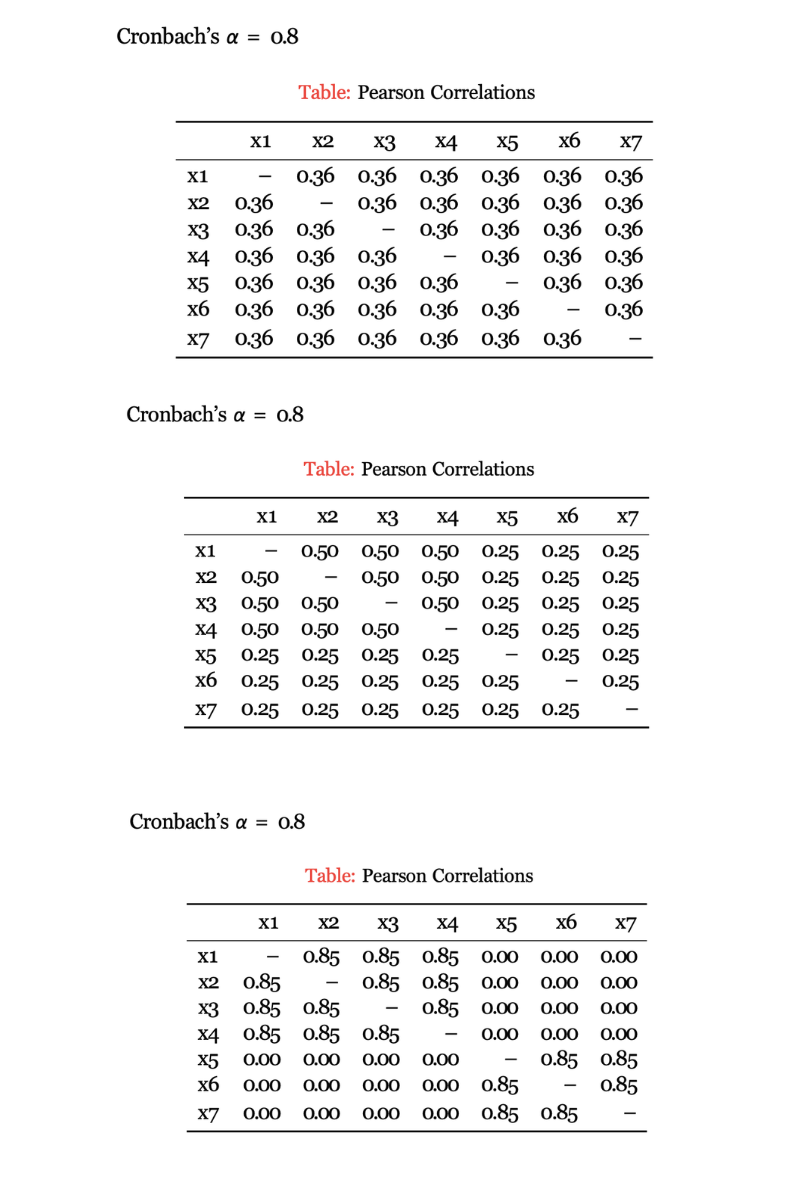
Cronbach’s α is very popular because it is
easy to calculate & interpret; it is also the default in most common statistical software
in practice α can be
low for highly reliable tests (as measured by other indexes).
α is simply a measure
measure ‘uniformity’
in other words → it measures how homogeneous the test is as a whole
it should not drive decisions in test development
limitations of Cronbach’s αre
Limitations of coefficient alpha as an index of test unidimensionality.
Coefficient alpha: Unnecessarily ambiguous; unduly ubiquitous
On the use, the misuse, & the very limited usefulness of Cronbach’s alpha.
Commentary on coefficient alpha → A cautionary tale
McDonald’s ω
